What It Is For
A Walk Break is exactly that: a few minutes of walking at whatever pace feels easy, or marching on the spot where there is no room. It has no technique to learn. Its purpose is to interrupt a long spell of sitting, to change position, and to give the body a period of light rhythmic movement.
UK guidance gives the idea official standing. The Chief Medical Officers advise adults to minimise sedentary time and, when possible, to break up long periods of inactivity with at least light activity.[1] For people who work at screens, the Health and Safety Executive says breaks should allow them to stand up and move around, or at least to stretch and change posture.[2]
The NHS notes that many adults sit for more than seven hours a day, and that reaching a weekly activity target does not fully offset long periods of sitting.[3] The guidance says nothing specific about a walk of any given length, and the Chief Medical Officers say the evidence does not support a set limit or threshold for sedentary time.[1]
How to Do It
Just what it sounds like: a chance to get up and move. Walk at any pace you like, letting your arms swing and your breath stay easy. If you have no room, march on the spot. You should finish feeling a little warmer and looser.
- Easy walk, any pace
- Let the arms swing
- Breathe easy
How It Got Its Name
The name is plain English. Researchers tend to speak of breaks in sedentary time, activity breaks or bouts of walking, and UK regulations refer to breaks or changes of activity.[5][2] The phrase has no single source.
History
Walking needs no origin story, but the idea that sitting at work matters as a separate issue has a clear beginning. In 1953 Jerry Morris and colleagues reported in The Lancet that conductors on London's double-decker buses, who climbed stairs and walked all shift, had about half the heart attacks and sudden deaths of the seated drivers. Postmen compared similarly well with desk-based telephonists and other sedentary workers.[6] This was an observational comparison of jobs and could not show cause on its own, but it is a landmark in the study of activity at work.
Workplace law came next, for different reasons. The Health and Safety (Display Screen Equipment) Regulations 1992 require employers to plan work so that screen users get breaks or changes of activity. The regulations set no fixed timing, though the Health and Safety Executive prefers short, frequent breaks, giving 5 to 10 minutes each hour as an example.[2]
The modern research focus on breaking up sitting arrived in the 2010s. A 2012 trial by David Dunstan and colleagues in Australia, described below, became a frequently cited reference point.[5] The UK Chief Medical Officers refreshed their guidelines in July 2026, keeping sedentary time as a stated concern.[1]
Muscles and Tendons
Walking is a working move for the whole lower body, at low intensity. In the stance phase, which takes about 60 per cent of the cycle at maturity, the leg extensors carry body weight, and the hip abductors control the tilt of the pelvis. The gluteus medius has a particular part in this, which is why its weakness is linked to a recognisable abnormal gait.[4]
In the swing phase the hip flexors start the movement of the leg forward. Near the end of stance the hip extends and those same muscles are stretched, a signal that helps to trigger the swing.[4] This lengthening is rhythmic and brief, so a walk is not a stretch in the usual sense, but it does take the hips, knees and ankles through a different range from a seated position. The calf muscles and Achilles tendon are loaded and released with each step, and a relaxed arm swing adds a little movement at the shoulders and trunk.
Stretched
- Hip flexors
- Lengthen briefly near the end of each stance phase as the hip extends
- Calf muscles
- Rhythmic lengthening as the body passes over the foot
Working
- Hip abductors
- Gluteus medius controls the tilt of the pelvis on the stance leg
- Hip flexors
- Start each swing of the leg
- Leg extensors
- Gluteals, quadriceps and calves support body weight and move it forward
- Shoulder muscles
- Light effort in the arm swing
Tendons and Fascia
- Achilles tendon
- Loaded and released with each step
What Research Has Looked At
Dunstan's 2012 crossover trial had 19 overweight or obese adults aged 45 to 65 sit for several hours on separate days, without breaks or with two-minute walks every 20 minutes, at light or moderate intensity. Glucose and insulin responses to a test drink were lower with both types of walking break than with unbroken sitting.[5]
A 2023 Columbia University crossover study of 11 middle-aged and older adults compared four schedules of light walking over eight hours. Only five minutes every 30 minutes significantly lowered the glucose response, whereas all four schedules lowered systolic blood pressure compared with sitting.[7] Both studies were short and small, and they measured immediate responses, not long-term outcomes.
A larger Australian trial, WalkBack, published in The Lancet in 2024, compared a progressive walking and education programme with a control group in adults who had recently had low back pain. Its main measure was whether and when back pain came back.[8] That programme was individually coached and ran over a long period, so nothing about it can be carried across to a two-minute walk within a routine.
Where It Is Used Today
Walk breaks appear in advice for screen workers and in activity guidance for older adults.[2][1] Software that prompts users to take breaks is common, though the Health and Safety Executive points out that the employer remains responsible for planning work properly.[2]
In guided mobility routines, a walk is often placed between floor exercises or at the end of a session, for a change of position. Physiotherapists also commonly suggest walking to people with long-standing back complaints, as part of a wider plan.
Variations and Related Moves
Marching on the spot is the option for small spaces. A brisker pace turns the break into light cardio. Older adults for whom walking is difficult can use standing as a first step, since the guidance asks for light activity when physically possible, or at least for time out of the seat.[1]
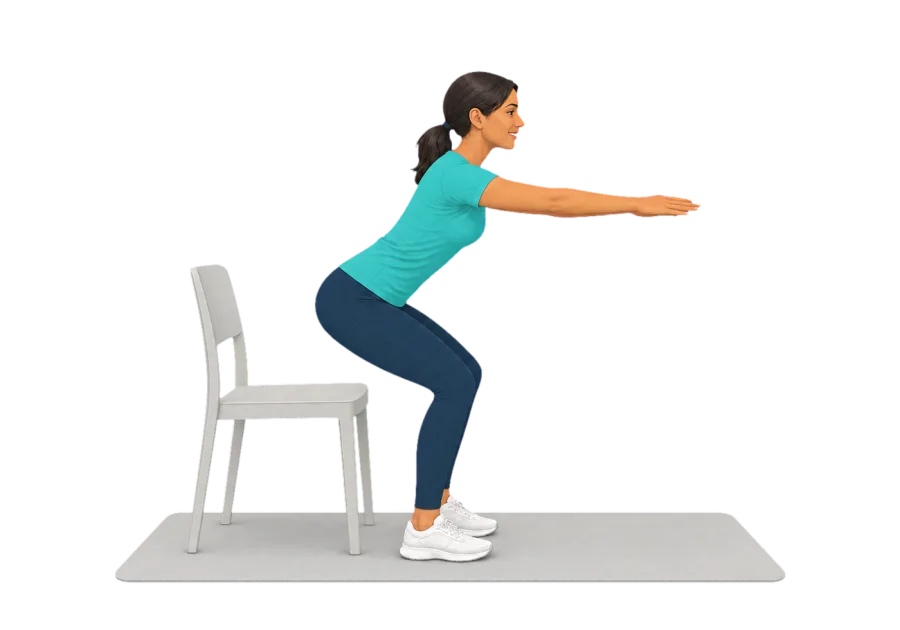
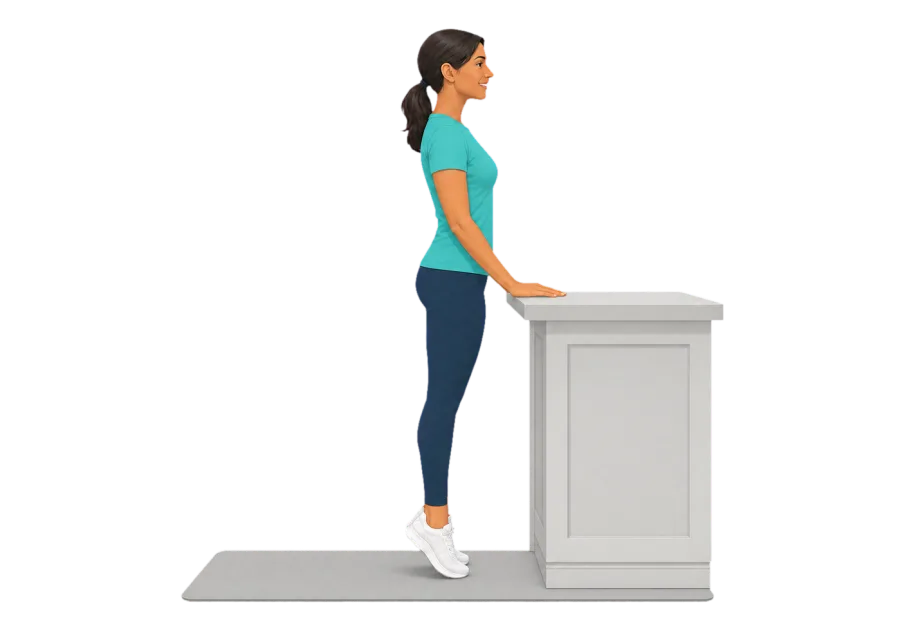
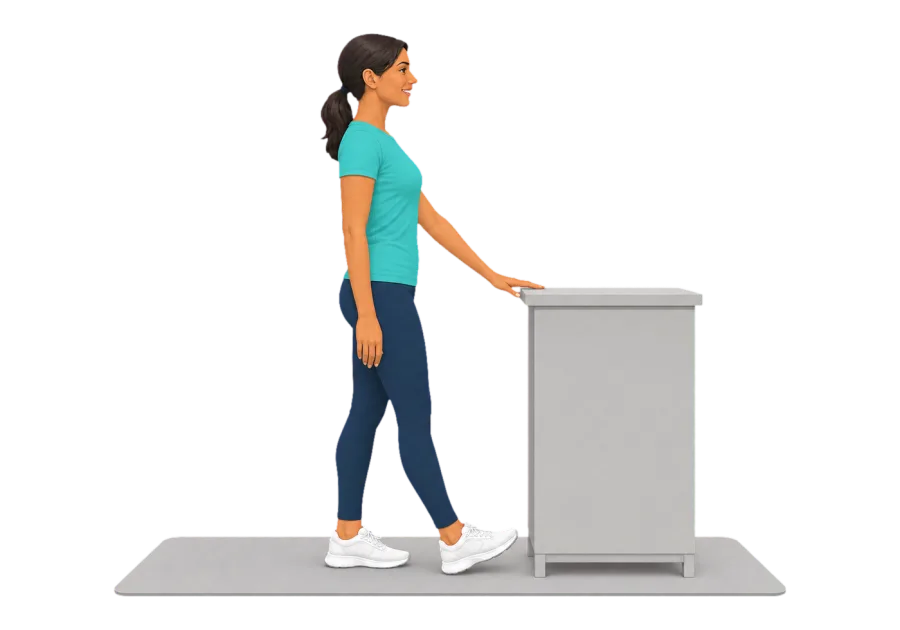
Sit to Stand is a shorter way to interrupt sitting, and Heel Raises work the calves in a similar rhythmic way. Heel to Toe walking adds a balance challenge.
Routines With This Move
- Low Back Ease
- Steady and Strong
- Steady and Strong, Longer
See Also
Sources
- UK Chief Medical Officers' physical activity guidelines (opens in a new tab). GOV.UK, 2026.
- Working safely with display screen equipment: work routine and breaks (opens in a new tab). Health and Safety Executive.
- Why we should sit less (opens in a new tab). NHS, 2024.
- Gait (human) (opens in a new tab). Wikipedia.
- Breaking up prolonged sitting reduces postprandial glucose and insulin responses (opens in a new tab). Diabetes Care, 2012.
- 138: The legacy of Jerry Morris' research on physical activity (opens in a new tab). Essential Evidence, Travel West, 2015.
- Breaking Up Prolonged Sitting to Improve Cardiometabolic Risk: Dose-Response Analysis of a Randomized Crossover Trial (opens in a new tab). Medicine & Science in Sports & Exercise, summary at Sedentary Behaviour Research Network, 2023.
- WalkBack trial for low back pain (opens in a new tab). Australian Physiotherapy Association, 2025.
Further Reading
- New UK CMO activity guidelines show every movement counts (opens in a new tab). GOV.UK.
- Should VDU users be given breaks? (opens in a new tab). Health and Safety Executive.
General information about this move, not medical advice. Stop if something hurts, and read our Safety page before you start. If you have a health condition, ask your doctor or physiotherapist first.