What It Is For
The Single-Leg Stand is a balance practice. With the base of support reduced to one foot, the small sways that go unnoticed on two feet need active correction at the ankle, the hip and the trunk. Resting the fingertips on a counter gives a light reference without taking the weight, and a fixed point for the eyes adds a visual reference.
It is among the simplest balance exercises in public guidance. The NHS includes a one-leg stand in its balance exercises, performed facing a wall with fingertips touching it and held for 5 to 10 seconds on each side.[1] Practice versions of this kind are used by people who want to keep steady on their feet, and by athletes who need control on one leg.
How to Do It
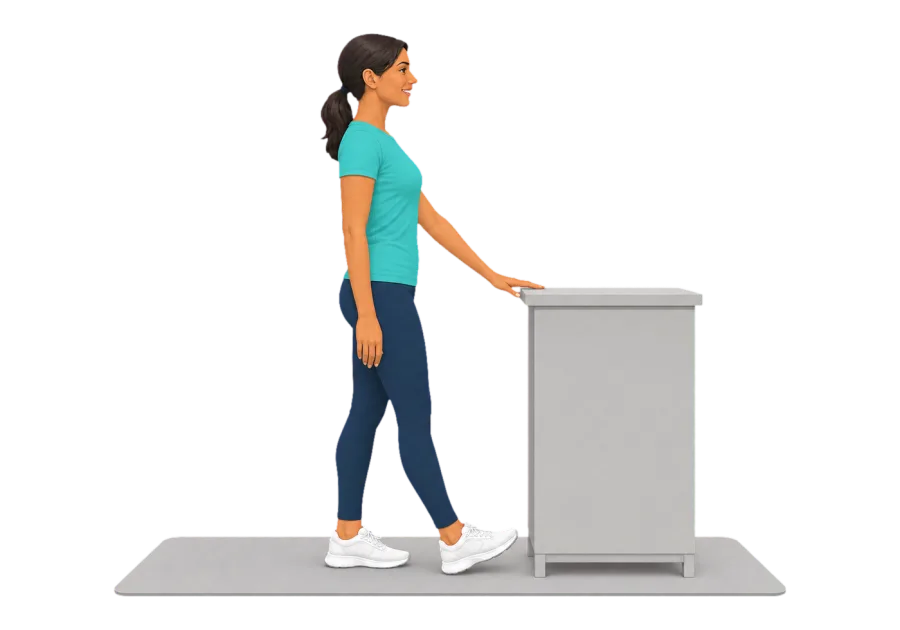
A simple balance practice, and worth doing at any age. Stand beside a counter with your fingertips resting on it, lift one foot slightly and fix your eyes on a point ahead. Small wobbles are your ankle doing its job. You should feel your foot, ankle and hip working to keep you steady.
- Fingertips on a counter
- Lift one foot slightly
- Eyes on a fixed point
Stand next to a counter, wall or sturdy chair and hold on whenever you need to.
How It Got Its Name
The name is descriptive and has many close equivalents. Researchers write of one-leg balance, one-legged stance or unipedal stance, and police manuals use one leg stand.[3][4][5][6] The NHS uses one-leg stand.[1] The name Single-Leg Stand has no documented first use. The closest named posture in yoga, Vrikshasana, takes its name from the Sanskrit words for tree and posture.[7]
History
As an exercise it has no inventor. Standing on one leg is an ordinary human ability, and the question is when it became a deliberate practice or a measurement.
The yoga record is the oldest found here. Vrikshasana is described in the seventeenth-century Gheranda Samhita, 2.36, and is listed in other texts of that century, including the Hatha Ratnavali.[7] A seventh-century carving at Mahabalipuram shows a figure on one leg, which the yoga teacher Tias Little has suggested may show a similar pose, though this is an interpretation and not a documented practice.[7] The modern pose, with the sole on the inner thigh, is a separate thing from the slight lift taught here.
Standing on one leg as a measurement came much later. In the United States, research funded by the National Highway Traffic Safety Administration began in 1975, led by Marcelline Burns and Herb Moskowitz, and reviewed informal roadside tests. The one leg stand was one of three tests it recommended, and American officers were using the battery by 1981.[6] Its accuracy and fairness have been disputed, since older or less mobile people may fail regardless of sobriety.[6]
By the 1990s, timed one-leg balance was also being studied in older adults. The Albuquerque Falls Study, reported in 1997, followed 316 community-living adults over 60 for three years.[3] The date of the first timed one-leg test has not been established in the sources consulted.
Muscles and Tendons
This is a working move and stretches nothing in particular. Gluteus medius is the most important muscle at the hip: the two parts of the muscle act together to abduct the hip and stabilise the pelvis in the coronal plane, and dysfunction of the muscle or its nerve may produce the Trendelenburg sign, in which the pelvis drops on the unsupported side.[2]
Lower down, the corrections happen mostly at the ankle and foot. As a matter of standard anatomy, the calf muscles act through the Achilles tendon, tibialis anterior lifts the foot from the front of the shin, and the fibularis muscles on the outer leg control side-to-side tilt. These are the small wobbles felt in the ankle during the hold. They are loaded rather than lengthened.
Working
- Gluteus medius
- Steadies the pelvis in the coronal plane on the standing side
- Ankle muscles
- Calf muscles, tibialis anterior and the fibularis muscles make constant small corrections
- Intrinsic foot muscles
- Adjust pressure under the foot
- Trunk muscles
- Keep the upper body over the standing leg
Tendons and Fascia
- Achilles tendon
- Carries the small calf corrections to the heel, under load rather than on stretch
- Fibularis tendons
- Pass behind the outer ankle and take part in side-to-side ankle control
What Research Has Looked At
Most research uses one-leg stance as a measurement. In the Albuquerque study, 84.5 per cent of participants could stand on one leg unassisted for 5 seconds at baseline. Impaired one-leg balance was the only significant independent predictor of injurious falls, with a relative risk of 2.13, but it did not predict falls in general, and the authors cautioned that no single factor is accurate enough to predict risk alone.[3]
A 2022 study in the British Journal of Sports Medicine timed a 10-second one-legged stance in 1,702 people aged 51 to 75. Those unable to complete it had an adjusted hazard ratio for death from any cause of 1.84.[4] This is an association, and it does not show that practising the stance changes survival.
A 2024 Mayo Clinic cross-sectional study of 40 adults over 50 compared gait, balance and strength measures. One-leg stance duration, measured with eyes open on a force plate, showed the largest age-related change of the measures studied, about 0.6 standard deviations per decade on the non-dominant side.[5] The sample was small and the study does not follow people over time.
Where It Is Used Today
Public exercise guidance uses it directly, as in the NHS balance exercises.[1] Physiotherapists and exercise professionals use it as a simple practice and as a quick timed check, since it needs no equipment. It is still one of the three standardised field sobriety tests in the United States, in which a person raises one foot about six inches and counts aloud.[6]
Yoga classes teach Vrikshasana, which the sources describe as one of the very few standing poses found in medieval hatha yoga and as an iconic pose of modern yoga.[7]
Variations and Related Moves
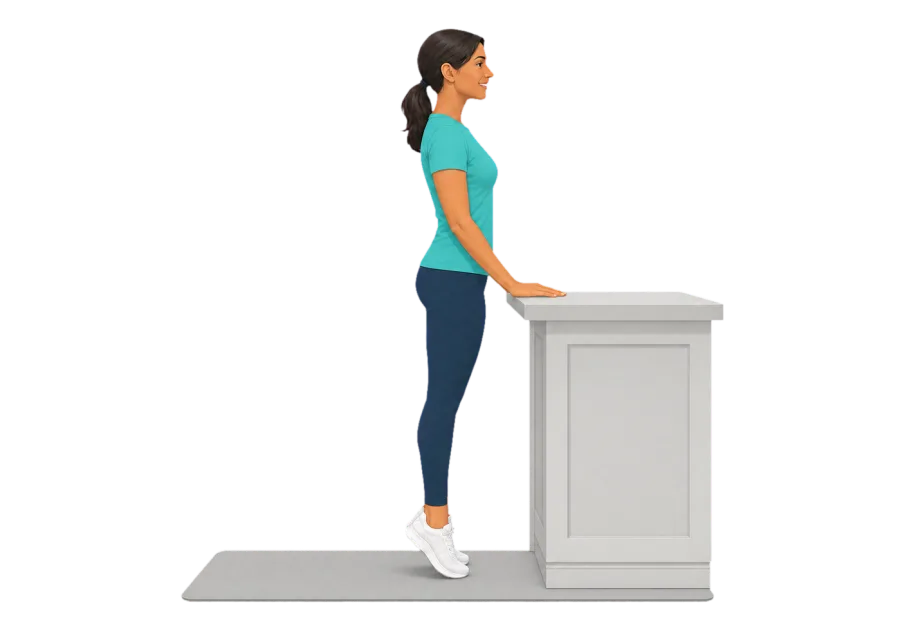
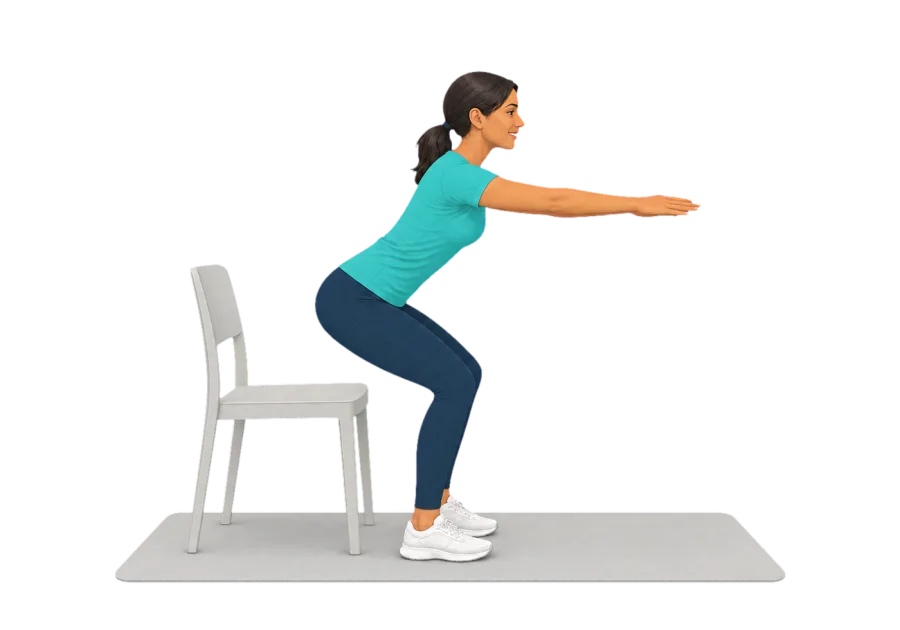
Both hands on the counter is easier, and taking the fingertips away is harder. Heel to Toe Walk narrows the base of support in a different way, and Sit to Stand and Heel Raises build leg strength used in the same tasks.
Routines With This Move
- Steady Five
- Steady and Strong
- Steady and Strong, Longer
See Also
Sources
- Balance exercises (opens in a new tab). NHS.
- Gluteus medius (opens in a new tab). Wikipedia.
- One-leg balance is an important predictor of injurious falls in older persons (opens in a new tab). Journal of the American Geriatrics Society, 1997.
- Successful 10-second one-legged stance performance predicts survival in middle-aged and older individuals (opens in a new tab). British Journal of Sports Medicine, 2022.
- Age-related changes in gait, balance, and strength parameters: A cross-sectional study (opens in a new tab). PLOS ONE, 2024.
- Field sobriety testing (opens in a new tab). Wikipedia.
- Vrikshasana (opens in a new tab). Wikipedia.
Further Reading
- Strength exercises (opens in a new tab). NHS.
- Tandem gait (opens in a new tab). Wikipedia.
General information about this move, not medical advice. Stop if something hurts, and read our Safety page before you start. If you have a health condition, ask your doctor or physiotherapist first.