What It Is For
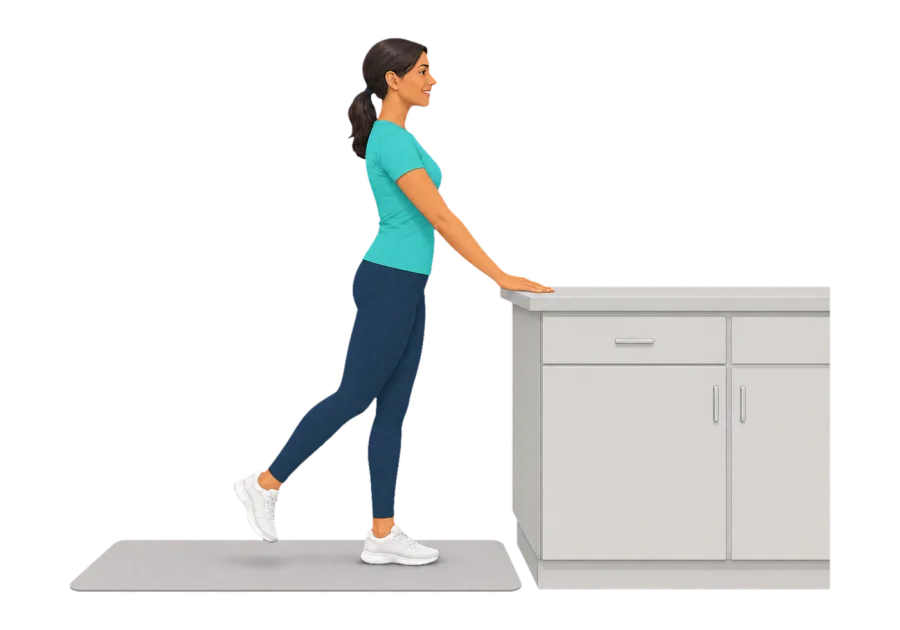
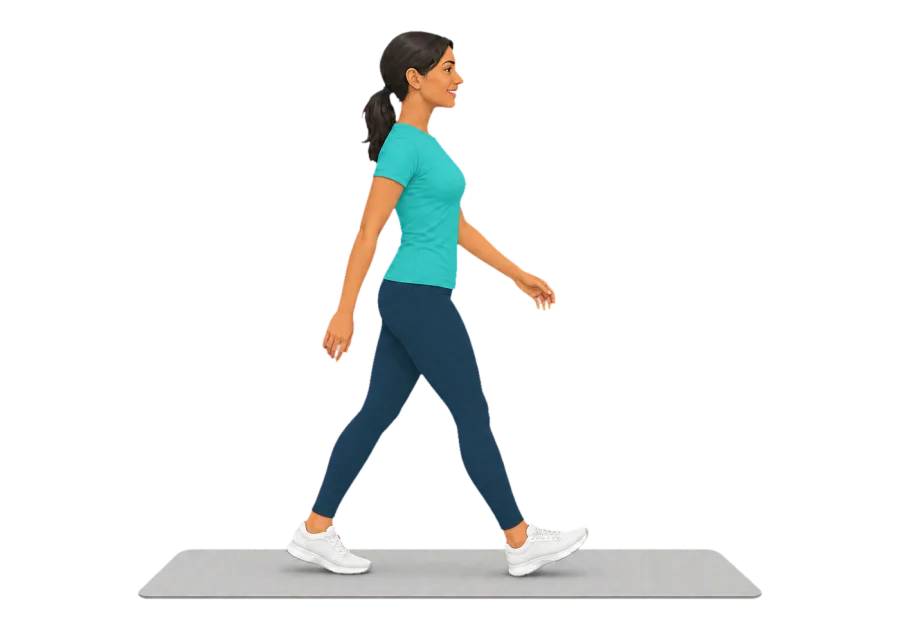
The Heel to Toe Walk narrows the base of support to a single line. Each step is placed so that the heel lands directly in front of the toes of the other foot, and the body must be controlled over this narrow track with each transfer of weight. Walking beside a counter keeps a support within reach.
The NHS includes a heel-to-toe walk in its balance exercises, advising at least 5 steps and moving away from a wall as confidence improves.[1] The walk is used as practice for steadiness, and it has a second life as a test. It needs no equipment, and doctors and police have both adopted it as a quick examination of balance.[2][3]
How to Do It
A balance walk, like walking along a tightrope. Walk slowly alongside a counter, placing the heel of each foot directly in front of the toes of the other, with a hand ready to hold on. Keep your eyes forward. You should feel your ankles and hips making small corrections with every step.
- Walk alongside a counter
- Heel touches toe
- Slow and steady
Stand next to a counter, wall or sturdy chair and hold on whenever you need to.
How It Got Its Name
Heel to toe is a plain description. Tandem gait, the medical name, uses tandem in its sense of one behind the other. The tightrope comparison is informal. The term used by police in the United States is walk and turn, after the nine steps out, the turn and the nine steps back.[3] A first use of the phrase heel to toe has not been documented.
History
No inventor is recorded, and the history is unusual: the test seems to have entered medicine gradually, without anyone introducing it. A 2018 review by Margolesky and Singer, titled How tandem gait stumbled into the neurological exam, traces its origins to observations from the early nineteenth century.[5] Luigi Rolando in 1809 and Marie-Jean-Pierre Flourens in 1824 saw gait problems in animals after injury to the cerebellum, and in the later nineteenth century William Hammond and William Gowers described a drunken gait in people with cerebellar disease.[2]
Early twentieth-century textbooks linked abnormal tandem gait with disorders of the cerebellar vermis, but explicit testing is said to have become part of the neurological examination only in the late twentieth century.[2] The sources therefore need careful reading: the observations are old, while the formal heel-to-toe test is much newer. Margolesky and Singer note that there is still no standardised, guideline-based protocol.[5]
Other fields adopted it separately. Older work cited in later tandem walking research includes an ataxia test battery by Graybiel and Fregly from 1966.[6] In road policing, research funded by the National Highway Traffic Safety Administration began in 1975 under Marcelline Burns and Herb Moskowitz, and narrowed some 15 to 20 informal roadside tests down to three, including the walk and turn. Officers in the United States were using the battery by 1981.[3]
A related step in the history of balance testing is Romberg's test, named after the German neurologist Moritz Romberg, which examines standing with the feet together. A later variation, the sharpened Romberg, places the feet heel to toe.[7]
Muscles and Tendons
The walk works muscles and stretches none. The narrow stance gives the body little margin for sideways sway, so the corrections happen mainly side to side. Gluteus medius abducts the hip and stabilises the pelvis in the coronal plane, keeping the hips level as weight passes from one foot to the other.[4]
As a matter of standard anatomy, the fibularis muscles on the outer leg and tibialis anterior on the shin tilt the foot from side to side, and the calf muscles, working through the Achilles tendon, control forward sway. Together with balance signals from the inner ear, vision and sensation in the feet, these allow the small corrections felt at the ankle. That reliance on several systems explains the walk's value as a clinical test. Loss of foot sensation or inner ear function can both impair it.[2]
Working
- Gluteus medius
- Steadies the pelvis during each single-leg moment
- Ankle muscles
- Calf muscles, tibialis anterior and the fibularis muscles correct side-to-side sway
- Trunk muscles
- Keep the upper body over a narrow base
Tendons and Fascia
- Achilles tendon
- Carries calf effort at the heel, under load rather than on stretch
- Fibularis tendons
- Pass behind the outer ankle and take part in side-to-side control
What Research Has Looked At
Research on tandem walking has mostly examined it as a test. A 2018 study in Laryngoscope compared 90 adults with vestibular disorders and 292 controls, using 10 steps with arms crossed and eyes closed. Accuracy was at best moderate, and the authors advised care if the test is used for screening.[6]
A 2019 study of 102 people with Parkinson's disease found that tandem gait abnormality was common and was associated with reported falls.[8] These findings describe the walk as a measurement, not the effect of practising it, and the sources consulted do not report a trial of the walk alone.
Where It Is Used Today
Neurologists use tandem gait mainly to examine balance and cerebellar ataxia. The usual form is at least ten steps along a straight line without support, and a failed test is not proof of ataxia on its own, since vision problems, weakness and arthritis of the hip or knee can also affect it.[2]
In the United States, it is used as a field sobriety test, with nine heel-to-toe steps out and nine back. Critics have questioned its specificity, because sedentary, older or less mobile people may fail regardless of sobriety.[3] In exercise settings, the NHS gives it as a simple balance practice at home.[1]
Variations and Related Moves
A hand on the counter is easier, and walking with eyes forward and no hands is harder. Test versions cross the arms, close the eyes or add a turn.[6][3] A stationary form, standing with one foot directly in front of the other, is the position of the sharpened Romberg.[7] The Single-Leg Stand is the closest relative in this collection.
Routines With This Move
- Steady and Strong
- Steady and Strong, Longer
See Also
Sources
- Balance exercises (opens in a new tab). NHS.
- Tandem gait (opens in a new tab). Wikipedia.
- Field sobriety testing (opens in a new tab). Wikipedia.
- Gluteus medius (opens in a new tab). Wikipedia.
- How tandem gait stumbled into the neurological exam: a review (opens in a new tab). Neurological Sciences, 2018.
- Tandem walking as a quick screening test for vestibular disorders (opens in a new tab). Laryngoscope, 2018.
- Romberg's test (opens in a new tab). Wikipedia.
- Tandem gait abnormality in Parkinson disease: Prevalence and implication as a predictor of fall risk (opens in a new tab). Parkinsonism and Related Disorders, 2019.
Further Reading
- Strength exercises (opens in a new tab). NHS.
- One-leg balance is an important predictor of injurious falls in older persons (opens in a new tab). Journal of the American Geriatrics Society.
General information about this move, not medical advice. Stop if something hurts, and read our Safety page before you start. If you have a health condition, ask your doctor or physiotherapist first.