What It Is For
The Neck Side Stretch takes the head sideways over a still trunk, with one ear travelling towards the shoulder. The opposite shoulder stays low, which keeps its muscle attachments apart. No hand is needed: the weight of the head does the work. People use it after long periods at a screen, when the head and shoulders have held one position for hours.
The NHS lists a neck stretch among its flexibility exercises: sit upright, hold one shoulder down with the opposite hand, tilt the head away and hold for five seconds, three times a side.[1] Its page on neck pain directs readers to these exercises, and names sitting at a desk for a long time as a common cause of neck pain.[2]
How to Do It
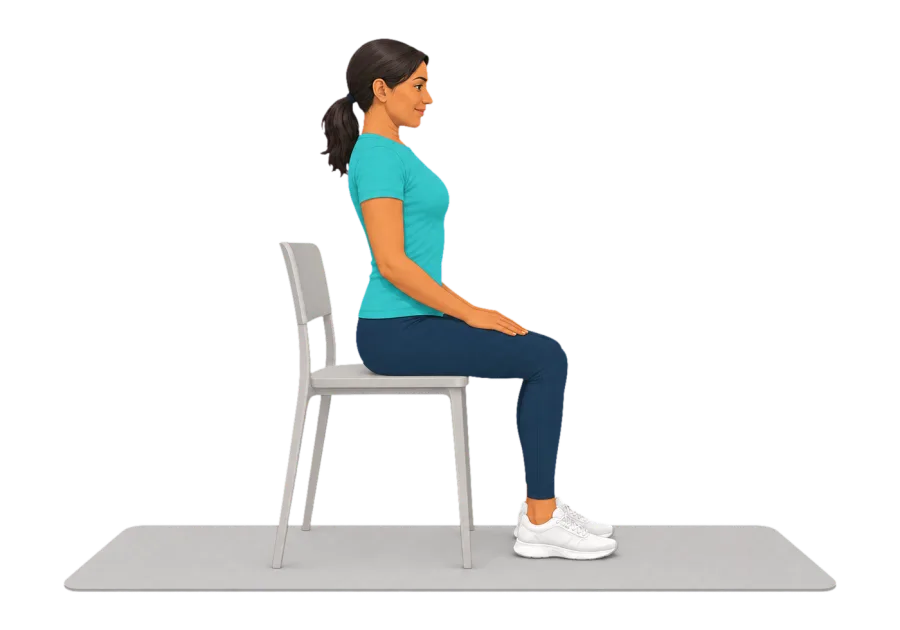
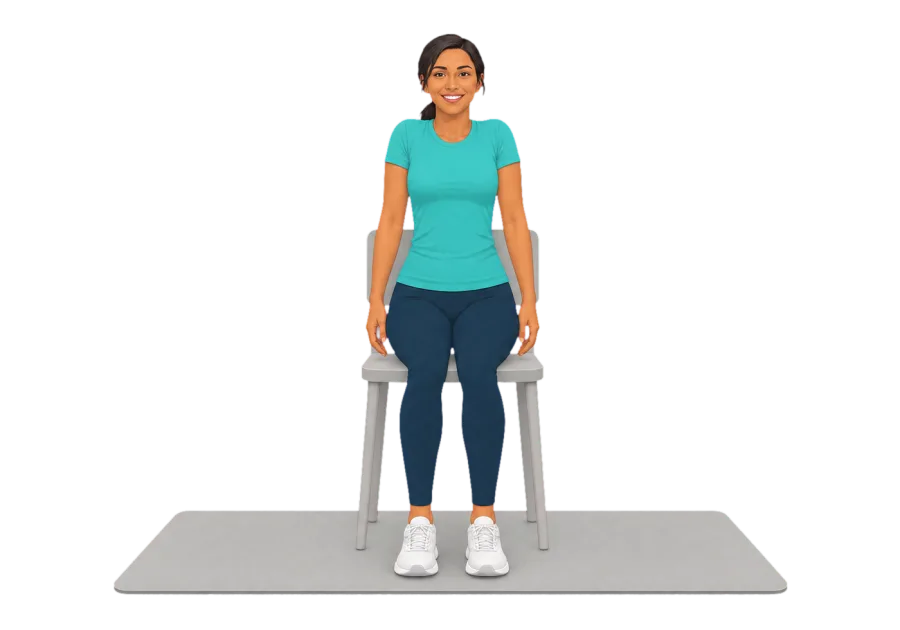
A soft stretch for the side of the neck. Sit tall and tilt one ear towards your shoulder, letting the opposite shoulder grow heavy. There is no need to pull: the weight of your head is plenty. You should feel a gentle stretch from the side of your neck to the top of your shoulder.
- Ear toward shoulder
- Opposite shoulder heavy
- No pulling
How It Got Its Name
The name is descriptive and has no recorded first use. Each source chooses its own words: the NHS says neck stretch, Arthritis UK describes a head tilt, Carnegie Mellon's desk guide lists it under Neck, and physiotherapy leaflets speak of bending the neck to the side.[1][5][6][7] Clinicians often call it an upper trapezius stretch, or a cervical side bend, from the Latin cervix, meaning neck.
History
No inventor or first description of this stretch has been found, and it is unlikely that one exists. Tilting the head to ease a stiff neck is an everyday movement, and no exercise tradition has a documented claim to it.
What can be traced is its place in modern advice. It now sits in NHS public guidance, in charity leaflets and in university occupational guidance.[1][5][8][6] Research interest came in the same period as concern about desk work. By 2007 and 2008 researchers were using home stretching programmes for the neck in clinical trials, a sign that stretching had become a standard comparison in the field.[9][10] This article could not establish when the move first appeared in a printed exercise manual, and that remains an open question.
Muscles and Tendons
The main muscle under stretch is the upper part of the trapezius on the side away from the tilt. Its fibres begin at the base of the skull, the nuchal ligament and the spine of the seventh cervical vertebra, and end on the outer third of the collarbone, so they span the distance the stretch increases.[3] Letting the shoulder sink lengthens this line from below, while the tilt lengthens it from above. That explains the cue about a heavy shoulder.
Levator scapulae runs from the transverse processes of the top four cervical vertebrae to the upper inner border of the shoulder blade. It raises the shoulder blade and bends the neck to its own side, so a tilt away from it and a lowered shoulder both move its ends apart.[4] The scalenes and part of the sternocleidomastoid also lie along the line of stretch. The feeling usually sits between the side of the neck and the top of the shoulder, as a stretch and not as tingling or shooting pain.
Very little muscle work is involved. The muscles on the tilting side begin the movement, and gravity then takes over. Keeping the shoulders down matters more than effort, as the NHS instructions imply, because a shrug shortens the very muscles the stretch aims to lengthen.[1]
Stretched
- Upper trapezius
- The side away from the tilt, from the base of the skull to the outer collarbone
- Levator scapulae
- From the upper neck to the top inner corner of the shoulder blade
- Scalenes
- Along the side of the neck, on the side away from the tilt
- Sternocleidomastoid
- Partly, as it runs from behind the ear to the breastbone and collarbone
Working
- Lateral neck flexors, tilting side
- Start the tilt, then gravity carries most of the weight
- Lower trapezius
- Helps keep the opposite shoulder low without a hard pull
Tendons and Fascia
- Nuchal ligament
- The midline band at the back of the neck, from which the upper trapezius arises
What Research Has Looked At
Trials have studied neck stretching programmes as a whole, not this one movement. In a crossover trial of 125 women with non-specific neck pain, four weeks of stretching five times a week was compared with twice-weekly manual therapy. Pain scores fell in both groups with no significant difference between them, while manual therapy did better on some other measures.[9]
A one-year trial of 101 people compared stretching alone with stretching plus strength training and found no significant difference in pain or disability. Adherence fell well below target in both groups, and there was no untreated comparison group.[10] A Cochrane review update gave its clearest support to specific strengthening exercises of the neck, shoulder blade region and shoulder for chronic neck pain.[12] A field study of data entry workers found that low compliance prevented any valid assessment of stretching, though extra short breaks were linked with less reported discomfort.[13]
Where It Is Used Today
Desk workers meet it in workplace stretching programmes. Carnegie Mellon's guide has staff tilt the head to each shoulder for a count of five, and the CU Boulder guide includes a neck side stretch in an hourly routine.[6][8] Physiotherapy leaflets use it with different dosing: one musculoskeletal service has patients hold a chair with both hands to fix the shoulders down and bend the neck at a moderate pace, as a mobility exercise and not a sustained hold.[7]
Charities use it too. The National Axial Spondyloarthritis Society includes the tilt in its neck and shoulder stretches.[11] Arthritis UK teaches a version with a gentle tensing of the neck muscles, held for five seconds, which makes it more of a light strength exercise.[5]
Variations and Related Moves
A smaller tilt is the easier form. In the more intense form a hand rests on the head with no pressure, adding only its weight. The NHS version uses the opposite hand to hold the shoulder down, and the leaflet version grips a chair, both of which anchor the shoulder.[1][7]
The National Axial Spondyloarthritis Society describes a further version that adds a turn of the head towards the same side, as if looking at the armpit, to reach the muscles running from neck to shoulder.[11] Clinicians often associate this angled position with levator scapulae. The Chin Tuck and Shoulder Rolls are common companions in the same routines.
Routines With This Move
- Chair Break
- Desk Reset
- End of the Working Day
- Neck Release
- Open Shoulders
- Upper Body Unwind
See Also
Sources
- Flexibility exercises (opens in a new tab). NHS.
- Neck pain (opens in a new tab). NHS.
- Trapezius (opens in a new tab). Wikipedia.
- Levator scapulae muscle (opens in a new tab). Wikipedia.
- Exercises for the neck (opens in a new tab). Arthritis UK.
- Desk Stretches (opens in a new tab). Carnegie Mellon University, Environmental Health and Safety.
- Neck Mobility Exercises (opens in a new tab). Musculoskeletal Physiotherapy OCATS, Health Services at Wolves.
- Stretching: For Seated, Office, and Desk Workers (opens in a new tab). CU Boulder Environmental Health and Safety.
- Stretching exercises vs manual therapy in treatment of chronic neck pain: a randomized, controlled cross-over trial (opens in a new tab). Journal of Rehabilitation Medicine, 2007.
- Strength training and stretching versus stretching only in the treatment of patients with chronic neck pain: a randomized one-year follow-up study (opens in a new tab). Clinical Rehabilitation, 2008.
- Neck and Shoulder Stretches (opens in a new tab). National Axial Spondyloarthritis Society, 2020.
- Exercises for mechanical neck disorders: A Cochrane review update (opens in a new tab). Manual Therapy, 2016.
- Supplementary breaks and stretching exercises for data entry operators: a follow-up field study (opens in a new tab). American Journal of Industrial Medicine, 2007.
Further Reading
- Sitting exercises (opens in a new tab). NHS.
- Stretching (opens in a new tab). Wikipedia.
General information about this move, not medical advice. Stop if something hurts, and read our Safety page before you start. If you have a health condition, ask your doctor or physiotherapist first.