What It Is For
The Wall Sit is an isometric hold: the muscles work hard but the joints do not move. With the back against a wall, the body slides down until the knees bend, and the thighs have to hold body weight for the length of the hold. The wall takes the balance out of the exercise, so that attention stays on the legs.
Its appeal is that it needs nothing but a wall, and the effort can be adjusted by the depth of the bend. Athletes use it to build leg strength for sports that hold a low, bent-knee position. A separate use has grown from research on blood pressure, in which long holds are done in sets at a chosen effort.[1][2]
How to Do It
A steady strength hold for the thighs. Stand with your back to a wall and slide down to a comfortable bend, keeping your knees over your ankles and pushing the floor away. It does not need to be low to count. You should feel your thighs working hard, with no pain in your knees.
- Back to the wall
- Slide down to a comfortable bend
- Press the floor away
Pad your knees with a folded towel or cushion. Skip it if kneeling hurts.
How It Got Its Name
Wall sit names what it looks like. The older image is the imaginary chair, a name which Wikipedia links to its use as a means of exercise or punishment.[4] Researchers tend to use isometric wall squat, a more exact term.[1] The first use of each name has not been documented.
History
No inventor or first description of the Wall Sit has been found. Its use as a punishment and as an exercise both appear in general accounts without dates.[4]
The science behind it is better documented than the move. Isometric training was studied at the Max Planck Institute in the 1950s by Theodor Hettinger and Erich Albert Müller, whose 1953 paper reported that contractions above about a third of maximum strength increase strength.[5] Their work helped to establish isometrics as a training method, but no source consulted connects it to the Wall Sit.
The wall squat's later history comes largely from British blood pressure research. Jim Wiles, a professor of exercise science at Canterbury Christ Church University, has made isometric exercise and blood pressure his main field, including work on rating effort during wall squats.[6] A 2023 network meta-analysis in the British Journal of Sports Medicine, with Wiles among the authors, brought the wall squat wider attention among the forms of exercise training it compared.[1][7]
In May 2025 the University of Kent and Canterbury Christ Church University announced ISOFITTER, a trial funded by the National Institute for Health and Care Research. It tests three weekly, individually tailored home wall squat sessions for mild to moderately high blood pressure.[8]
Muscles and Tendons
Nothing here is stretched. The quadriceps, made up of rectus femoris and the three vasti, is the main extensor of the knee and does most of the work.[3] All four heads join into the patellar tendon, which attaches to the tibial tuberosity, so the front of the knee is under continuous load.[3] The depth of the bend changes how much effort is needed, which is why a higher position is easier.
Glutes, calves, hamstrings and adductors also contract through the hold, but as helpers.[4] Because the knees are held over the ankles and the wall supports the trunk, the back muscles work little. The thighs may burn because a sustained contraction limits blood flow through the muscle, as a matter of standard exercise physiology.
Working
- Quadriceps
- Main working muscle, holding the knees bent against body weight
- Glutes
- Support the hips
- Hamstrings and adductors
- Assist in steadying the hip and knee
- Calves
- Hold the lower leg steady
Tendons and Fascia
- Patellar tendon
- Carries the quadriceps force to the shin; loaded, not stretched
- Quadriceps tendon
- The upper part of the same tendon line, above the kneecap, loaded throughout the hold
What Research Has Looked At
The 2023 meta-analysis pooled 270 randomised controlled trials with 15,827 participants. In pairwise analyses, isometric exercise training was associated with the largest reductions in resting blood pressure among the modes studied, at about 8.24 mm Hg systolic and 4.00 mm Hg diastolic.[1][7] Independent experts quoted at the time noted that the differences between exercise types were not large and that other kinds of exercise offer other benefits, and urged caution in people with dangerously high blood pressure.[7]
A 2026 trial in BMJ Open Sport and Exercise Medicine enrolled 100 adults with systolic pressure of 120 to 140 mm Hg, who were not taking blood pressure medication. After four weeks of wall squats, groups continued for four more weeks at different frequencies while their blood pressure was measured.[2] This account comes from a news report, not the paper itself, and the trial used a much longer protocol than the hold taught here.
Where It Is Used Today
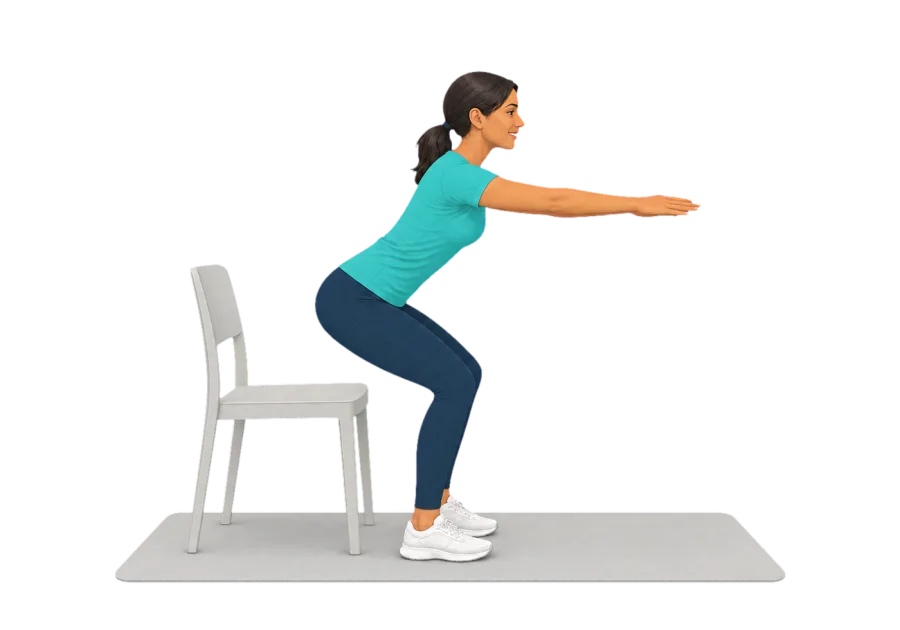
The Wall Sit is used in strength conditioning for fencing, ice hockey, sailing, skiing and track and field.[4] Not all general guidance includes it: the NHS strength exercises use mini-squats holding a chair instead.[9]
In research, the standard protocol differs from the 30-second hold taught here. A common research protocol is four two-minute holds with rests, three times a week, and the ISOFITTER sessions are individually tailored.[4][2][8] That is a different dose from a short hold in a mobility routine.
Variations and Related Moves
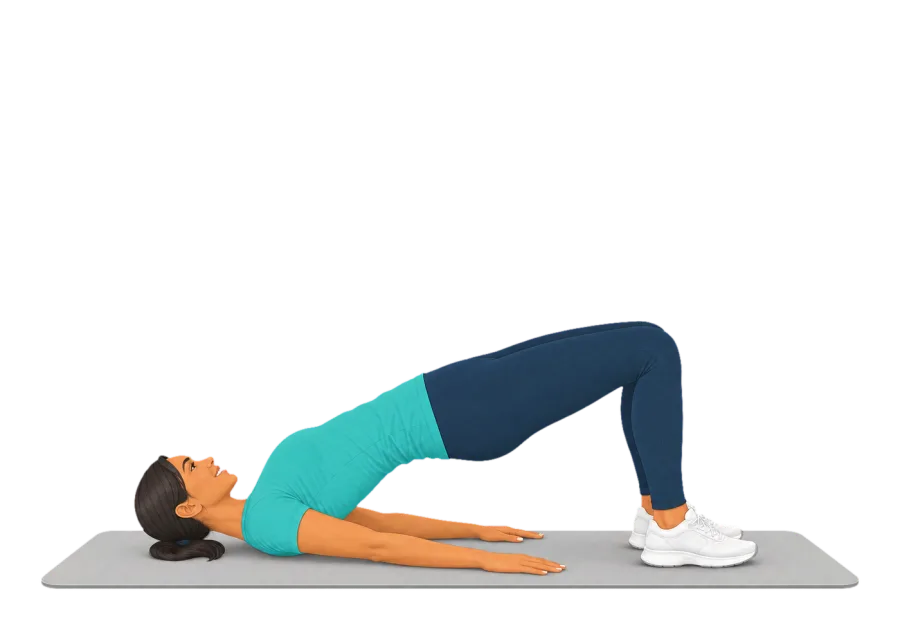
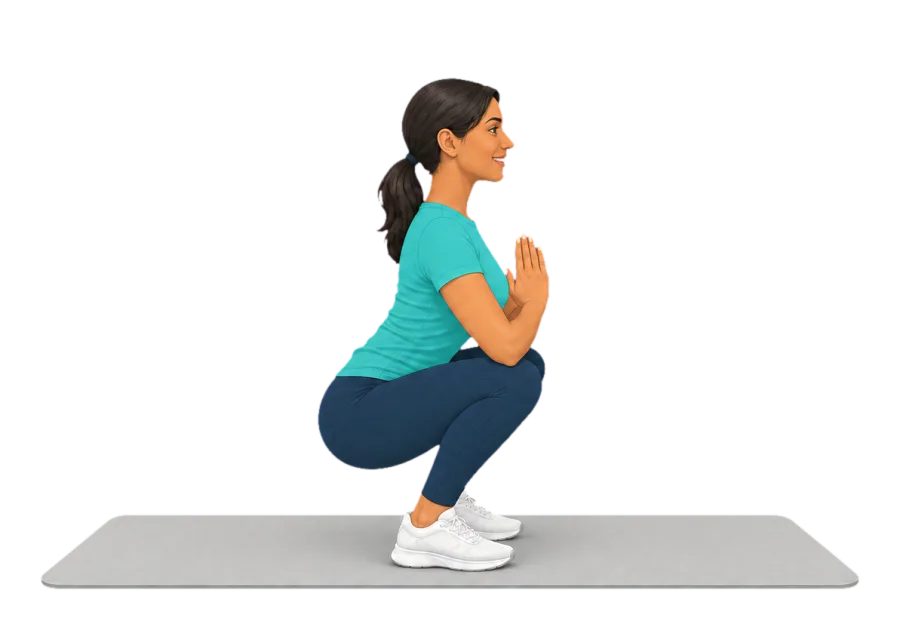
Staying higher is easier, and moving lower toward a ninety-degree knee angle is harder. Mini-squats are a moving form with support.[9] Sit to Stand trains the same muscles through movement, and Wall Slides use the same wall setup for the shoulders rather than the legs.
Routines With This Move
- Race Prep: Run, Sled and Lunge
See Also
Sources
- Exercise training and resting blood pressure: a large-scale pairwise and network meta-analysis of randomised controlled trials (opens in a new tab). British Journal of Sports Medicine, 2023.
- This simple wall exercise done once a week could reduce blood pressure (opens in a new tab). Newsweek, 2026.
- Quadriceps (opens in a new tab). Wikipedia.
- Imaginary chair (Wall sit) (opens in a new tab). Wikipedia.
- Isometric exercise (opens in a new tab). Wikipedia.
- Professor Jim Wiles (opens in a new tab). Canterbury Christ Church University.
- Isometric exercise vs. cardio: Which is best for lowering blood pressure? (opens in a new tab). Medical News Today, 2023.
- New study to test if wall squat exercise can lower blood pressure (opens in a new tab). University of Kent, 2025.
- Strength exercises (opens in a new tab). NHS.
Further Reading
- Balance exercises (opens in a new tab). NHS.
- Hamstring (opens in a new tab). Wikipedia.
General information about this move, not medical advice. Stop if something hurts, and read our Safety page before you start. If you have a health condition, ask your doctor or physiotherapist first.