What It Is For
Sit to Stand turns a daily task into training. The person sits near the front of a sturdy chair with the feet below the knees, leans forward, stands and then lowers slowly. The NHS lists it among its strength exercises, with a recommendation to move slowly and to let the legs, not the arms, do the work.[1]
The move has two lives. As an exercise it builds leg strength with no equipment, and lowering slowly makes it harder without any added weight. As a measurement it gives clinicians a quick view of how well a person's legs serve them. Few other exercises are also a test of the ability they train.
It matters most to people for whom getting out of a chair is becoming difficult, though it scales upward. Crossing the arms and slowing the descent makes it more demanding for stronger users.
How to Do It
One of the most useful strength moves there is, because you do it all day. Sit near the front of a chair with your feet under your knees, lean forward and stand up, then sit down slowly. Use your hands if you need them. You should feel your thighs and buttocks working, especially on the way down.
- Feet under knees
- Use your hands if you need to
- Take your time
How It Got Its Name
The name describes the transfer, and the research literature often abbreviates it to STS. Chair stand and chair rise are the common names in testing: the CDC's tool is called the 30-Second Chair Stand, while earlier papers speak of rising from a chair.[6][7] Who first used the term sit-to-stand has not been traced.
History
People have always stood up from seats, so the move has no origin as such. Its history as a measurement can be dated more closely. In 1985 Csuka and McCarty proposed a simple way to measure leg strength by timing ten rises from a standard chair. They tested 139 adults aged 20 to 85 and used the method to follow six patients with muscle inflammation.[8] Theirs is the earliest version found for this article, though earlier informal use is possible.
Other versions soon followed. In 1994 Guralnik and colleagues included five timed chair rises in a short battery of tests given to more than 5,000 people aged 71 and over. The paper called it a short physical performance battery. Scores were associated with self-reported disability and predicted later nursing home admission and death.[7]
A different format followed in 1999. C. Jessie Jones, Roberta Rikli and W. C. Beam counted how many stands a person could complete in 30 seconds, and reported in 76 older adults that the count related well to leg press strength.[9] In 2006 Bohannon pooled studies of the five-repetition test to produce age-based reference times.[10] The CDC later adopted the 30-second version in its STEADI fall risk toolkit.[6]
Muscles and Tendons
This is a strength move, and it stretches nothing to any useful degree. A laboratory study of ten people divided the rise into phases. The upper body first rotates forward to carry the body's mass over the feet, and then the legs extend to drive it upward.[2] After the seat is left, most of the leg muscles work concentrically, shortening under load, as the hips and knees extend.[2]
The quadriceps are the main drivers at the knee, and the gluteus maximus and hamstrings extend the hip.[3] On the way down the same muscles work eccentrically, lengthening under control, which explains why thighs and buttocks tire on a slow sit. The patellar tendon carries the quadriceps' pull to the shin and is loaded during the movement, not stretched.[4]
Set-up changes the demand. A 2002 review found that seat height, armrests and foot position strongly influence the movement. Higher seats reduced knee and hip moments, armrests roughly halved the hip moments required, and moving the feet changed the strategy used.[5] Hence the cue to put the feet under the knees, and the option of using the hands.
Working
- Quadriceps
- Extend the knees on the way up and control them on the way down
- Gluteus maximus
- Extends the hip as the trunk rises
- Hamstrings
- Assist hip extension and help control the lowering
- Calf and shin muscles
- Steady the ankle and help shift weight over the feet
- Erector spinae and abdominals
- Keep the trunk organised during the forward lean
Tendons and Fascia
- Patellar tendon
- Loaded, not stretched, as the quadriceps work across the knee
What Research Has Looked At
A central question is what the test really measures. In 669 community-dwelling people aged 75 to 93, quadriceps strength was the most important single predictor of time, but vision, sensation, reaction time, sway, body weight and psychological measures together accounted for more than half of the explained variance. The authors concluded that sitting to standing is a skill and not merely a proxy for leg strength.[12]
The Otago trial in Dunedin, New Zealand, tested a tailored home programme of strength and balance exercises in 233 women aged 80 and over. Over one year the exercise group recorded 88 falls and the control group 152.[13] That finding concerns a whole programme, given as individually tailored physical therapy, so it cannot be credited to this one exercise.
Where It Is Used Today
Clinics use the test in fall risk screening. The CDC's 2017 sheet uses a straight-backed chair with a 17-inch seat, arms crossed at the chest and a count over 30 seconds. Below-average scores range from under 14 stands for men aged 60 to 64 to under 4 for women aged 90 to 94. Anyone who must use the arms scores zero.[6] Bohannon's reference times for five repetitions are 11.4 seconds at 60 to 69, 12.6 seconds at 70 to 79 and 14.8 seconds at 80 to 89.[10]
As an exercise it features in the Otago programme, developed in New Zealand. A current American booklet for the programme includes sit to stand from a chair.[11] Physiotherapists use it throughout rehabilitation, and fitness instructors use it as a starting point on the way to squats.
Variations and Related Moves
The easier form uses the hands on the chair or thighs, or a higher seat.[5] The more intense form crosses the arms, which is also the test position, and slows the lowering.[6] Lower seats add difficulty, and stepping up to one leg or holding weights takes it further into strength training.
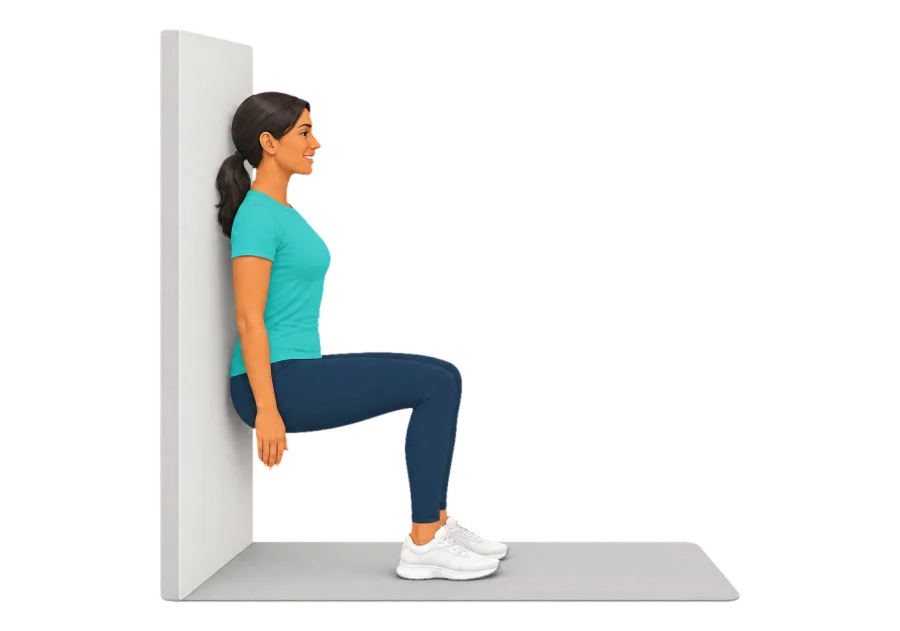
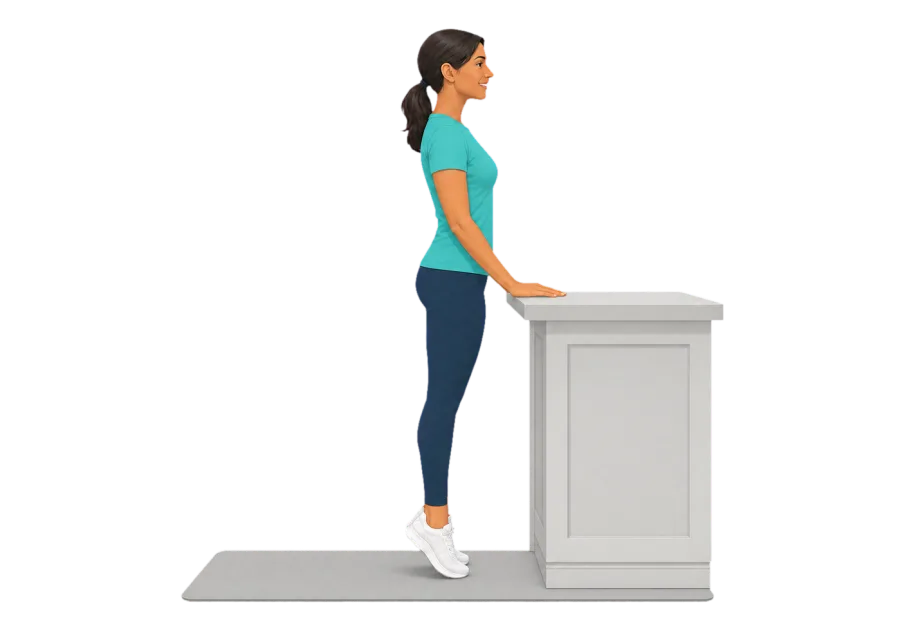
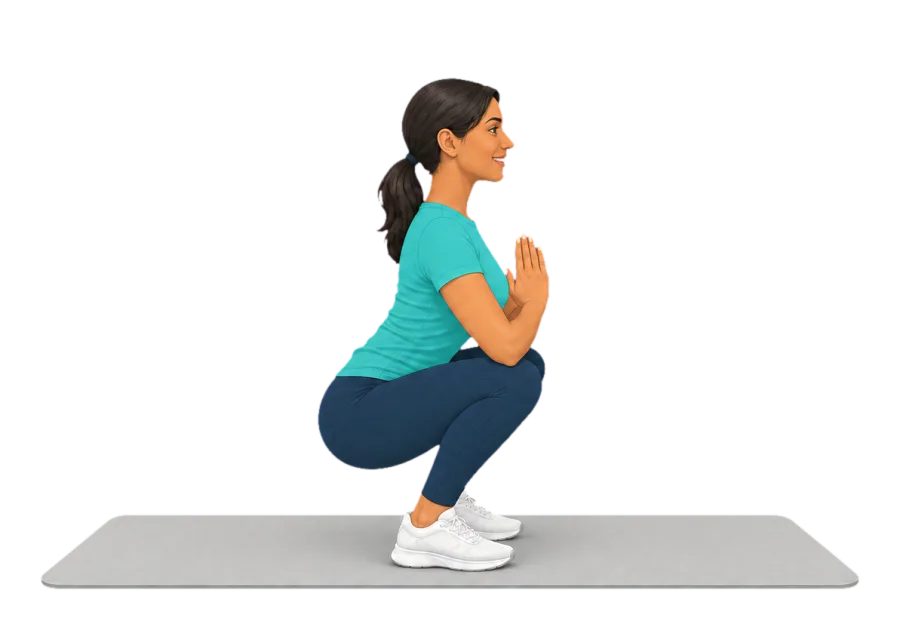
The Otago booklet places it alongside knee bends, calf raises and toe raises.[11] The Wall Sit trains a similar position without movement, and the Deep Squat Hold takes the same joints through a much larger range.
Routines With This Move
- Desk Reset
- Steady Five
- Steady and Strong
- Steady and Strong, Longer
See Also
Sources
- Strength exercises (opens in a new tab). NHS.
- Biomechanics and muscular activity during sit-to-stand transfer (opens in a new tab). Clinical Biomechanics, 1994.
- Gluteus maximus (opens in a new tab). Wikipedia.
- Quadriceps (opens in a new tab). Wikipedia.
- Determinants of the sit-to-stand movement: a review (opens in a new tab). Physical Therapy, 2002.
- Assessment: 30-Second Chair Stand (opens in a new tab). CDC STEADI, 2017.
- A short physical performance battery assessing lower extremity function: association with self-reported disability and prediction of mortality and nursing home admission (opens in a new tab). Journal of Gerontology, 1994.
- Simple method for measurement of lower extremity muscle strength (opens in a new tab). American Journal of Medicine, 1985.
- A 30-s chair-stand test as a measure of lower body strength in community-residing older adults (opens in a new tab). Research Quarterly for Exercise and Sport, 1999.
- Reference values for the five-repetition sit-to-stand test: a descriptive meta-analysis of data from elders (opens in a new tab). Perceptual and Motor Skills, 2006.
- Otago Exercise Program Activity Booklet (opens in a new tab). University of North Carolina School of Medicine, 2024.
- Sit-to-stand performance depends on sensation, speed, balance, and psychological status in addition to strength in older people (opens in a new tab). Journals of Gerontology Series A, 2002.
- Randomised controlled trial of a general practice programme of home based exercise to prevent falls in elderly women (opens in a new tab). BMJ, 1997.
Further Reading
General information about this move, not medical advice. Stop if something hurts, and read our Safety page before you start. If you have a health condition, ask your doctor or physiotherapist first.