What It Is For
The Doorway Chest Stretch lengthens the muscles across the front of the chest and shoulder. A forearm rests against a door frame with the elbow at about shoulder height, and the person leans or steps forward until a gentle pull is felt across the chest.[1] Clinicians also use it to reach the pectoralis minor, a small muscle beneath the main chest muscle, and one research team describes it as widely used in clinics for that purpose.[2]
The pectoralis major draws the upper arm across the body and turns it inward.[3] Typing, driving and reading a phone all keep the arms forward and in, which is why the stretch is often offered as a break from desk work. The door frame gives a fixed point to work against, so the stretch needs no equipment and takes a few moments.
The sensation matters. The stretch is meant to be felt in the muscle across the chest, and a pinching or pulling feeling at the very front of the shoulder joint is a sign that the position needs changing.
How to Do It
A stretch for the chest and the front of the shoulder, welcome after hours at a keyboard. Rest your forearm on a door frame with your elbow about shoulder height, then step gently through. Keep your shoulder down and away from your ear. You should feel it across your chest, not at the front of the joint.
- Forearm on the door frame
- Step through gently
- Keep the shoulder down
Stay below the point of pinching. Smaller range is fine.
How It Got Its Name
The name is descriptive and comes from the piece of furniture used. Pectoralis, the anatomical word behind the casual term pec stretch, comes from the Latin pectus, meaning breast.[3]
Names vary between sources. One NHS physiotherapy leaflet calls the same action an anterior shoulder stretch.[1] The best known laboratory study calls it a unilateral self-stretch, and later writers refer to that study as testing the doorway stretch.[5][6] The term doorway stretch is used directly in more recent research.[2] The first use of any of these names is not documented.
History
No single inventor is recorded, and no first description of this stretch was found. It belongs to the general stock of exercise and physiotherapy practice, passed on through clinics and gyms rather than through a named system. The history that can be traced is the history of people measuring it.
In 2006 John Borstad and Paula Ludewig compared three stretches for the pectoralis minor in 50 adults without shoulder problems, tracking the muscle with electromagnetic motion capture.[5] Their interest grew from earlier findings linking a short pectoralis minor with particular movements of the shoulder blade.[5] The paper gave the self-stretch a place in the clinical literature, and clinicians still cite it.[6]
In 2009 a team led by Takayuki Muraki tested related positions on nine cadaver specimens, measuring the muscle directly with a displacement sensor. They found that length rose steadily as the shoulder moved, and that moving the shoulder blade back with the arm slightly forward gave the largest change.[7] Studies in living people followed, including a six-week programme published in 2017 and a study of high school baseball players published in 2021.[8][2]
Muscles and Tendons
Pectoralis major has two main parts. The clavicular head rises from the inner half of the collarbone, and the sternocostal head from the breastbone and upper rib cartilages. Both converge on a flat tendon that attaches to the outer edge of the groove at the top of the upper arm bone.[3] Holding the arm out to the side while the body moves forward takes that attachment away from the breastbone, which is what lengthens the muscle. Because the fibres fan out from such a wide base, changing the height of the arm changes which fibres are under most tension, although this has been little measured.
Pectoralis minor runs from the third to fifth ribs up to the coracoid process, a small hook on the front of the shoulder blade.[4] It does not reach the arm, so it is lengthened by moving the shoulder blade rather than the arm alone. This is why the cue to keep the shoulder down and back is more than a detail: if the shoulder blade tips forward and rides up, this muscle stays slack and the load moves to the front of the joint.
The working muscles are modest but useful. The lower trapezius keeps the shoulder away from the ear, and the serratus anterior and rhomboids keep the shoulder blade against the ribs. The chest muscles themselves should stay relaxed, since the door frame takes the weight of the arm.
Stretched
- Pectoralis major
- The large fan-shaped chest muscle, lengthened as the arm is held out and back from the body
- Pectoralis minor
- Lies under pectoralis major and is drawn longer as the shoulder blade moves back
- Anterior deltoid
- The front of the shoulder muscle, lengthened mildly in the same position
Working
- Lower trapezius
- Helps keep the shoulder down and away from the ear
- Serratus anterior and rhomboids
- Hold the shoulder blade against the rib cage
- Leg and trunk muscles
- Control the step through the door and keep the ribs from flaring
Tendons and Fascia
- Pectoralis major tendon
- Flat tendon attaching to the outer lip of the groove on the upper arm bone
- Pectoralis minor tendon
- Attaches to the coracoid process, the small hook at the front of the shoulder blade
What Research Has Looked At
Borstad and Ludewig reported that the self-stretch lengthened the pectoralis minor by 2.24 cm, compared with 1.69 cm for a manual stretch lying down and 0.77 cm for a manual stretch sitting up.[5] The participants had no shoulder problems, and the figures describe the muscle during the stretch, not afterwards.
Longer-term findings are less tidy. In 2017 Rosa and colleagues had 25 people with shoulder pain and 25 people with a tight pectoralis minor stretch daily for six weeks. Muscle length did not change in either group, and shoulder blade movement was largely unchanged, although the group with pain reported better arm function. The authors suggested that mechanisms other than muscle length may be involved.[8]
Higuchi and colleagues measured the immediate effect of one bout of doorway stretching, with the shoulder and elbow each at 90 degrees. Pectoralis minor length and internal rotation of the shoulder increased, and shoulder blade position changed.[2] This was a short-term measurement in teenage baseball players and says nothing about lasting change. The cadaver work points to arm position as a real variable: lifting the arm forward or out lengthened the muscle more than external rotation at 90 degrees did.[7]
Where It Is Used Today
NHS physiotherapy services give the stretch to patients as a home exercise, with the amount set by the physiotherapist.[1] It is also used in sport. A 2021 study of 34 high school baseball players chose it because of its clinical popularity, and its authors link pectoralis minor length and shoulder blade position to the shoulder rotation that throwers depend on.[2]
Not every clinician favours it. Physical therapist Mike Reinold writes that the doorway stretch is hard to coach and hard to check once someone is at home, where they may twist the shoulder. He avoids it for most people who need only a pectoralis minor stretch, while finding it suitable for some.[6] The concern fits the common cue to stay below any point of pinching and to keep the movement small.
Variations and Related Moves
The main variable is arm height. Lowering the elbow gives a gentler stretch, and raising the arm above shoulder height makes it more intense. A straight-arm version with the palm on the frame is common, as is a two-armed version done in the middle of a doorway or in the corner of a room.
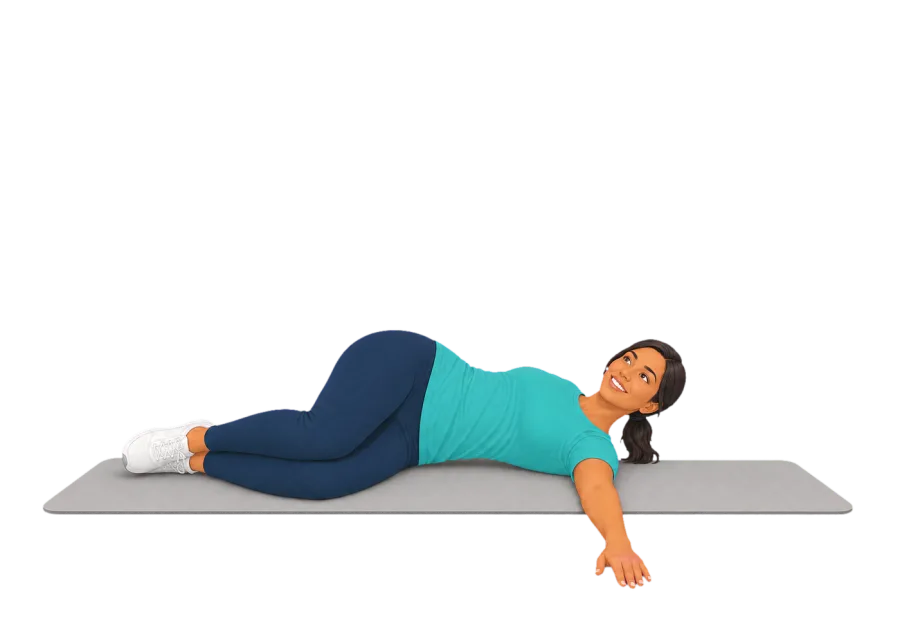
Reinold prefers lying on a half foam roller or a towel roll with the shoulders relaxed, adding arm elevation, for people who need to reach the pectoralis minor without a shoulder being twisted against a frame.[6] Thoracic rotation drills and wall slides are often paired with the stretch, since the upper back and shoulder blades move together with the chest.
Routines With This Move
- End of the Working Day
- Neck Release
- Open Shoulders
- Overhead Ready
- Upper Body Unwind
See Also
Sources
- Anterior shoulder stretch (opens in a new tab). South Tees Hospitals NHS Foundation Trust.
- Acute effects of doorway stretch on the glenohumeral rotational range of motion and scapular position in high-school baseball players (opens in a new tab). JSES International, 2021.
- Pectoralis major muscle (opens in a new tab). Wikipedia.
- Pectoralis minor (opens in a new tab). Wikipedia.
- Comparison of three stretches for the pectoralis minor muscle (opens in a new tab). Journal of Shoulder and Elbow Surgery, 2006.
- What is the Best Stretch for the Pectoralis Minor? (opens in a new tab). Mike Reinold.
- Lengthening of the Pectoralis Minor Muscle During Passive Shoulder Motions and Stretching Techniques: A Cadaveric Biomechanical Study (opens in a new tab). Physical Therapy, 2009.
- Effects of a stretching protocol for the pectoralis minor on muscle length, function, and scapular kinematics in individuals with and without shoulder pain (opens in a new tab). Journal of Hand Therapy, 2017.
Further Reading
- Serratus anterior muscle (opens in a new tab). Wikipedia.
- Shoulder girdle (opens in a new tab). Wikipedia.
General information about this move, not medical advice. Stop if something hurts, and read our Safety page before you start. If you have a health condition, ask your doctor or physiotherapist first.