What It Is For
Wall Slides train the coordinated movement of the shoulder blade and upper arm. In the form taught here, a person stands with the back and arms against a wall and the elbows bent, then slides the arms slowly up and back down, going only as high as possible without arching the lower back. The wall gives constant feedback about where the arms and spine are, so a loss of position is obvious at once.
The drill is a mobility exercise and a low-load muscle exercise at the same time. Raising the arm overhead depends on the shoulder blade rotating upwards, a job shared by serratus anterior and the upper and lower parts of trapezius.[1][2] Keeping the ribs down adds a demand on the trunk, because arching the back is the most common way of seeming to reach higher.
Clinicians use the seated version, known as the seated wall angel, as an intervention for upper quarter mobility.[3] Coaches and physiotherapists also use the standing form as a simple check of overhead range before lifting or swimming, although that use is drawn from practice and is not well documented.
How to Do It
A shoulder drill that also wakes up the muscles around your shoulder blades. Stand with your back and arms against a wall, elbows bent, then slide your arms up slowly and back down, keeping your ribs down. Only go as high as you can without arching. You should feel your upper back working and your shoulders moving freely.
- Back and arms to the wall
- Keep the ribs down
- Slow and smooth
Stay below the point of pinching. Smaller range is fine.
How It Got Its Name
Wall slide is a literal name: the arms slide on the wall. Clinical papers use it for the movement in which the forearms slide up a wall that the person is facing.[5][6] The back-to-wall form is called the wall angel, and the seated form the seated wall angel.[3] A branded version has been studied under the name Wall Angel Slider.[7] The word angel is generally taken to come from the shape of a snow angel, in which the arms sweep up and down, but no source was found that records this or the first use of the term.
History
No inventor is recorded for either version. The earliest firm marker found is a 2006 paper by Hardwick and colleagues at Washington University in St Louis, which said that the wall slide was not a new exercise and pointed to a 2002 textbook on movement impairment by Shirley Sahrmann, while noting that clinicians used it less often than the push-up plus.[5] The textbook itself was not available for this article, so what it says about the exercise has not been checked directly.
That 2006 study put the wall slide on the research map. Its subjects stood facing the wall in a staggered stance with the outer edges of the forearms on the wall and the shoulders and elbows at 90 degrees, then slid up while shifting their weight forwards.[5] Later work kept this forward-facing form. A 2016 Korean study described subjects standing in front of the wall with the ulnar border of the forearm in contact.[6]
The back-to-wall version has a separate and less well documented path. When and where it appeared has not been traced. A 2024 paper described the seated form as commonly used as an intervention and proposed a way of scoring it as a clinical test, saying that it had not been described in that way before.[3]
Muscles and Tendons
This is a working drill more than a stretch. Serratus anterior, the saw-toothed muscle on the side of the ribcage, draws the shoulder blade forward around the ribs and helps rotate it upwards, and with the upper and lower trapezius it keeps the blade rotating as the arm rises overhead.[2] The lower fibres of trapezius draw the blade down and help with this rotation.[4] The rhomboids and middle trapezius retract the blade.[1]
Holding the backs of the forearms near the wall also calls on the outward rotators of the shoulder. Tissues at the front of the chest and under the arm may limit the movement, and for many people the mild stretch is felt there, but the load on them is small. Some people find that the hands cannot reach the wall at all. This is a limit of the position, and a smaller range is the usual response.
Stretched
- Pectoralis major
- Mild stretch as the arms rise with the backs of the forearms near the wall
- Latissimus dorsi
- Lengthens as the arms approach overhead
- Pectoralis minor
- May be felt at the front of the shoulder, depending on how far the shoulder blade tilts back
Working
- Serratus anterior
- Rotates the shoulder blade upwards so the arm can rise overhead
- Lower and upper trapezius
- Share upward rotation with serratus anterior
- Middle trapezius and rhomboids
- Hold the shoulder blades back against the ribs
- Infraspinatus and teres minor
- Hold the upper arm turned outwards
- Abdominals
- Keep the ribs down and stop the lower back arching
What Research Has Looked At
Nearly all of the electromyography research uses the forward-facing form, so its results should not be assumed to apply to the back-to-wall drill, where gravity, contact and arm rotation are all different. Hardwick and colleagues recorded 20 uninjured adults and found serratus anterior activity similar across the wall slide, scapular plane elevation and the push-up plus at 90 degrees, and concluded that the wall slide was effective at activating the muscle at and above that height.[5]
Later work has refined that picture. A 2022 study reported moderate serratus activity in the regular wall slide (32 per cent of maximal voluntary contraction), rising to 46 per cent with a band at the elbows.[8] A 2023 study of 32 adults found that the wall slide was among the higher activators of lower trapezius in exercises done below 90 degrees, although still about 29 per cent below the prone Y exercise used as the reference.[9] A 2025 study of 19 adults found low trapezius activity overall, below 20 per cent of maximum, with more upper and middle trapezius activity when the head was held in a corrected position.[10]
A small 2016 trial gave 22 people with scapular downward rotation either wall slides or sling slides for four weeks, and measured scapular alignment by X-ray as well as pain scores, reporting differences in favour of the wall slide group.[6] For the wall angel itself, a 2025 single-group study of 48 people with limited scapular mobility recorded gains in scapular upward rotation and shoulder external rotation after two weeks, with no control group for comparison.[7]
Where It Is Used Today
The forward-facing wall slide is a recognised option in shoulder rehabilitation, especially where clinicians want serratus anterior working above 90 degrees of elevation.[5] Researchers have looked for ways to develop it, including adding a resistance band at the elbows or wrists.[8] The back-to-wall form has entered clinical assessment: the seated wall angel was scored in patients with anterior shoulder instability.[3]
In gyms and workplaces the standing wall angel is used as a warm-up for overhead lifting and as a break from desk work. A 2025 study used a wall angel style slider exercise in a programme of 3 sets of 8 repetitions over six sessions.[7]
Variations and Related Moves
A smaller range is the standard way to make the drill easier. A more demanding form steps away from the wall and adds a lift-off, in which the hands leave the wall briefly. The forward-facing wall slide, with the forearms on the wall, is the version used in most studies, and it can be loaded with a resistance band around the elbows or wrists.[8] The seated wall angel, with the lower back and head against the wall and the knees bent, removes the option of arching.[3]
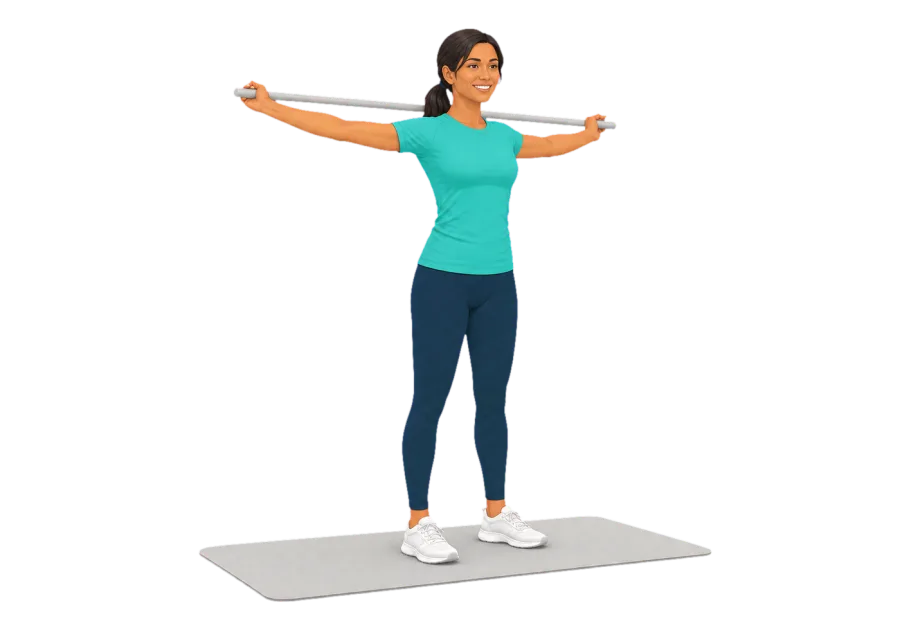
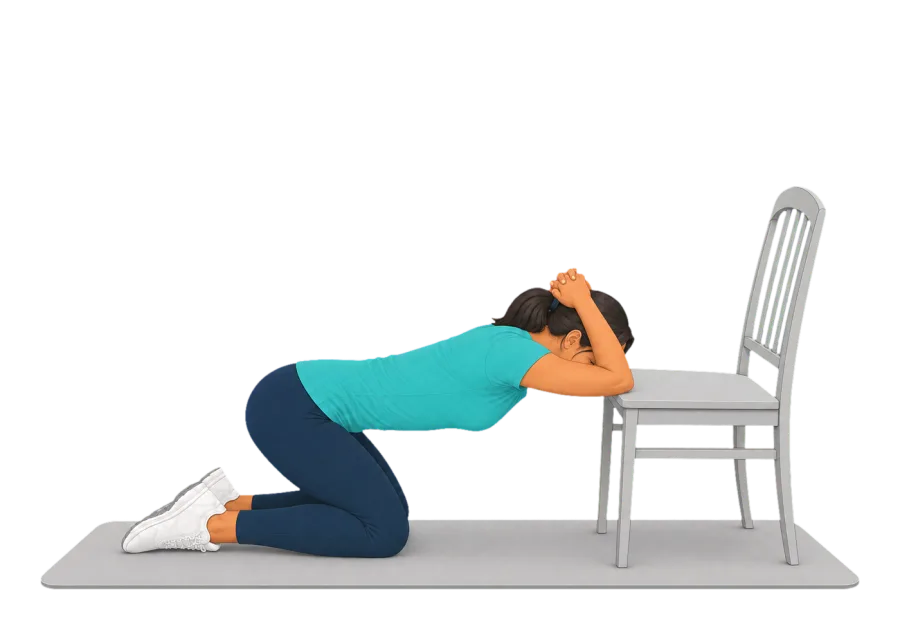
Related moves include the Shoulder Pass-Through, which takes the shoulder through a larger arc with a stick or band, and the Bench Lat Stretch, which addresses the muscles that often limit overhead reach.
Routines With This Move
- Lifter's Full Reset
- Open Shoulders
- Overhead Ready
- Upper Body Unwind
See Also
Sources
- Scapula (opens in a new tab). Wikipedia.
- Serratus anterior muscle (opens in a new tab). Wikipedia.
- The Clinical Utility of the Seated Wall Angel as a Test with Scoring (opens in a new tab). International Journal of Sports Physical Therapy, 2024.
- Trapezius (opens in a new tab). Wikipedia.
- A comparison of serratus anterior muscle activation during a wall slide exercise and other traditional exercises (opens in a new tab). Journal of Orthopaedic and Sports Physical Therapy, 2006.
- The effects of wall slide and sling slide exercises on scapular alignment and pain in subjects with scapular downward rotation (opens in a new tab). Journal of Physical Therapy Science, 2016.
- Sequential Changes in Scapular Range of Motion After An Intervention Using the KOJI AWARENESS Original "Wall Angel Slider" Exercise (opens in a new tab). Journal of Sport Rehabilitation, 2025.
- Theraband Applications for Improved Upper Extremity Wall-Slide Exercises (opens in a new tab). Journal of Athletic Training, 2022.
- Variation of muscle recruitment during exercises performed below horizontal arm elevation that target the lower trapezius: A repeated measures cross-sectional study on asymptomatic individuals (opens in a new tab). Journal of Electromyography and Kinesiology, 2023.
- Trapezius muscle activity during wall slide exercise: Natural vs corrected head posture (opens in a new tab). Journal of Bodywork and Movement Therapies, 2025.
Further Reading
- Research Review: Serratus Anterior Activation During Wall Slides (opens in a new tab). Brookbush Institute.
- Rotator cuff (opens in a new tab). Wikipedia.
General information about this move, not medical advice. Stop if something hurts, and read our Safety page before you start. If you have a health condition, ask your doctor or physiotherapist first.