What It Is For
This exercise is a supported extension of the thoracic spine, the region of twelve vertebrae that naturally forms a forward-curving kyphosis from about the second to the twelfth thoracic vertebra.[1] A person lies with a foam roller or rolled towel across the upper back, supports the head with the hands, and arches gently over the prop. The prop acts as a fulcrum: the segments above and below it can bend backwards around a fixed point.
It is usually chosen by people who spend long periods rounded over a desk or who want more upper back movement for overhead sport. The technique point is to keep the ribs down and the roller above the lower back, so that the extension comes from the thoracic spine and not from an arching lumbar spine. The aim is movement in a stiff region. It should not be confused with changing the shape of the spine: a 2026 trial in footballers, described below, found no group difference in kyphosis angle.[2]
The exercise differs from foam rolling proper. Rolling means moving back and forth across a muscle as a form of self-massage, also known as self-myofascial release.[3] Here the body stays almost still and the roller provides a shape to bend over, so most of the research on rolling does not apply directly.
How to Do It
A gentle backward bend for an upper back that has been rounded over a desk. Lie with a foam roller or rolled towel across your upper back, support your head with your hands, and arch gently over it. Keep your ribs down and stay above your lower back. You should feel a broad, comfortable pressure and stretch between your shoulder blades.
- Roller or rolled towel across the upper back
- Support your head
- Arch gently over it
Arch only a little at first. Stop if it causes sharp pain or pain down a leg.
How It Got Its Name
Upper Back Extension is a plain description: extension is the anatomical term for bending backwards. In clinical and research writing the same move is called thoracic spine extension with a foam roller, as in the 2026 football trial.[2] The foam roller's own name is equally literal. It comes from the object, a lightweight cylinder of elastomeric foam.[3] No first use of any of these terms for this exercise could be found.
History
The history of the exercise is really the history of its prop, and even that rests on a thin record. Moshe Feldenkrais (1904 to 1984), a physicist and engineer, developed a system of movement awareness lessons.[5][6] Physiotherapy historian Glenn Ruscoe places his first use of foam rollers in the mid-1970s, after he encountered foam packing rollers in the United States and used them for body support and balance work.[6] Two University of Stirling researchers writing in The Conversation give a similar account, saying that he added rollers about two decades after his work became popular in the 1950s.[7]
Accounts of the next step are close but not identical. Ruscoe and a newspaper column both credit Sean Gallagher, a Feldenkrais student, with applying the roller to self-massage in 1987 and introducing it to Broadway dancers.[6][8] The newspaper column instead dates the first Feldenkrais use of rollers to the 1980s, which conflicts with the mid-1970s date.[8] These are secondary accounts, and no primary record was found. Ruscoe then credits a figure he names as Mike Clarke with promoting the term self myofascial release in the 1990s, and records a first United States foam roller patent in 2004.[6]
None of these accounts mention thoracic extension. No inventor of the exercise is recorded, and it is not known when therapists first used a roller as a fulcrum for the upper back. It was established by the 2020s, when one trial could say that thoracic self-mobilisation is often linked with foam rollers, while choosing taped tennis balls because rollers cost more and travel badly.[9] That tennis ball device had been described in a 2012 clinical suggestion, as a cheap and portable tool.[10]
Muscles and Tendons
The main restraint is the spine itself. The thoracic vertebrae carry ribs at each level, and from the fifth to the eighth vertebrae the spinous processes overlap steeply, with the laminae lying over each other like roof tiles.[4] Backward bending brings these structures closer together, so the end of the range is usually felt as a firm stop and a broad pressure between the shoulder blades, not as a strong muscular stretch.
At the front of the body, the abdominal wall and the anterior longitudinal ligament of the spine are placed under gentle tension. The front of the chest stretches a little, and more so when the arms are taken overhead, because pectoralis major and latissimus dorsi both attach to the humerus. The back extensors work to take the spine into extension and the abdominals work to stop the lower ribs flaring. The neck should do very little, which is why the head is supported in the hands.
Stretched
- Rectus abdominis
- Lengthens gently as the ribcage opens away from the pelvis
- Pectoralis major
- Mild stretch, stronger when the arms go overhead
- Latissimus dorsi
- Lengthens only in the arms overhead version
- Intercostals
- Mild stretch across the front of the ribcage
Working
- Thoracic erector spinae
- Help draw the upper back into extension and control the return
- Abdominals
- Keep the ribs down so that the bend stays above the lower back
- Neck flexors
- Work lightly, with the hands taking most of the weight of the head
Tendons and Fascia
- Anterior longitudinal ligament
- Runs down the front of the vertebral bodies and is tensioned by spinal extension
What Research Has Looked At
No study was found that tests the held extension over a roller on its own. The nearest evidence comes from programmes. In the football trial, six weeks of thoracic exercise improved rotation angles and a posture test inclination angle more than routine training, with no intervention-related adverse events, but the primary outcome of kyphosis angle did not change differently between groups.[2] In a trial of adolescent volleyball players, whose programme allowed optional foam roller use, four weeks of added thoracic work gave similar results to routine training.[12]
Studies of self-mobilisation with tennis balls give a related picture. A small 2015 trial of 19 adults found a difference in chest expansion after six weeks and no difference in lung function.[13] A 2023 trial in 24 people with low back pain measured lower lumbar segmental rotation after four weeks of the same kind of exercise.[9] Work on foam rolling proper is more plentiful, and a 2015 systematic review of 14 articles reported short-term gains in joint range of motion, but with no agreed programme and widely varying methods.[14] That review concerns rolling and not the static hold described here.
Where It Is Used Today
Foam rollers are now common in gyms and were once limited largely to professional athletes.[7] Upper back extension over a roller has become part of clinical and team programmes as well: the 2026 trial in professional footballers used it as the first of six thoracic exercises in a three-times-weekly programme.[2] A home version with a rolled towel needs no equipment at all, which suits people who are trying the move for the first time or who find a roller too firm.
Physiotherapists also use a range of other tools for the same purpose, including taped tennis balls and wall-based extension.[10][11] Gym users often do it as part of the warm-up before overhead lifting, though no figures on that use could be found.
Variations and Related Moves
A rolled towel is the gentler option, because it is lower and softer than a roller. Taking the arms overhead makes the move more intense by adding a stretch to the muscles that attach to the upper arm. Moving the roller a little up or down the back changes which segments bend most, though it should stay above the lower back.
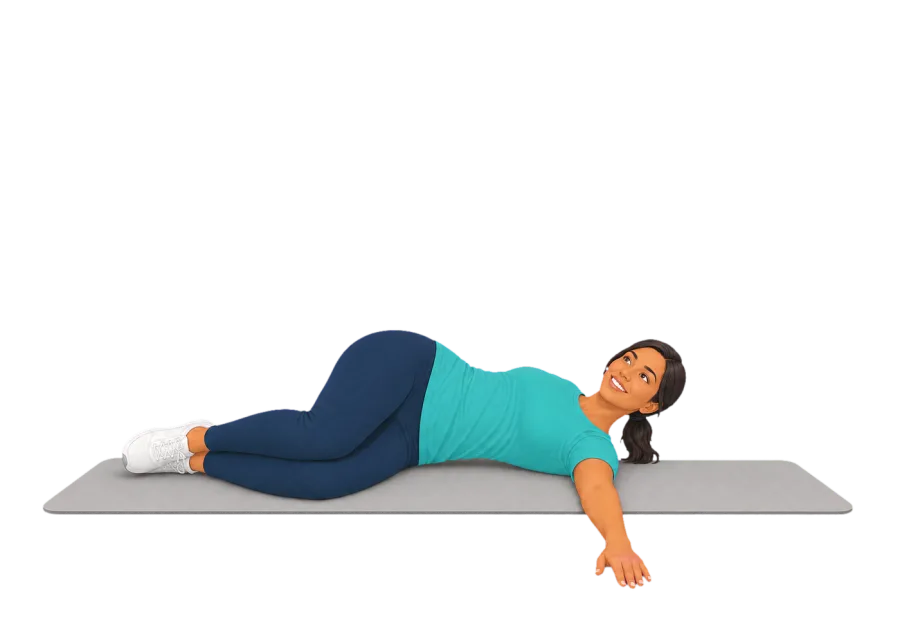
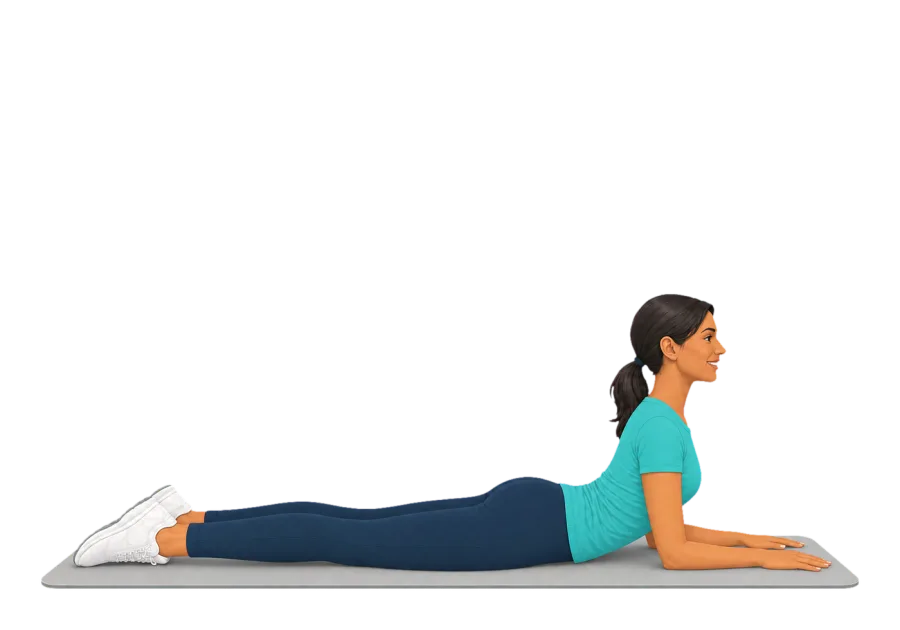
Thoracic extension at a wall offers a standing alternative and has been used in trials.[11] The tennis ball device described by Johnson and Grindstaff is a more localised version.[10] Related moves in other positions include the Sphinx, which extends the spine from lying face down, and the Open Book, which targets the same region through rotation.
Routines With This Move
- Lifter's Full Reset
See Also
Sources
- Spinal column (opens in a new tab). Wikipedia.
- Effects of adding thoracic spine exercises to routine soccer training on spinal alignment and mobility in professional male soccer players: a randomized controlled study (opens in a new tab). BMC Sports Science, Medicine and Rehabilitation, 2026.
- Foam roller (opens in a new tab). Wikipedia.
- Thoracic vertebrae (opens in a new tab). Wikipedia.
- Moshé Feldenkrais (opens in a new tab). Wikipedia.
- Foam Roller (opens in a new tab). history.physio, 2021.
- Does foam rolling actually do any good? (opens in a new tab). The Conversation, deposited at University of Stirling, 2018.
- The painful magic of foam rollers (opens in a new tab). Minden Times, 2018.
- Effects of Thoracic Spine Self-mobilization on Patients with Low Back Pain and Lumbar Hypermobility: A Randomized Controlled Trial (opens in a new tab). Progress in Rehabilitation Medicine, 2023.
- Thoracic region self-mobilization: a clinical suggestion (opens in a new tab). International Journal of Sports Physical Therapy, 2012.
- Effect of thoracic mobilization exercises on hamstring flexibility: a randomized controlled trial (opens in a new tab). Turkish Journal of Medical Sciences, 2023.
- Thoracic mobility training and performance outcomes in adolescent female volleyball players: a randomized controlled trial (opens in a new tab). BMC Sports Science, Medicine and Rehabilitation, 2026.
- The effect of thoracic region self-mobilization on chest expansion and pulmonary function (opens in a new tab). Journal of Physical Therapy Science, 2015.
- The effects of self-myofascial release using a foam roll or roller massager on joint range of motion, muscle recovery, and performance: a systematic review (opens in a new tab). International Journal of Sports Physical Therapy, 2015.
Further Reading
- Feldenkrais method (opens in a new tab). Wikipedia.
- Kyphosis (opens in a new tab). Wikipedia.
General information about this move, not medical advice. Stop if something hurts, and read our Safety page before you start. If you have a health condition, ask your doctor or physiotherapist first.