What It Is For
Cat Cow is a mobility exercise more than a stretch. On hands and knees, the spine moves slowly from rounded to arched and back again, while the shoulders and hips stay roughly in place.[1] Its value is the repeated, comfortable movement, not a long hold at either end. The American Council on Exercise suggests about five cycles and presents it as a warm-up as well as a way to ease the back.[2]
Linking movement with breath gives it a calm rhythm. In the usual form, the in-breath accompanies the arch and the out-breath accompanies the round. Because the trunk is horizontal, the spine does not carry body weight as it does when standing, which is one reason it is widely used early in a session.
How to Do It
A slow, flowing move that takes your spine through its easy range. On hands and knees, breathe in as your chest moves forward and your back gently arches, then breathe out as you round your back towards the ceiling. It should feel like a warm-up for your whole back, never a strain.
- On hands and knees
- Move with your breath
- Move slowly, inside an easy range
Spread your fingers and keep weight even. Use fists or forearms if your wrists complain.
Pad your knees with a folded towel or cushion. Skip it if kneeling hurts.
How It Got Its Name
Both names describe animals. The rounded shape recalls a cat arching its back, and the sagging, lifted shape recalls the back of a cow. Marjaryasana comes from marjari, meaning cat, and Bidalasana, a second Sanskrit name for the same shape, comes from another word for cat.[5][1] Yoga Journal gives bitila as cow, the source of Bitilasana.[8] The English pairing Cat Cow names the two positions. Rehabilitation writers use the name cat-camel for the same movement.[6]
History
The pair has no ancient pedigree that can be demonstrated, and no inventor is recorded. The 19th-century Sritattvanidhi illustrates a pose called Marjarottanasana, an upside-down cat stretch, which shares a name element but is a different position.[1] The 17th-century Hatha Ratnavali lists a tiger pose without describing it, so nothing can be said about what it looked like.[1]
The closest early parallel comes from gymnastics. Niels Bukh's Primary Gymnastics, published in 1924, describes a prone-kneeling position that resembles the pose, and Mark Singleton has traced this type of exercise to a 19th-century Scandinavian gymnastics tradition.[1] Cat pose then appears in twentieth-century yoga teaching: one list of asanas credits T. K. V. Desikachar and Satyananda Saraswati.[9] Sivananda Yoga has taught it as suitable in pregnancy.[1] When the two shapes were first paired as a breath-led flow is not documented.
A parallel history runs through back research. Stuart McGill, a leading researcher in low back stability, set out a programme in a 2001 review in which the cat-camel opens the session, at around six cycles of flexion and extension.[6] Whether this was borrowed from yoga or arose separately is not recorded.
Muscles and Tendons
Each end of the movement shortens one side of the trunk and lengthens the other. When the back rounds, the abdominal muscles draw the ribs and pelvis towards each other, as the rectus abdominis does in lumbar flexion, while the back muscles lengthen.[3] When the back arches, the erector spinae extend the spine and the abdominals lengthen.[4] The range is modest, so neither stretch is intense. Sources describing the exercise differ in emphasis: Yoga Journal says that it strengthens and stretches the back, abdominals, shoulders, wrists and hips, while the back researcher Stuart McGill's programme uses its equivalent as a motion exercise and not as a stretch.[5][6]
The arms and thighs work lightly to hold the frame still. The thoracolumbar fascia encloses the spinal muscles of the lower back, and it moves with the spine as it bends, but the exercise is not known to act on it in any specific way.[7]
Stretched
- Erector spinae
- Mildly lengthened at the rounded end of the movement
- Rectus abdominis
- Mildly lengthened at the arched end of the movement
Working
- Rectus abdominis and obliques
- Help to round the back on the out-breath
- Erector spinae
- Help to arch the back on the in-breath
- Arm and shoulder muscles
- Hold the upper body steady over the hands
- Hip muscles
- Hold the thighs steady above the knees
Tendons and Fascia
- Thoracolumbar fascia
- Encloses the spinal muscles of the lower back and moves with them as the spine bends
Where It Is Used Today
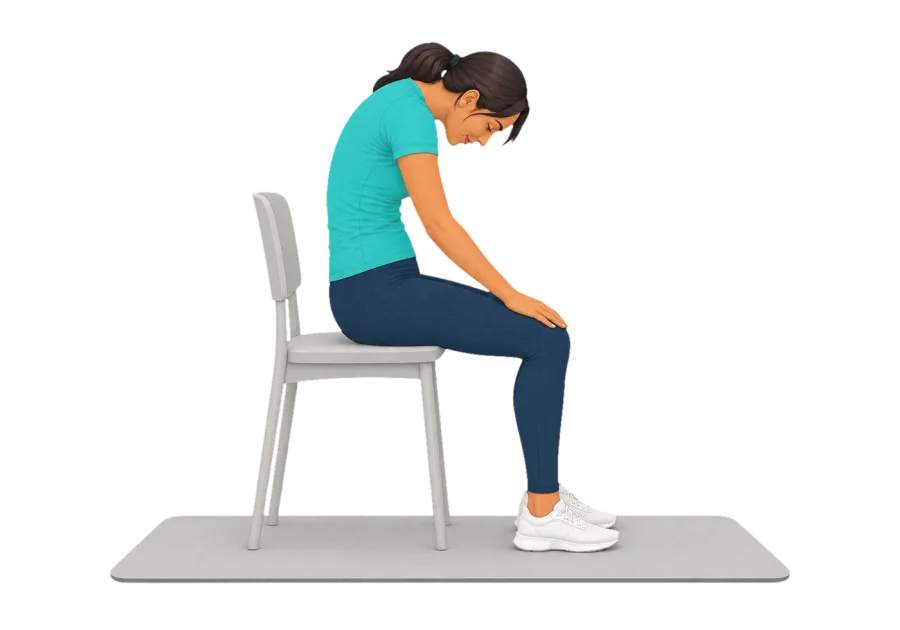
The move is common at the start of yoga classes, where it warms up the spine before more demanding poses. The Cleveland Clinic describes a sitting or standing form, with the arms moving and the upper back rounding, for people who do not want to get down to the floor.[10]
In strength and rehabilitation settings, it is used as a warm-up for back training, following McGill's sequence. There, the instruction is to move through a comfortable range for a few repetitions, without chasing extra range at the ends.[6] The American Council on Exercise includes it in an article for trainers working with clients who have low back complaints.[2]
Variations and Related Moves
The seated version, with hands on the thighs in a chair, needs no kneeling and no wrist load. A standing version is also common.[10] Pausing for a breath at each end adds time in the arched and rounded positions.
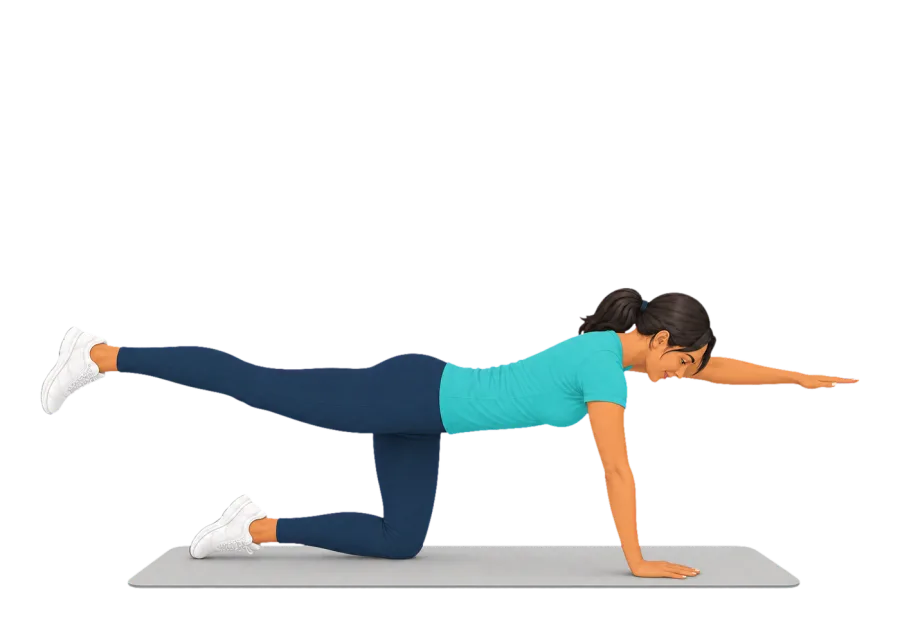
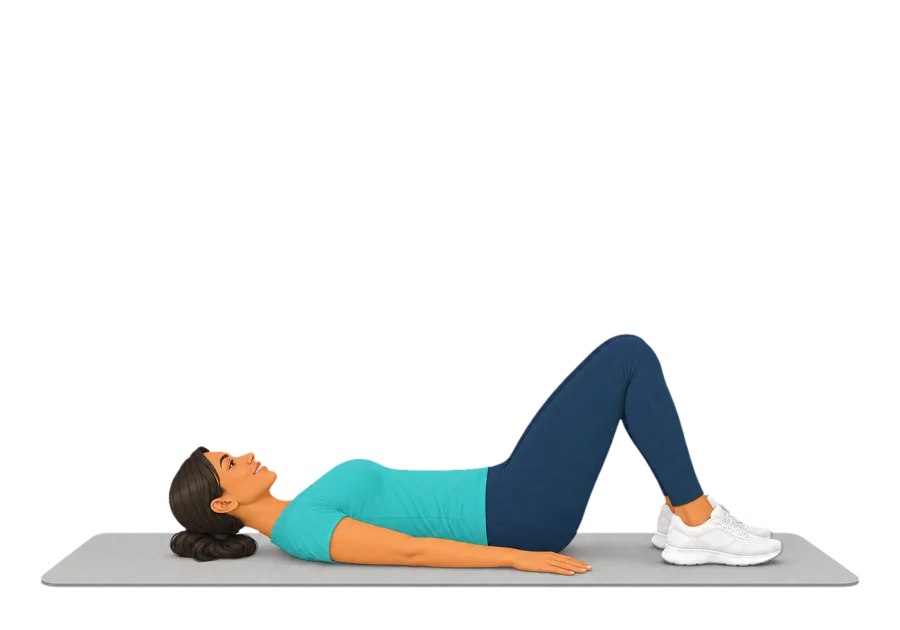
Related movements build on the same kneeling base. Vyaghrasana, or Tiger Pose, stretches one leg behind, and Chakravakasana, or Sunbird Pose, extends the opposite arm and leg, much like the Bird Dog exercise.[1] Pelvic tilts, done lying down, isolate the lower part of the same movement.
Routines With This Move
- Fifteen Minute Reset
- Five Minute Reset
- Lights Out
- Long Wind Down
- Low Back Ease
- Low Back Long Ease
- Low Back Quick Ease
- Morning Wake Up
- Quick Wake Up
- Slow Morning
- Ten Minute Reset
See Also
Sources
- Bidalasana (opens in a new tab). Wikipedia.
- 10 Yoga Poses to Alleviate Low Back Pain (opens in a new tab). American Council on Exercise, 2017.
- Rectus abdominis muscle (opens in a new tab). Wikipedia.
- Erector spinae muscles (opens in a new tab). Wikipedia.
- Cat Pose: How to Practice Marjaryasana (opens in a new tab). Yoga Journal.
- Low-Back Stability Training (opens in a new tab). University of New Mexico.
- Thoracolumbar fascia (opens in a new tab). Wikipedia.
- Cow Pose: How to Practice Bitilasana (opens in a new tab). Yoga Journal.
- List of asanas (opens in a new tab). Wikipedia.
- Try These Yoga Poses To Improve Your Flexibility (opens in a new tab). Cleveland Clinic, 2022.
Further Reading
- Tirumalai Krishnamacharya (opens in a new tab). Wikipedia.
- Yoga Body (opens in a new tab). Wikipedia.
General information about this move, not medical advice. Stop if something hurts, and read our Safety page before you start. If you have a health condition, ask your doctor or physiotherapist first.