What It Is For
Pelvic Tilts teach a person to move the pelvis and lower spine on purpose. Lying with bent knees and flat feet, the person rocks the pelvis backwards so the lower back presses lightly into the floor, then lets it return to a small arch.[1][2] The movement is small.
Physiotherapists often include it in back mobility programmes, where it is given as an early and gentle movement.[1][2][3] It is used to improve lumbopelvic flexibility and to retrain control of the deep local muscles, as one research team puts it.[4]
Beyond the clinic, the same control of the pelvis is called on in exercises such as the bridge, the dead bug and Pilates mat work.
How to Do It
A small, slow move for getting to know your lower back. Lie on your back with your knees bent and feet flat, then gently flatten your lower back into the floor and let it arch away again. The movement comes from your pelvis and is quite small. You should feel your stomach muscles switch on lightly.
- Knees bent, feet flat
- Slow and small
- Keep your shoulders relaxed
How It Got Its Name
The name is purely anatomical: the pelvis tilts around the hip joints, forwards or backwards.[5] Clinical leaflets vary the wording, with terms such as crook lying pelvic tilt, where crook lying means lying on the back with the knees bent.[2] In Pilates a related action is taught as imprint, and the term is used by Stott Pilates alongside neutral.[8] The first use of the phrase pelvic tilt is not documented.
History
No single inventor is recorded. The action is simple, and movement teachers may well have used it long before anyone wrote about it. The earliest documented clinical use found here is Paul C. Williams's programme for chronic low back pain, published in 1937. Williams, a Dallas orthopaedic surgeon, recommended a posterior pelvic tilt position as necessary for the best results, reasoning that reducing the lumbar curve eased pressure on the back of the spine.[9]
The posterior tilt then became a listed part of the Williams flexion exercises, which for many years were common practice in back care.[7][9] From the late 1950s Robin McKenzie's extension-based approach offered a contrasting view, and modern physiotherapy tends to choose direction according to each person's response.[10][2]
A parallel line runs through Pilates. Joseph Pilates, who called his method Contrology and published Return to Life Through Contrology in 1945, taught a flattened lower spine, according to modern Stott Pilates material.[11][12] In the 1980s Moira Merrithew and Lindsay Merrithew built Stott Pilates in Toronto around the opposite idea, a neutral spine that keeps the natural lumbar curve.[13] The Merrithew account is written by the method's owners and should be read with that in mind.
Later studies used electromyography to find out which muscles take part.[6][4]
Muscles and Tendons
A posterior pelvic tilt raises the front of the pelvis and lowers the back. An anterior tilt does the opposite.[5] Here both directions pass through the small range around a resting position, so the move is mainly about muscle control, not stretch. Any lengthening of the lower back muscles or hip flexors is slight.
Drysdale and colleagues recorded activity in the rectus abdominis and external oblique during the supine pelvic tilt in 26 women.[6] In a separate study of 12 men in standing, Takaki and colleagues used fine-wire electrodes and found the transversus abdominis most active during posterior tilting, and the multifidus and erector spinae more active during anterior tilting.[4] The two directions therefore call on broadly opposite groups.
StatPearls describes the Williams version as tightening the abdominals and buttocks to flatten the back.[7] The version described here uses a lighter effort, with the shoulders relaxed and the movement coming from the pelvis. The hip extensors can help, though the glutes do not need to grip hard for a small tilt.
Stretched
- Lumbar erector spinae
- Lengthen very slightly as the lower back flattens
- Hip flexors
- Lengthen very slightly in the flattened phase, though this is a small effect with the knees bent
Working
- Rectus abdominis and external obliques
- Draw the front of the pelvis up as the back flattens
- Transversus abdominis
- The deep abdominal muscle, active during posterior tilting in a study in standing
- Gluteus maximus
- Can help tilt the pelvis backwards, used lightly here
- Multifidus and erector spinae
- Active as the pelvis tips forward and the lower back arches
Tendons and Fascia
- Thoracolumbar fascia
- The connective tissue across the lower back, which moves with the pelvis
What Research Has Looked At
Most research concerns which muscles work, not what the exercise does over time. Drysdale, Earl and Hertel compared the pelvic tilt with abdominal hollowing in 26 healthy young women in three leg positions, recording surface muscle activity. Rectus abdominis and external oblique activity was higher in the pelvic tilt than in hollowing in every position.[6] The authors concluded that hollowing can be done with minimal activation of the large global abdominal muscles, which implies that the pelvic tilt draws on them more.
Takaki and colleagues recorded deep muscles directly in 12 healthy young men performing tilts in standing. They concluded that the multifidus and erector spinae relate to anterior tilting, that the transversus abdominis is more active during posterior tilting, and that local muscles may contribute to the movement.[4] The sample was small, and the position differs from the lying version.
As for the Williams programme as a whole, StatPearls notes that most of the supporting evidence is low-level and that few recent studies exist.[7]
Where It Is Used Today
NHS physiotherapy services include the pelvic tilt in leaflets for people with back pain. Newcastle Hospitals teaches pressing the lower back down and tucking the bottom under for five seconds.[1] East Lancashire suggests rocking the lower back and pelvis through the available range, 5 to 15 times.[2] Plymouth gives a seated or lying version as a slow rocking movement, repeated 10 to 15 times.[3]
It is also taught in Pilates studios, where the pelvis is a central point of attention.[8] NHS guidance on exercise in pregnancy advises against lying flat on the back for more than a few minutes in later pregnancy, which applies to the lying version.[14]
Variations and Related Moves
The seated version, on a firm chair, is the usual gentler alternative, and it is useful for people who find lying down awkward.[3] Holding each end of the movement for a breath makes it a little harder, since the muscles have to sustain the position.
The same action on hands and knees forms the lower half of Cat-Cow. The Bridge and Dead Bug both build on control of the same position, and the Pilates imprint uses it as a starting point for mat work.[8]
Routines With This Move
- Lights Out
- Low Back Ease
- Low Back Long Ease
- Low Back Quick Ease
See Also
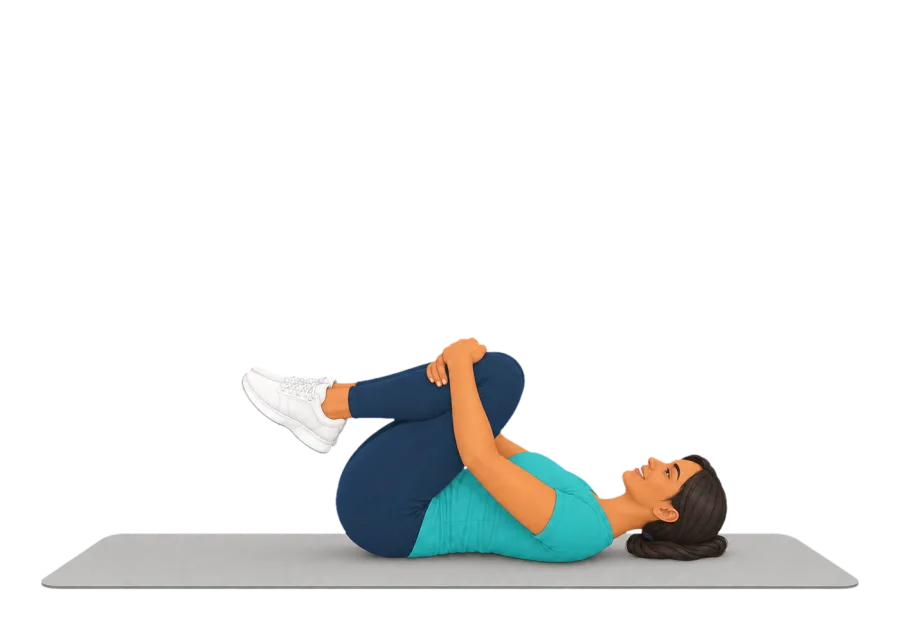
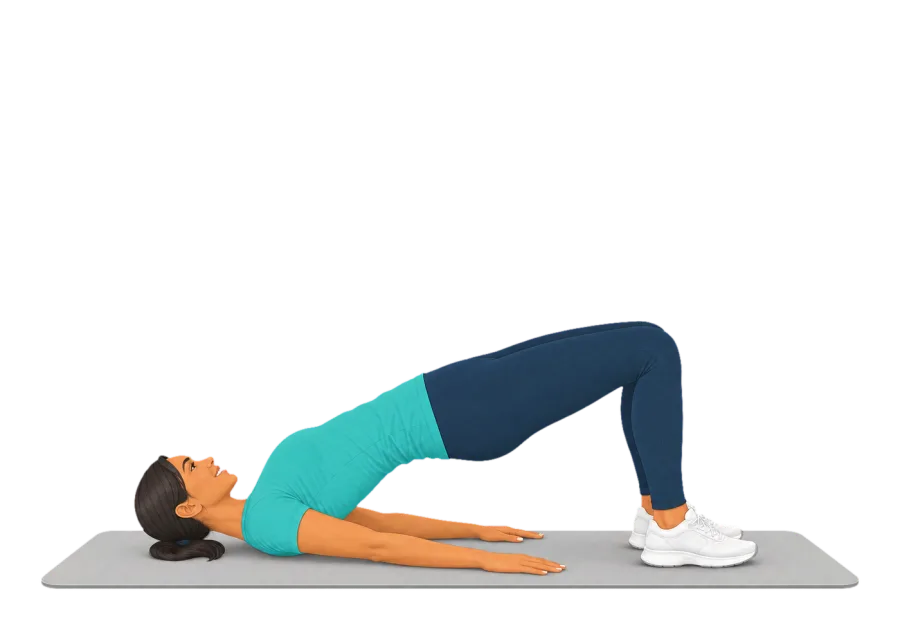
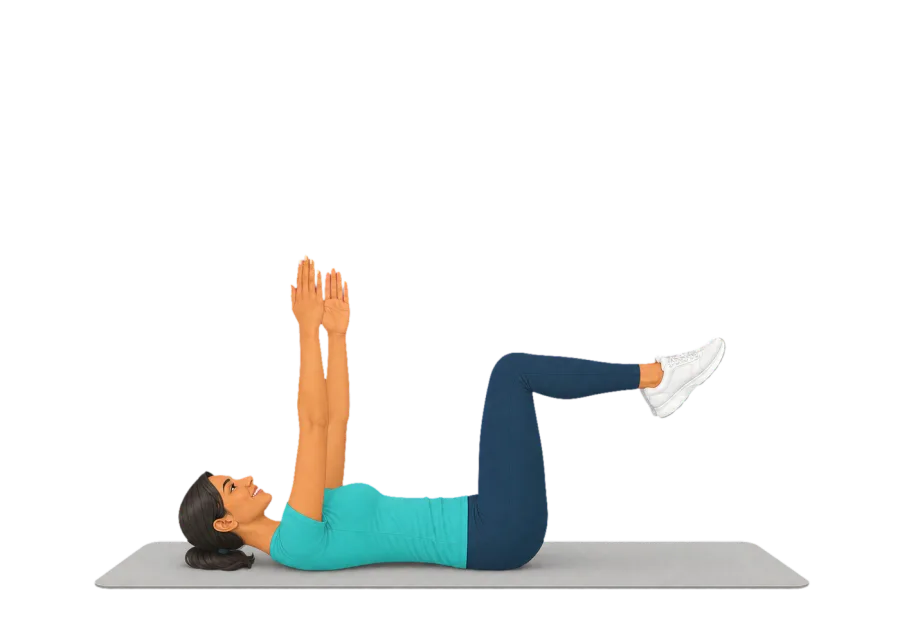
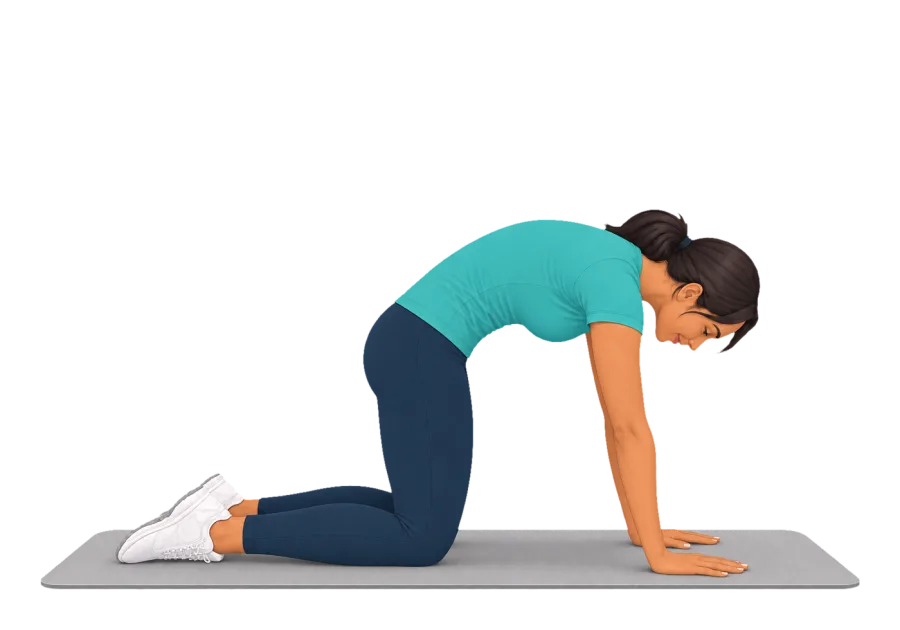
Sources
- Back problems (opens in a new tab). Newcastle Hospitals NHS Foundation Trust.
- Back Pain: General Mobility Exercises (opens in a new tab). East Lancashire Hospitals NHS Trust, 2021.
- Back Rehabilitation Programme (opens in a new tab). University Hospitals Plymouth NHS Trust.
- Analysis of muscle activity during active pelvic tilting in sagittal plane (opens in a new tab). Physical Therapy Research, 2016.
- Pelvic tilt (opens in a new tab). Wikipedia.
- Surface Electromyographic Activity of the Abdominal Muscles During Pelvic-Tilt and Abdominal-Hollowing Exercises (opens in a new tab). Journal of Athletic Training, 2004.
- Williams Back Exercises (opens in a new tab). StatPearls, NCBI Bookshelf, 2025.
- STOTT PILATES FAQs (opens in a new tab). Merrithew.
- Williams Flexion Exercises (opens in a new tab). Wikipedia.
- McKenzie method (opens in a new tab). Wikipedia.
- Pilates (opens in a new tab). Wikipedia.
- Move through the History of Matwork in Chicago (opens in a new tab). Merrithew, 2017.
- Stott Pilates (opens in a new tab). Wikipedia.
- Exercise in pregnancy (opens in a new tab). NHS.
Further Reading
- Transverse abdominal muscle (opens in a new tab). Wikipedia.
- Erector spinae muscles (opens in a new tab). Wikipedia.
General information about this move, not medical advice. Stop if something hurts, and read our Safety page before you start. If you have a health condition, ask your doctor or physiotherapist first.