What It Is For
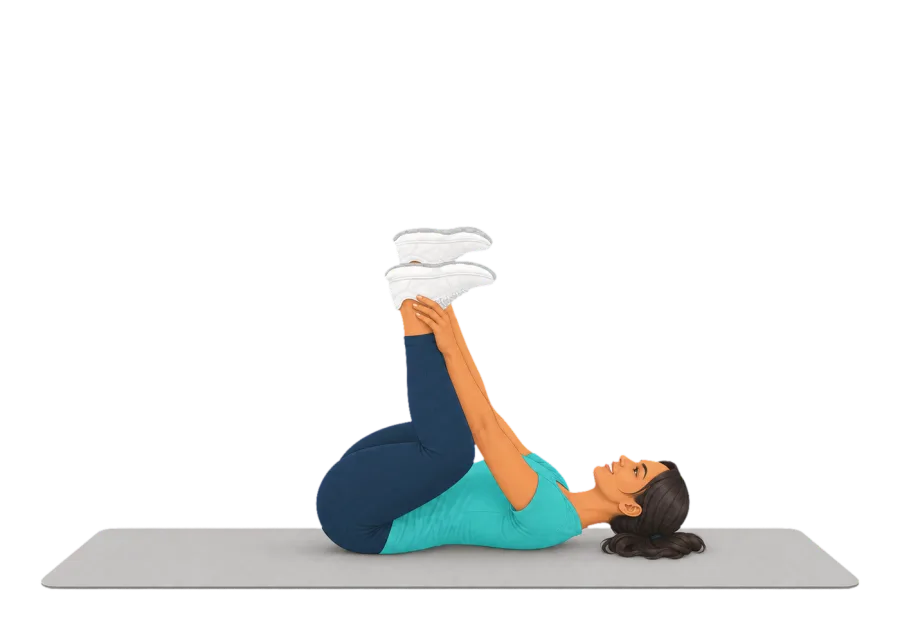
Knee Hugs lets the lower back round while the body is fully supported by the floor. Lying on the back, the person draws the knees towards the chest with the hands and keeps the head resting. Physiotherapy leaflets describe the sensation as a stretch in the back and bottom muscles.[1]
Physiotherapists often include it in general back mobility programmes. An NHS leaflet from East Lancashire suggests beginning with this kind of exercise when symptoms are made worse by walking and standing, and one from Plymouth uses a one-leg version in a rehabilitation programme.[2][3] These are general exercise suggestions from services that also advise people on warning signs.[2]
Outside clinics, it is used simply as a comfortable resting position. Hands behind the thighs can be used in place of holding the shins, which keeps the knees less sharply bent.
How to Do It
A comforting way to let your lower back round and rest. Lie on your back, hug both knees in towards your chest and rock gently, with your head resting on the floor. Hold behind your thighs if your knees are sensitive. You should feel a soft stretch across your lower back and buttocks.
- Hug both knees in
- Rock gently
- Keep your head resting
How It Got Its Name
Knee Hugs is plain English, and NHS leaflets use similar words, such as double knee hugs and double leg knee hug.[6][2] Clinical sources also say knee to chest.[7]
The yoga names carry older meanings. Pawanmuktasana joins pavana, wind, and mukta, released, and it is usually translated as Wind-Relieving Pose.[5] Apanasana is built from apana, a term for the downward-moving energy linked to elimination, and one yoga site renders it as Pose of Downward-Moving Energy.[8] Sources differ on whether the two names refer to the same pose.
History
No single inventor of drawing the knees to the chest is recorded, and it is a position so natural that one would be hard to identify. The earliest documented use as a formal exercise found here comes from medicine. In 1937 the Dallas orthopaedic surgeon Paul C. Williams published a programme for chronic low back pain, building on an earlier squat exercise promoted by Eugene Regen. Williams argued that upright posture loaded the back of the lumbar discs, and his exercises aimed to reduce the lumbar curve.[4]
Pulling the knees to the chest became a central element of those Williams flexion exercises, along with the posterior pelvic tilt and partial sit-ups.[4][7] For years they were a standard part of care for back pain, although StatPearls notes that most supporting evidence is of a low level and that few recent studies exist.[7] From 1956 the New Zealand physiotherapist Robin McKenzie developed an approach centred on extension, the opposite direction, and it gradually took over much of the ground.[9] A small 1984 report favoured McKenzie's protocol, and a review quoted on Wikipedia calls the two methods contradictory in theory and practice. Several claims in that article are marked as lacking citations.[4]
The yoga history is thinner, and claims of great antiquity are not supported by the sources consulted. One modern yoga site says Apanasana has roots in traditional Hatha Yoga but gives no text or date.[8] The earliest firm anchor found is Swami Satyananda Saraswati of the Bihar School of Yoga, founded in the early 1960s, who is credited with creating a pawanmuktasana series as preparation for major poses.[10][11] His manual Asana Pranayama Mudra Bandha was published in 1969.[11] Whether a knees-to-chest pose appears in earlier texts could not be confirmed, and it is reported as undocumented here.
Muscles and Tendons
Bringing the knees up bends the hips and tilts the pelvis backwards, which rounds the lumbar spine. The muscles alongside the lower spine, the erector spinae and the multifidus beneath them, are drawn slightly longer, and the gluteus maximus lengthens as the hips bend.[1] The stretch is mild and the tissues involved are mainly lengthened by position, with little effort.
The connective tissue of the lower back, including the thoracolumbar fascia and the ligaments behind the spine, is also put under light tension. Paul Williams proposed that flexion opened the spaces where spinal nerves leave the spine, and a 1996 anatomical study is cited as reporting larger canal and foramen dimensions in flexion.[4] That is a measurement of geometry, not a finding about symptoms.
The arms provide the small amount of force needed. The hip flexors work briefly to lift the legs, then rest. Keeping the head on the floor leaves the neck relaxed, and it distinguishes this version from yoga forms in which the head rises to the knees.[5]
Stretched
- Lumbar erector spinae and multifidus
- The back muscles alongside the lower spine, lengthened gently as it rounds
- Gluteus maximus
- Lengthened as the hips bend, felt across the buttocks
Working
- Biceps and shoulder muscles
- The arms draw the legs in lightly and hold them there
- Hip flexors
- Lift the legs at the start, then largely rest
- Abdominals
- Work lightly, particularly during the rock
Tendons and Fascia
- Thoracolumbar fascia
- The connective tissue sheet across the lower back, under mild tension as the spine rounds
- Spinal ligaments
- The ligaments at the back of the spine lengthen slightly in flexion
Where It Is Used Today
The exercise is a fixture of NHS and other physiotherapy leaflets, though the details differ between services. Newcastle Hospitals suggests a five-second hold.[6] Another leaflet suggests holding for 20 to 30 seconds.[1] East Lancashire uses repeated movement of 5 to 15 repetitions, and Plymouth holds a single knee for 15 seconds.[2][3] The variety reflects the absence of a single standard dose.
In yoga it is used in many styles.[8] The Art of Living teaches a more active form in which one knee, then the other, then both are drawn in, with the head lifted towards the knee, followed by rocking.[5] Physiotherapy leaflets also offer extension options, and advise people to find which direction their symptoms prefer.[2]
Variations and Related Moves
Drawing in one knee at a time is gentler, and it appears first in some leaflets.[6][3] Making small circles with the knees adds a little massage-like movement against the floor, and it is a more mobile option. People with sensitive knees often hold behind the thighs.
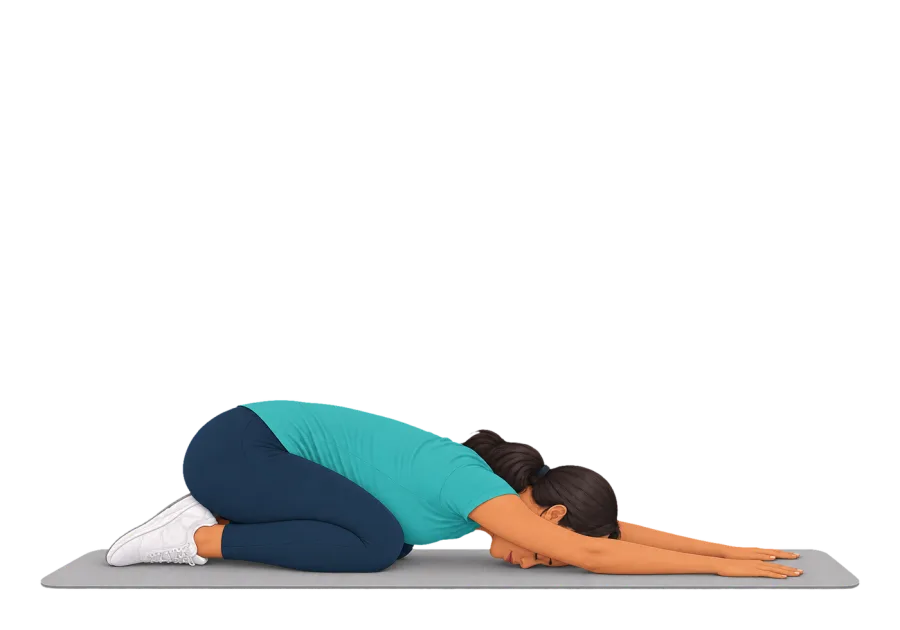
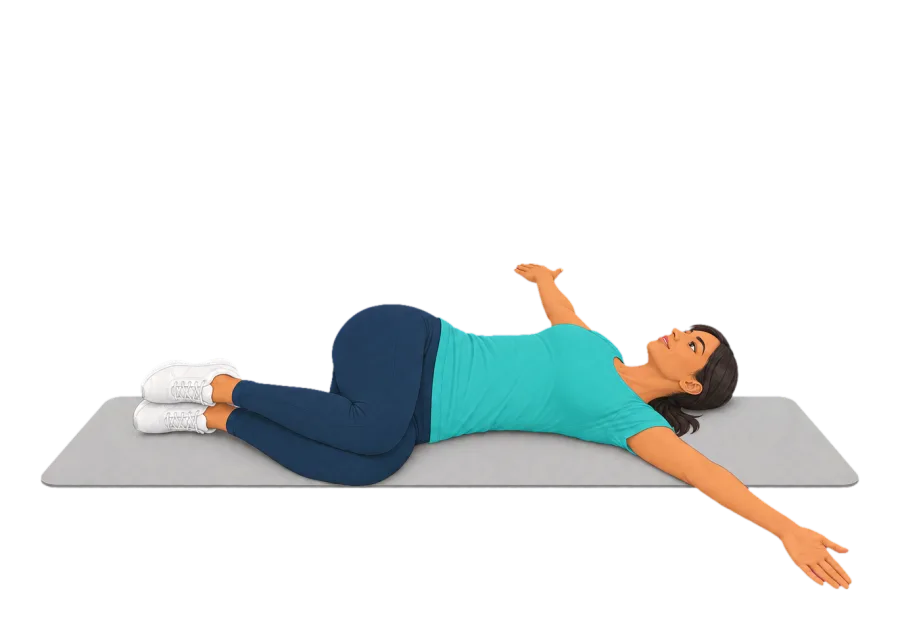
Adding a side-to-side rock gives the movement used at the end of Pawanmuktasana.[5] Knee rolls, in which bent knees sway from side to side, are a frequent companion on physiotherapy sheets.[1] Happy Baby, Child's Pose and the Supine Twist are related resting positions.
Routines With This Move
- Lights Out
- Long Shift Recovery
- Long Wind Down
- Low Back Ease
- Low Back Long Ease
- Low Back Quick Ease
- Slow Morning
See Also
Sources
- Low Back Mobility Exercises (opens in a new tab). Musculoskeletal Physiotherapy OCATS, hosted by NHS North Cheshire and Mersey.
- Back Pain: General Mobility Exercises (opens in a new tab). East Lancashire Hospitals NHS Trust, 2021.
- Back Rehabilitation Programme (opens in a new tab). University Hospitals Plymouth NHS Trust.
- Williams Flexion Exercises (opens in a new tab). Wikipedia.
- Yoga Asana – Pawanmuktasana (opens in a new tab). The Art of Living.
- Back problems (opens in a new tab). Newcastle Hospitals NHS Foundation Trust.
- Williams Back Exercises (opens in a new tab). StatPearls, NCBI Bookshelf, 2025.
- Apanasana (Knees-to-Chest Pose): Benefits, Steps & Variations (opens in a new tab). MyYogaTeacher.
- McKenzie method (opens in a new tab). Wikipedia.
- Welcome to Bihar Yoga – Practice (opens in a new tab). Bihar School of Yoga.
- Satyananda Saraswati (opens in a new tab). Wikipedia.
Further Reading
- Pawanmuktasana (opens in a new tab). YinYoga.com.
- Bihar School of Yoga (opens in a new tab). Wikipedia.
General information about this move, not medical advice. Stop if something hurts, and read our Safety page before you start. If you have a health condition, ask your doctor or physiotherapist first.