What It Is For
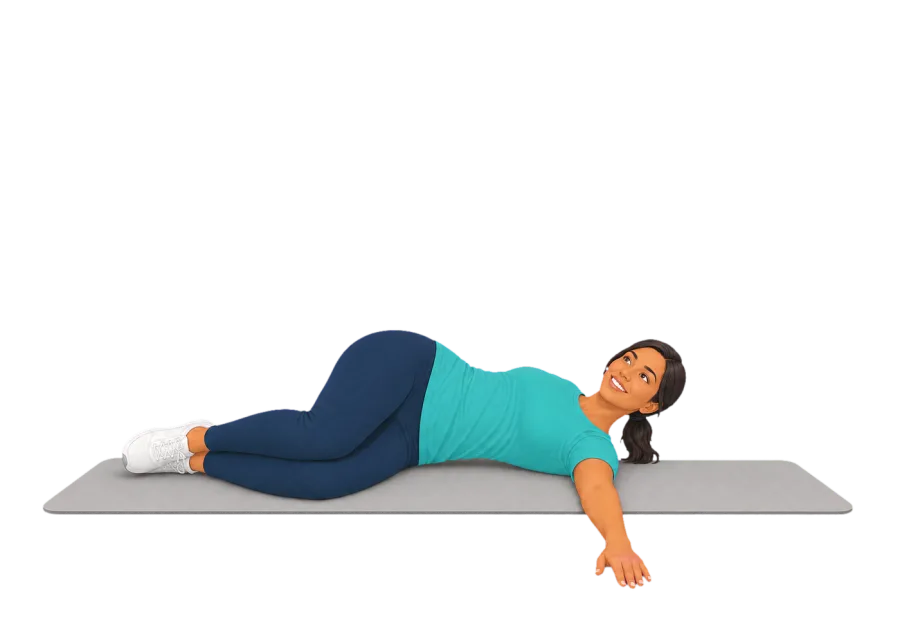
The Lying Twist is a low-effort way to rotate the trunk. With the shoulders on the floor and the knees dropped to one side, the pelvis turns while the chest stays put, so the rotation is shared along the spine. Gravity supplies the movement, which makes it a usual closing position for a session rather than a strength exercise.
Physiotherapy exercise libraries include the same action as a simple range-of-motion exercise. Physitrack's version has the patient lie with knees bent and arms out to the sides, drop the knees to one side only as far as is comfortable, and return.[1] The difference from the yoga form is mainly time: therapy programmes often use it as a slow repetition, while yoga classes hold it.
How to Do It
A lying twist where gravity does the work. Lie on your back with your arms out wide, bend your knees and let them drop to one side while your shoulders stay heavy. You should feel a slow unwinding through your spine and the outer hip. Rest here and let your breathing settle.
- Knees drop to one side
- Arms out wide
- Let gravity do the work
Round your back gently and only as far as is comfortable. Ease off if pain travels down a leg.
How It Got Its Name
The English name is descriptive. In Sanskrit, Jathara Parivartanasana combines jathara, the stomach or abdomen, with parivartana, to turn around, giving the sense of Revolved Abdomen Pose.[4] Supta Matsyendrasana means reclining Matsyendrasana, the lying variant of the seated twist named after Matsyendra, a founder of hatha yoga whose name means lord of the fishes.[5]
Neither name fits this move exactly. In Supta Matsyendrasana one leg usually stays straight, and in the full Jathara Parivartanasana both legs are straight. The bent-knee version taught here matches the easier Version A of that pose.[4] In physiotherapy, the plain terms lower trunk rotation and supine knees side to side are used.[1]
History
No single inventor of the lying twist is recorded. A claim of great age would be hard to support: the seated Matsyendrasana is medieval, described in the 15th-century Hatha Yoga Pradipika and the 17th-century Gheranda Samhita, but those texts concern the seated pose rather than a lying one.[5]
Jathara Parivartanasana does not appear in medieval hatha yoga texts. It is found in 20th-century manuals, notably B. K. S. Iyengar's Light on Yoga of 1966, in a strong form with straight legs lowered to one side.[4] The date at which Supta Matsyendrasana was first described was not found, and when the name came into use is not documented.
The bent-knee form has a parallel life in exercise therapy, where it appears as a basic range-of-motion exercise.[1] Who first prescribed it, and whether yoga influenced therapy or the other way round, is not recorded.
Muscles and Tendons
In this position the pelvis and the ribcage face different directions, which puts the tissue between them under gentle tension. The obliques run between the lower ribs and the pelvis, so they lengthen as the two turn apart; the external oblique normally rotates the trunk towards the opposite side.[2] Taking the knees across the body also puts the outer hip of the upper leg on stretch, which is why many people feel it in the buttock as well as the waist.
The thoracolumbar fascia, the broad sheet that connects trunk and limbs across the lower back and is tensioned by the latissimus dorsi, gluteus maximus and hamstrings, sits in the region being turned.[3] Because the legs rest and the floor supports the back, muscles do little work in the hold. The abdominals work mainly at the two ends, to lower the knees under control and bring them back.
Some rotation of the upper back also occurs, and the wide arms add a light stretch across the chest. How much rotation occurs at each level of the spine varies from person to person, and no source consulted measured it in this position.
Stretched
- Abdominal obliques
- Along the side of the waist as the ribs and pelvis turn in opposite directions
- Gluteus medius and outer hip
- Top hip, as the thigh crosses the body
- Lumbar back muscles
- Lower back, a mild stretch on the side facing upward
- Pectoral muscles
- Front of the chest, lightly, with the arms held wide
Working
- None to speak of in the hold
- Gravity moves the legs; the muscles rest
- Abdominals
- Control the legs as they lower and lift back to the centre
Tendons and Fascia
- Thoracolumbar fascia
- Sheet of connective tissue across the lower back, taken into mild tension by the rotation
Where It Is Used Today
The twist is a common final posture in yoga classes, often just before resting flat on the back. Iyengar Yoga teaches a more demanding version in which a weight may be held in the opposite hand and the legs lowered only halfway, and Ashtanga teacher Ronald Steiner has written that it is not enough on its own for core strength, a view summarised in the reference article.[4]
Physiotherapists give the moving version as a home exercise, with the instruction to go only as far as is comfortable.[1] It needs no equipment and very little effort, which also makes it a simple cool-down.
Variations and Related Moves
A pillow under the knees reduces the range for those who find the floor too far away. Straightening the top leg moves the position towards Supta Matsyendrasana, and straightening both leads to the full Jathara Parivartanasana.[4]
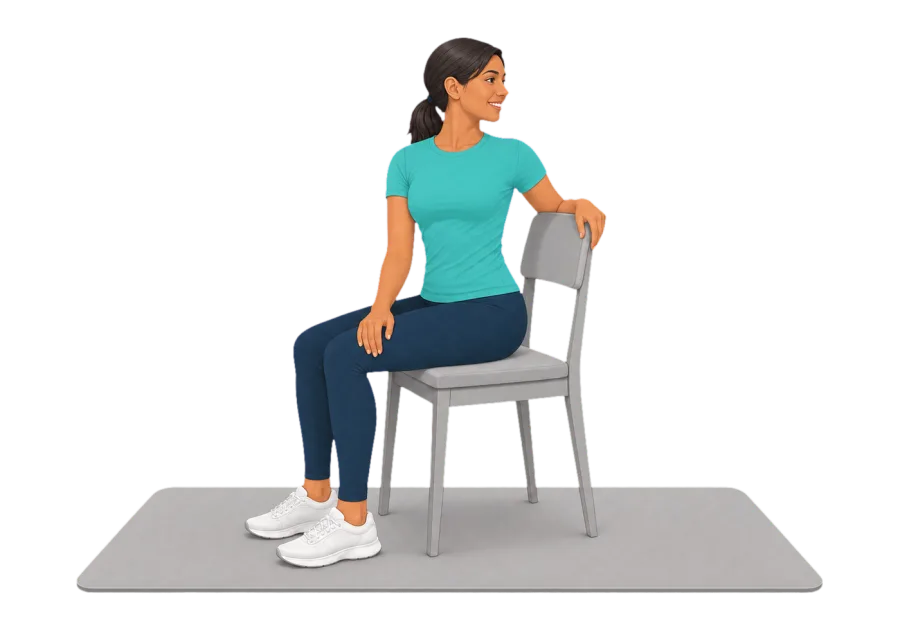
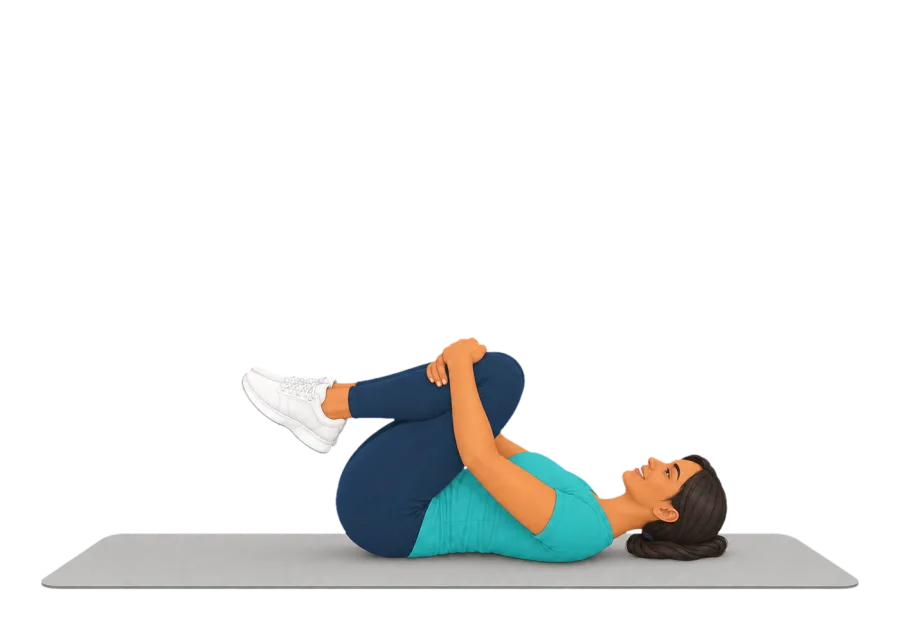
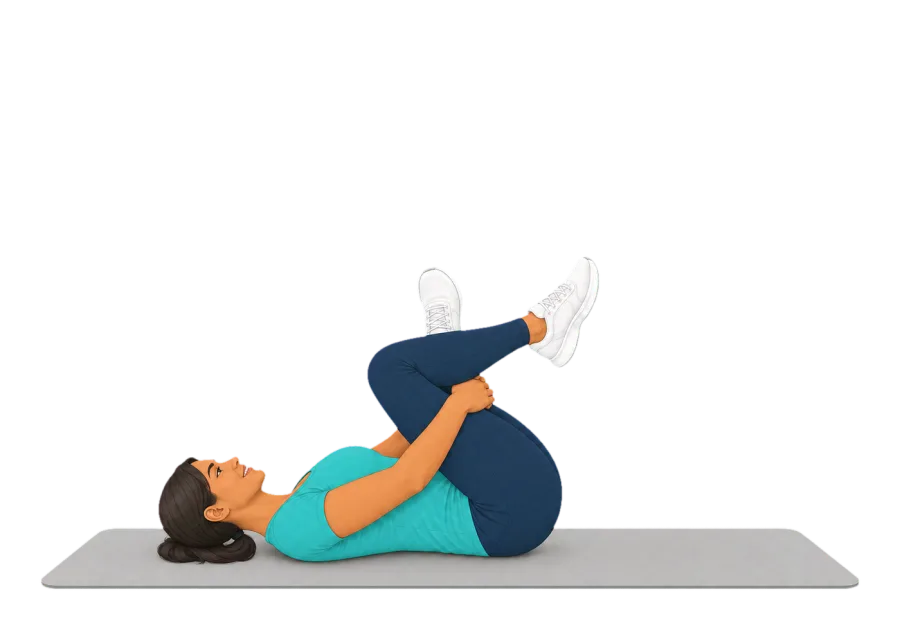
The seated twist in the same family brings the turn upright, and Figure Four on the back takes the outer hip stretch without the rotation. Knee Hugs, often done just before or after, take the spine in the other direction.
Routines With This Move
- After the Shift
- End of the Working Day
- Fifteen Minute Reset
- Five Minute Reset
- Hip Opener
- Lights Out
- Long Shift Recovery
- Long Wind Down
- Low Back Ease
- Low Back Long Ease
- Low Back Quick Ease
- Ten Minute Reset
- Wind Down
See Also
Sources
- Supine knees side to side (Lower trunk rotation AROM, arms out to side, supine feet standing) (opens in a new tab). Physitrack.
- Abdominal external oblique muscle (opens in a new tab). Wikipedia.
- Thoracolumbar fascia (opens in a new tab). Wikipedia.
- Jathara Parivartanasana (opens in a new tab). Wikipedia.
- Matsyendrasana (opens in a new tab). Wikipedia.
Further Reading
- Back pain (opens in a new tab). NHS.
- Video exercises for back pain (opens in a new tab). Chartered Society of Physiotherapy.
General information about this move, not medical advice. Stop if something hurts, and read our Safety page before you start. If you have a health condition, ask your doctor or physiotherapist first.