What It Is For
The Dead Bug trains the abdominal muscles to hold the trunk steady while the arms and legs move. The person lies on their back with arms pointing up and hips and knees bent to about 90 degrees, then slowly lowers one arm and the opposite leg and returns them. Fitness bodies class it as a core stability exercise suitable for most levels, with the trunk resisting the tendency of the limbs to arch the lower back.[1]
It differs from a sit-up or crunch in that the spine is meant to stay still. The challenge comes from the moving weight of the limbs, not from curling the trunk.[2] Trainers use it to teach people to breathe normally and move the hips and shoulders without the back joining in, and the American Council on Exercise describes it as a lying counterpart of the Bird Dog, asking for stability at the trunk with mobility at the hips and shoulders.[3]
Because the floor supports the whole spine and the speed is the person's own, it is often taught early in a programme, including to people returning to exercise. Physiotherapists often include it in programmes for people with low back pain.
How to Do It
A controlled strength move for your middle. Lie on your back with your arms up and your knees bent above your hips, then slowly lower the opposite arm and leg, keeping your back gently heavy on the floor, and swap. You should feel your stomach muscles working to keep your body still as your limbs move.
- Arms and knees up
- Back stays gently heavy
- Move slowly
How It Got Its Name
The name is a visual joke: a person on their back with limbs in the air looks like an insect that has flipped over. The first person to use it is not recorded. The earliest research use found for this article is a 2001 American paper that calls the exercise the Dying Bug, so both forms have been in circulation.[4] Dead Bug is the form that has lasted, and it is the one used in later studies.[7][2]
History
No inventor is recorded, and the exercise cannot be traced to a founding text. Popular claims that it comes from a particular school of rehabilitation could not be supported by any reliable source. It appears to have grown out of the spine stabilisation exercises used by physical therapists, but that is an inference from where it first shows up in the literature, not a documented history.
By 2001 it was established enough for a University of Southern California team to test it, with levels of increasing difficulty, alongside a four-point exercise now known as the Bird Dog.[4] In 2009 Stuart McGill and Amy Karpowicz at the University of Waterloo included a dead bug in their study of stabilisation exercises, with a fast, ballistic version aimed at athletic training.[5]
Pilates writers have also taken it up. A 2017 Brazilian study groups the dead bug with the single leg stretch and criss-cross as Pilates mat exercises.[8] Whether it belongs to Joseph Pilates' original repertoire was not verified for this article, and it is safer to regard it as an exercise now shared by several traditions. An American Council on Exercise piece from 2014 shows how far the form can vary: its Pilates version lifts the head and shoulders and lowers only one foot at a time.[9]
Muscles and Tendons
The Dead Bug is mainly a working move, not a stretch. Each time a leg lowers, its weight tilts the pelvis forward and pulls the lower back towards an arch. The rectus abdominis and the obliques work to resist this.[1][4] Using opposite limbs adds a twisting load, and the two sides of the trunk share the work unevenly: in one laboratory study the internal oblique on one side was more active in the held position and the other side more active in a fast burst.[5]
The transversus abdominis is the deep layer of the abdominal wall, arising in part from the thoracolumbar fascia, and it is often named as a target.[6][1] The hip flexors do steady work, holding the legs up and paying out slowly on each lowering. The stretch element is slight: the latissimus dorsi and the hip flexors lengthen a little at the end of each reach.
Stretched
- Latissimus dorsi
- Mild lengthening as the arm lowers overhead
- Hip flexors
- Mild lengthening on the side of the lowering leg
Working
- Rectus abdominis
- Resists the pull of the limbs that would arch the lower back
- External and internal obliques
- Resist extension and the twist created by opposite limbs moving
- Transversus abdominis
- Deep abdominal wall; commonly cued, measured less often
- Iliopsoas
- Holds the legs up and controls each lowering
- Shoulder flexors
- Control the weight of the arm
Tendons and Fascia
- Thoracolumbar fascia
- Transversus abdominis arises partly from it
- Linea alba
- Midline band where the abdominal aponeuroses meet
What Research Has Looked At
Most studies use electromyography, which records muscle activity as a percentage of a maximal effort. In the 2001 study of 12 healthy people, the rectus abdominis and obliques were equally active and rose in step with difficulty, but no muscle went above 41 per cent of maximum. The authors judged that likely to be too low for a strengthening effect in healthy people.[4]
McGill and Karpowicz, working with eight healthy men, recorded about 5 to 8 per cent of maximum in the rectus abdominis and obliques during a normal dead bug hold, and much higher peaks, up to 53 per cent, in the fast version.[5] A 2017 Korean study of 30 healthy students found abdominal activity rose with speed, and when arms and legs moved together rather than alone.[2] A Brazilian study compared healthy beginners with people with chronic low back pain and found the dead bug activated the obliques more than the multifidus and rectus abdominis.[8] All of these describe muscle activity in small groups, and none shows what the exercise does over time.
Where It Is Used Today
The exercise is a standard entry in personal trainer resources. The National Academy of Sports Medicine includes it in its exercise library, and the American Council on Exercise uses it as a checkpoint: the client is regressed until the spine stays in position without abdominal bracing and breathing stays normal.[1][3]
It is also common in physiotherapy clinics, Pilates studios and athletic warm-ups. Coaching cues differ. Some ask for the lower back to be pressed into the floor, others for a neutral spine with gentle contact, and the same page may mention both.[1][9] In McGill's protocol participants lay with one hand under the lower back.[5]
Variations and Related Moves
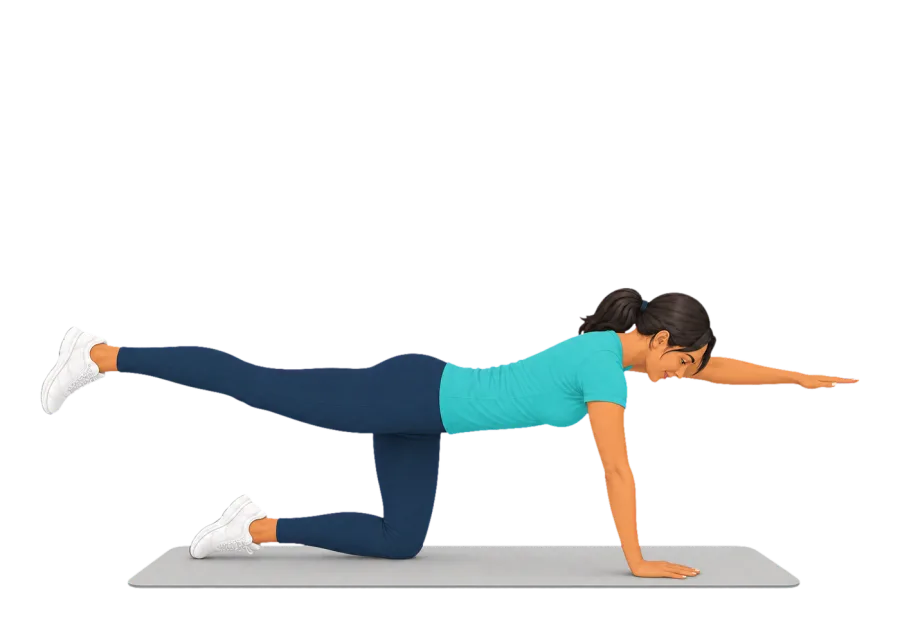
The simplest form moves the legs alone, or one foot at a time from a tabletop position.[9] Moving arms and legs together raises the demand, and slowing the lowering makes each repetition last longer.[2] McGill's fast version stiffens the trunk against a sudden limb movement.[5]
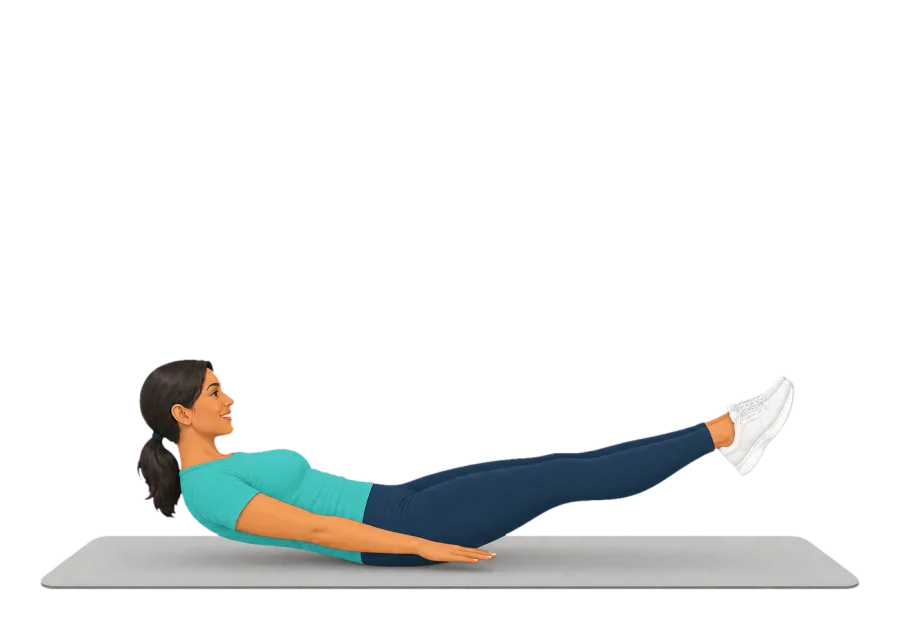
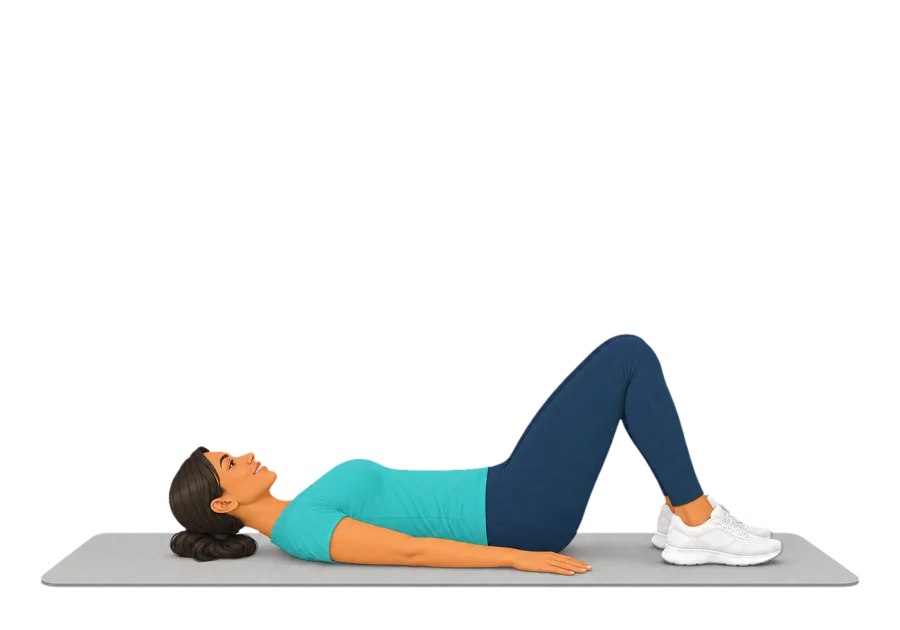
The Bird Dog is the closest relative, the same opposite limb pattern on hands and knees.[3] The Hollow Hold keeps the arms and legs still at a low angle, and Pelvic Tilt practises the lower back control the Dead Bug relies on.
See Also
Sources
- Dead Bug (opens in a new tab). National Academy of Sports Medicine.
- Changes in muscle activity of the abdominal muscles according to exercise method and speed during dead bug exercise (opens in a new tab). Physical Therapy Rehabilitation Science, 2017.
- Spinal Stability: To Brace or Not to Brace? (opens in a new tab). American Council on Exercise, 2018.
- Electromyographic activity of selected trunk muscles during dynamic spine stabilization exercises (opens in a new tab). Archives of Physical Medicine and Rehabilitation, 2001.
- Exercises for Spine Stabilization: Motion/Motor Patterns, Stability Progressions, and Clinical Technique (full text) (opens in a new tab). Archives of Physical Medicine and Rehabilitation, author's copy at BackFitPro, 2009.
- Transverse abdominal muscle (opens in a new tab). Wikipedia.
- Exercises for spine stabilization: motion/motor patterns, stability progressions, and clinical technique (opens in a new tab). Archives of Physical Medicine and Rehabilitation, 2009.
- Trunk Muscle EMG During Intermediate Pilates Mat Exercises in Beginner Healthy and Chronic Low Back Pain Individuals (opens in a new tab). Journal of Manipulative and Physiological Therapeutics, 2017.
- 10 Pilates Moves to Alleviate Back Pain (opens in a new tab). American Council on Exercise, 2014.
Further Reading
- Three moves for better spine health (opens in a new tab). Harvard Health Publishing.
- Erector spinae muscles (opens in a new tab). Wikipedia.
General information about this move, not medical advice. Stop if something hurts, and read our Safety page before you start. If you have a health condition, ask your doctor or physiotherapist first.