What It Is For
The Hollow Hold teaches a whole-body shape. Lying on the back, the trainee tilts the pelvis backward so that the lower back stays on the floor, then lifts the shoulders and legs to make a shallow curve. Coaches describe the shape as a way of making the body move as one unit, with the front of the trunk shortened and the lower back flattened.[1][2]
In gymnastics the same shape carries over to other positions. Coaching writers regard it, with its opposite, the arch, as a foundation for tumbling, kipping pull-ups, muscle-ups and handstands.[3][4] Holding it on the floor is the simplest way to practise it. It is also used as a general trunk strength exercise. A lower back that lifts from the floor shows that the load has outgrown the position, and the answer is to come down a little.
How to Do It
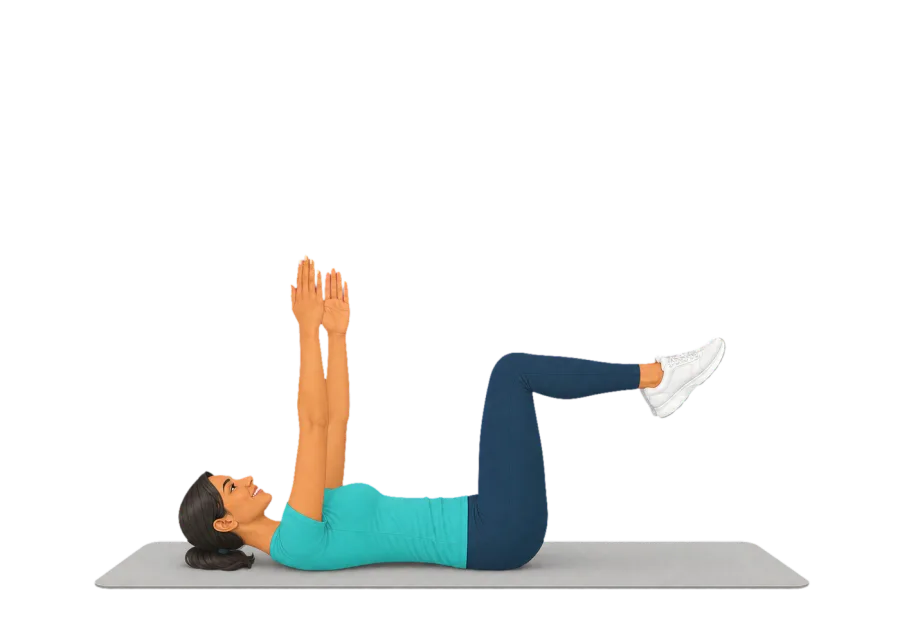
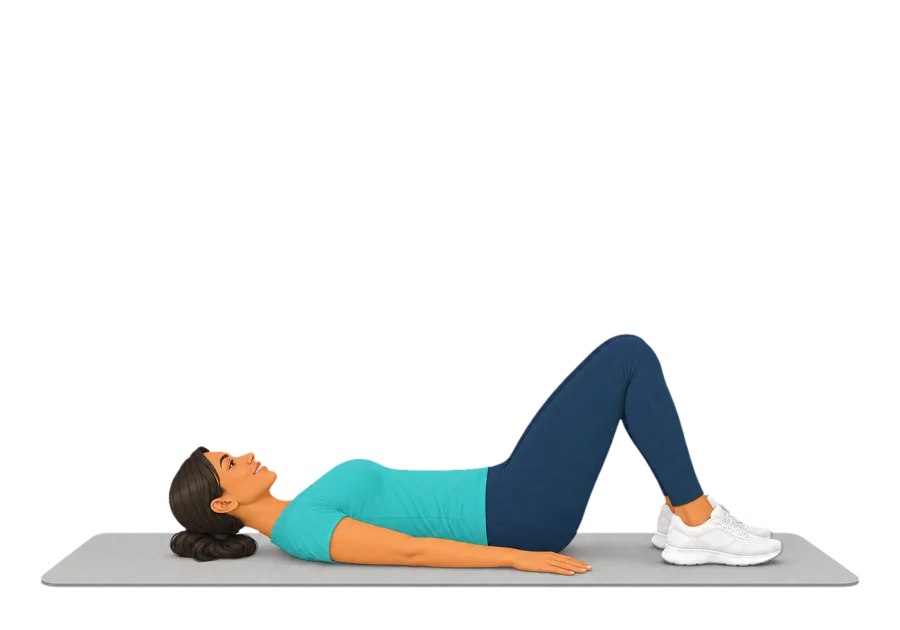
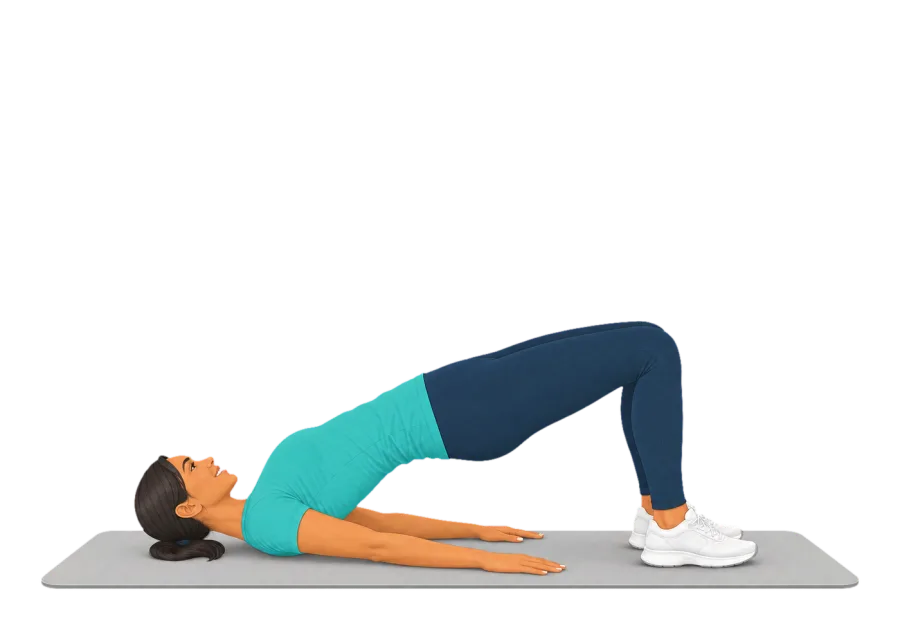
A gymnast's hold for the stomach muscles. Lie on your back, keep your lower back gently heavy on the floor, then lift your shoulders and legs, with your arms long. Bend your knees to make it easier. You should feel your whole front working. If your lower back lifts away, come down a little.
- Lower back gently heavy
- Lift shoulders and legs
- Arms long
How It Got Its Name
The name describes the shape: the front of the body is scooped inward. The word comes from gymnastics coaching and is paired with arch, the opposite extended shape.[3] No first use has been documented. The term should not be confused with abdominal hollowing, a separate technique in spinal exercise research that aims to recruit the deep transversus abdominis and internal oblique muscles.[9]
History
No inventor or first description of the Hollow Hold has been found. Coaching sources agree that it comes from gymnastics, but none gives a date or a name, and no governing-body or historical source could be verified for this article. Its exact age in gymnastics is therefore unknown.
What can be said is how it reached a wider audience. CrossFit, which publishes the hollow rock as a gymnastics conditioning exercise, and the calisthenics movement both teach it, and writing from these communities accounts for most of the English material on the move.[10][1][2] Its appearance as a named exercise in general fitness magazines is recent: Experience Life described it in 2019 as a beginner-friendly gymnastics and Pilates skill.[8] The Pilates connection is noted in that source, but its history is not documented there.
Muscles and Tendons
This is a strength hold, and nothing is meaningfully stretched. Rectus abdominis, which runs from the pubic crest to the xiphoid process and the costal cartilages of the fifth to seventh ribs, flexes the lumbar spine and is the main source of the curve.[5] It sits in the rectus sheath, formed by the aponeuroses of the lateral abdominal muscles, and the two sides are divided by the linea alba.[5]
The legs add a separate demand. The iliopsoas, the prime mover of hip flexion, and rectus femoris lift and hold the legs.[6][7] The psoas part attaches to the lumbar vertebrae, so it pulls the lower back toward an arch when the legs are long and low, and the abdominals must resist that pull.[6] This is why low straight legs are harder, and why the lower back lifting away is the usual sign of fatigue. Experience Life lists the abdominals, diaphragm, hip flexors and quadriceps as the muscles trained.[8]
Working
- Rectus abdominis
- Flexes the lumbar spine and draws pelvis and ribs together
- Obliques
- Support the abdominal wall and pelvic position
- Iliopsoas and rectus femoris
- Hold the legs off the floor
- Quadriceps
- Keep the knees straight in the full version
- Diaphragm
- Works against a braced abdomen, so breathing takes effort
Tendons and Fascia
- Rectus sheath
- Formed by the aponeuroses of the lateral abdominal muscles, it encloses the rectus abdominis
- Linea alba
- Midline fibrous band between the two sides of the rectus abdominis
Where It Is Used Today
Gymnastics training is the main home of the shape, with hollow holds and rocks as conditioning. CrossFit coaches use it to prepare for kipping and for handstand work, and they test it with holds and rocking drills.[4][10] Calisthenics athletes relate it to advanced skills such as the front lever and planche, both of which use a flat lower back and a tilted pelvis.[2]
It is also widely used in general trunk conditioning. One coaching article warns that it is often performed badly, with the feet too high or the lower back arched, and advises working up to it through simpler drills such as dead bug holds.[4]
Variations and Related Moves
Bending the knees is easier, since a shorter lever reduces the load on the trunk. Taking the arms overhead is harder.[8] The hollow rock adds a rocking motion from the same position, and a flat spot in the rock is said to mean a loss of lower abdominal control.[10] Dead Bug is the usual preparation, working from a similar lower back position with one limb moving at a time.[4] The arch hold, face down, is the opposite shape.[3]
See Also
Sources
- The Hollow Body Position: Why It’s So Important for Fitness Athletes (opens in a new tab). BarBend.
- What is the Hollow Body Position and Why is it Important? (opens in a new tab). Antranik Kizirian.
- The Importance of Mastering the Arch and Hollow for Your Core (opens in a new tab). Breaking Muscle, 2021.
- The Hollow Body: The Most Important Skill to Master (opens in a new tab). Breaking Muscle.
- Rectus abdominis muscle (opens in a new tab). Wikipedia.
- Iliopsoas (opens in a new tab). Wikipedia.
- Quadriceps (opens in a new tab). Wikipedia.
- Break It Down: The Hollow-Body Hold (opens in a new tab). Experience Life, 2019.
- The use of lumbar spinal stabilization techniques during the performance of abdominal strengthening exercise variations (opens in a new tab). Journal of Sports Medicine and Physical Fitness, 2005.
- The Hollow Rock (opens in a new tab). CrossFit.
Further Reading
General information about this move, not medical advice. Stop if something hurts, and read our Safety page before you start. If you have a health condition, ask your doctor or physiotherapist first.