What It Is For
Seated Cat Cow takes the spine slowly through flexion and extension from a chair. The person sits towards the front of the seat, hands on knees and feet under the knees. On a breath in, the chest lifts and the back arches. On a breath out, the back rounds and the chin moves towards the chest. Yoga Journal gives chair versions of both poses in these terms.[1][2]
Its usual setting is the desk. People use it to move the back after a long period of stillness, and it fits official advice that screen users should have breaks that let them stretch and change posture.[3] It asks for no change of clothes, no floor space and no weight through the wrists or knees, which suits people who find the hands-and-knees version uncomfortable.
Yoga teachers also use it as a simple way to link movement with the breath. No claim is needed beyond that: it is a small, repeated spinal movement that most people can do.
How to Do It
Cat Cow for a chair, ideal at a desk. Sit tall near the front of your seat with your hands on your knees, then arch your back and lift your chest, and round it as you breathe out. Let your breath set the pace. You should feel your whole spine moving, from your tailbone to your neck.
- Hands on knees
- Move with your breath
- Keep it slow and easy
How It Got Its Name
The name is borrowed from the floor poses. Cat is Marjaryasana, from marjari for cat, also called Bidalasana. Cow is Bitilasana, from bitila for cow.[1][2][5] The rounded back recalls a stretching cat, and the sagging back a standing cow. Seated simply states the adaptation. No separate Sanskrit name for the chair version was found.
History
The parent poses are less ancient than is often assumed. A similar position appears in Niels Bukh's Danish gymnastics text Primary Gymnastics, from 1924, as a prone-kneeling position drawing on nineteenth-century Scandinavian gymnastics. The nineteenth-century Sritattvanidhi illustrates a different pose with a cat name, and the seventeenth-century Hatha Ratnavali lists a tiger pose without describing it.[5] None of these shows the Cat and Cow sequence as it is taught now, which should be treated as a modern practice with no secure date.
The chair version belongs to the spread of adapted yoga in the late twentieth century. Alice Christensen of the American Yoga Association published Easy Does It Yoga for Older People in 1979, using chairs and other props. In 1982 Lakshmi Voelker developed her Chair Yoga for a pupil in her thirties whose arthritis ruled out floor poses.[6] Accounts differ in detail: a 2005 Associated Press report describes Voelker-Binder teaching seniors in Palm Springs and links the work to a student with rheumatoid arthritis.[7] Chair teaching probably has several roots, and neither source says who first sat a class down for Cat and Cow.
The seated sequence has no recorded first teacher. It became a staple of office yoga, but when that happened could not be established.
Muscles and Tendons
The two halves work as a pair. In the arching phase the erector spinae shorten, extending the spine, while the abdominal wall lengthens. In the rounding phase the abdominals shorten and tilt the pelvis back, and the erector spinae lengthen. The erector spinae and rectus abdominis act as antagonists, and the movement simply passes between them.[4]
The erector spinae sit in three columns along the spine, covered by the thoracolumbar fascia in the lower and middle back.[4] Yoga Journal describes Cow as creating a stretch along the front of the body, and Cat as a pose that warms the spine, shoulders and hips.[1][2] In a chair the pelvis pivots on the sitting bones, and the load is small. The muscular effort is light and the stretch at each end is mild.
Stretched
- Erector spinae
- Lengthen along the back as the spine rounds
- Abdominal wall
- Lengthens as the chest lifts and the back arches
- Muscles at the front of the neck and chest
- Gentle opening as the breastbone lifts
Working
- Abdominals
- Shorten to round the spine and tilt the pelvis back on the out-breath
- Erector spinae
- Shorten to arch the spine and lift the chest on the in-breath
- Muscles around the shoulder blades
- Move them apart and together with the hands resting on the knees
Tendons and Fascia
- Thoracolumbar fascia
- Covers the erector spinae and glides as the spine rounds and arches
- Linea alba
- Midline band of the abdominal wall, tensioned as the spine arches
Where It Is Used Today
Seated Cat Cow is common in chair yoga classes for older adults and in community centres, where the Associated Press reported chair classes spreading twenty years ago.[7] It is also taught in workplaces, and Yoga Journal's standard pose pages include a chair option for anyone who wants one.[1]
Adapted yoga teacher training has grown too, including accessible yoga programmes for people with disabilities, of which chair work is one part.[6] In a desk routine it usually comes early, as a first small movement before twists or side bends.
Variations and Related Moves
A smaller range suits a stiff or sensitive back. Tall people can sit on a folded blanket and shorter people can rest their feet on blocks, so that the knees sit at about 90 degrees.[1][2] Adding shoulder rolls brings the upper back in further.
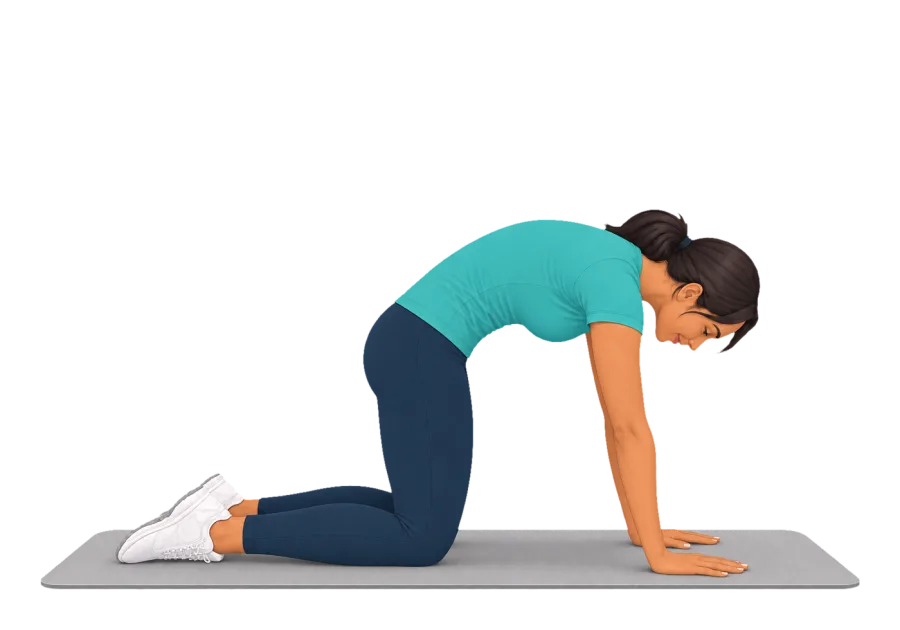
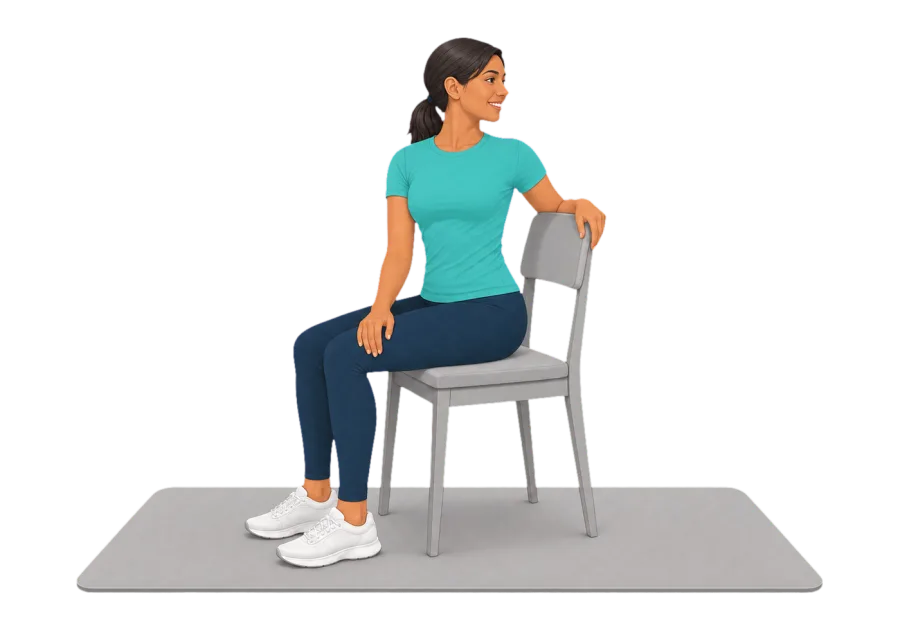
Cat Cow on hands and knees is the original, and takes more range. Seated Twist adds rotation, which this move lacks. Shoulder Rolls and Chin Tuck are other small desk moves often paired with it.
Routines With This Move
- Chair Break
- Desk Reset
- Neck Release
- Steady Five
- Steady and Strong
- Steady and Strong, Longer
See Also
Sources
- Cat Pose (opens in a new tab). Yoga Journal.
- Cow Pose (opens in a new tab). Yoga Journal.
- Working safely with display screen equipment: work routine and breaks (opens in a new tab). Health and Safety Executive.
- Erector spinae muscles (opens in a new tab). Wikipedia.
- Bidalasana (opens in a new tab). Wikipedia.
- Accessible yoga (opens in a new tab). Wikipedia.
- Chair yoga catching on among seniors (opens in a new tab). NBC News, from The Associated Press, 2005.
Further Reading
- Cow pose (opens in a new tab). Wikipedia.
- Three moves for better spine health (opens in a new tab). Harvard Health Publishing.
General information about this move, not medical advice. Stop if something hurts, and read our Safety page before you start. If you have a health condition, ask your doctor or physiotherapist first.