What It Is For
The drill works on ankle dorsiflexion, the movement that brings the shin forward over the foot. The person faces a wall with the toes about a hand-width away, then moves the knee towards the wall with the heel down, and returns. It is both a test and an exercise: if the knee reaches the wall, the foot can move further back.
Coaches care because dorsiflexion is part of squatting and lunging. A 2015 study of 101 adults found that dorsiflexion range was among the measures linked to squat depth, with bent-knee dorsiflexion and hip flexion range standing out in men, and straight-knee dorsiflexion and dorsiflexor strength in women.[1]
The feeling can give a clue about what is limiting movement. One clinical reference suggests that a pinching sensation at the front of the ankle points towards the talocrural joint, while a stretch behind the ankle points towards a short soleus.[2] This is a teaching guide and not a diagnosis.
How to Do It
A simple test and drill for ankle movement, useful for squats and lunges. Face a wall with your toes a hand-width away, then drive your knee forward over your toes towards the wall, keeping your heel down. You should feel the front of the ankle bending and a stretch in the calf. Move your foot back as it gets easier.
- Toes a hand-width from the wall
- Heel stays down
- Small and smooth
How It Got Its Name
The name describes the action: the knee goes to the wall, and the body rocks forwards and backwards. In clinical writing the same movement is called the weight-bearing lunge test, or the wall test.[2][5] The drill's name, used in coaching, has no recorded author. Some writers shorten it to knee-to-wall.
History
The documented history is that of a measurement. In 1998, Kim Bennell and colleagues published a reliability study of the weight-bearing lunge in the Australian Journal of Physiotherapy. They tested 13 volunteers, measuring both the distance from the great toe to the wall and the angle of the shin with an inclinometer, and found excellent agreement both within and between raters.[6]
That paper set out to test the reliability of the measure, and it should not be assumed to have invented it. The first use of the test has not been established.
Further evidence followed. A 2015 systematic review by Powden, Hoch and Hoch gathered 12 studies and concluded that the test can be used clinically whichever method is chosen.[5] When or by whom the repeated rocking drill was first taught is not documented. It shares the rules of the test: heel down and knee moving forward over the toes.
Muscles and Tendons
The position selects the soleus. The gastrocnemius starts on the femur, above the knee, while the soleus starts on the tibia and fibula. Both then join to form the Achilles tendon, which attaches to the back of the heel.[3][4] Bending the knee slackens the gastrocnemius, so with a bent knee the soleus and Achilles tendon carry more of the tension. That is the main difference between this drill and a straight-leg calf stretch.
Tension is not the only limit. The talus must glide within the ankle joint as the shin moves forward, so stiffness in the joint itself, or its capsule, can stop the knee before the calf does. This is why the app describes feeling the front of the ankle bending as well as a stretch in the calf.
The muscles of the front of the shin help draw the tibia forward, and the quadriceps control the knee. Small, smooth repetitions are enough. Keeping the heel down is the point of the exercise: once it lifts, the range appears to grow without the ankle moving further.
Stretched
- Soleus
- The main calf muscle lengthened here, since it stays under tension with the knee bent
- Gastrocnemius
- Lengthened less than in a straight-knee calf stretch, because it crosses the knee
Working
- Tibialis anterior
- Helps draw the shin forward over the foot
- Quadriceps
- Control the knee as it moves forward and back
- Foot muscles
- Keep the arch and the heel steady
Tendons and Fascia
- Achilles tendon
- Formed by the gastrocnemius and soleus, tensioned as the shin moves forward
What Research Has Looked At
Most research concerns the test. The Powden review reported intraclass correlation coefficients of 0.80 to 0.99 between clinicians and 0.65 to 0.99 within clinicians. It placed the minimal detectable change at about 4.6 to 4.7 degrees, or 1.6 to 1.9 cm, so small gains on a tape measure may be noise.[5]
Researchers have also compared it with movement. In a 2014 study of 40 active adults, Dill and colleagues found that those with more dorsiflexion on the weight-bearing lunge showed greater knee flexion and ankle displacement in squats, while a non-weight-bearing measure showed no such differences.[8] This suggests the standing test is the more relevant one, but it is a cross-sectional comparison and does not show what happens if range changes. In Hoch's study, people with less dorsiflexion landed in a more upright posture with greater ground reaction force.[7]
Evidence on changing dorsiflexion is modest. A 2006 systematic review by Radford and colleagues pooled five trials of static calf stretching and found gains of about 2 to 3 degrees, which it called small and of uncertain clinical importance.[9] That review covers static stretching, not this rocking drill, and no trial of the drill itself was found.
Where It Is Used Today
Physiotherapists and researchers use the test to assess the ankle. Hoch and colleagues used weight-bearing dorsiflexion in a 2015 study of 15 people with chronic ankle instability.[7] One clinical reference gives a cut-off of about 12 cm from toes to wall, while reporting no sensitivity or specificity figures for it.[2]
Its link with squat depth explains its appeal to people who train squats and lunges.[1] It needs only a wall, which suits warm-ups, offices and home use. A tape measure on the floor makes progress easy to record.
Variations and Related Moves
The basic progression is to move the foot further from the wall. The easier version uses a smaller range. A person tracking progress should repeat the same setup each time.
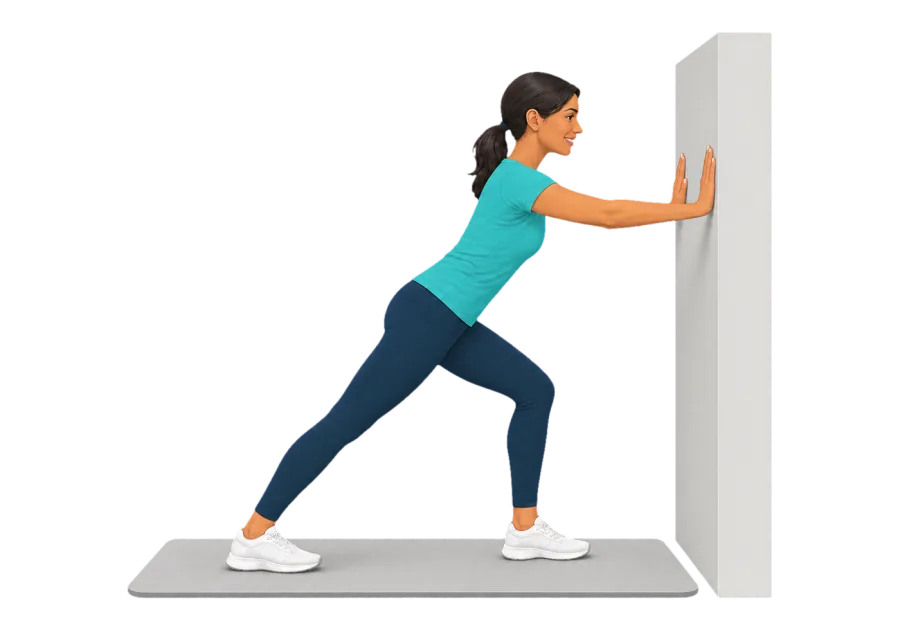
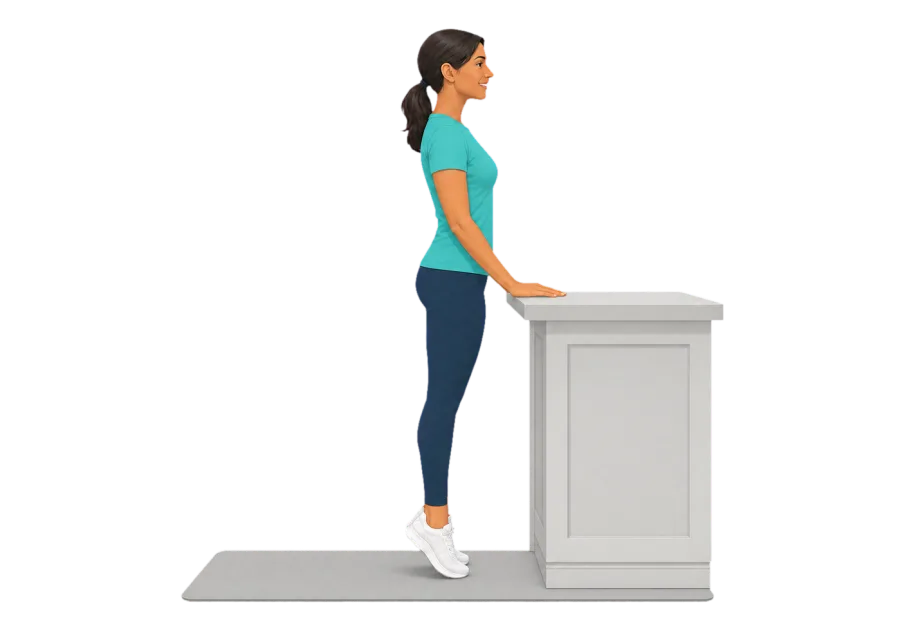
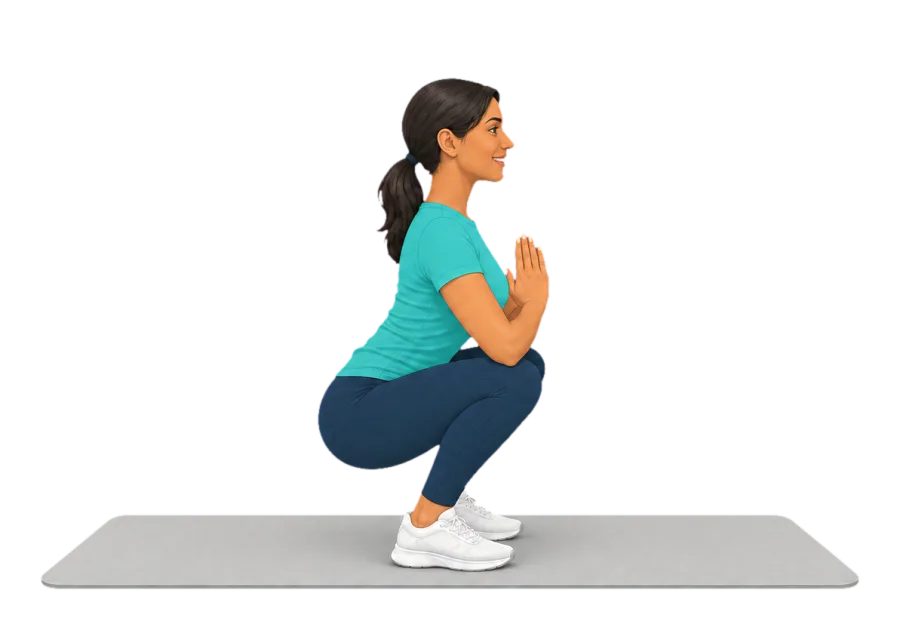
Related moves include the Wall Calf Stretch, which places more emphasis on the gastrocnemius, Heel Raises, which strengthen the calf through a similar joint range, and the Deep Squat Hold, where the same dorsiflexion is needed under full body weight.
Routines With This Move
- Before the Run
- Calves to Hamstrings
- Fresh Legs
- Lifter's Full Reset
- Long Shift Recovery
- Race Prep: Run, Sled and Lunge
- Squat Depth
- Whole Leg Reset
See Also
Sources
- Lower extremity strength and the range of motion in relation to squat depth (opens in a new tab). Journal of Human Kinetics, 2015.
- Weight Bearing Lunge Test (Wall Test) (opens in a new tab). Physiotutors.
- Gastrocnemius (opens in a new tab). Orthobullets.
- Soleus muscle (opens in a new tab). Wikipedia.
- Reliability and minimal detectable change of the weight-bearing lunge test: A systematic review (opens in a new tab). Manual Therapy, 2015.
- Intra-rater and inter-rater reliability of a weight-bearing lunge measure of ankle dorsiflexion (opens in a new tab). Australian Journal of Physiotherapy, 1998.
- Weight-Bearing Dorsiflexion Range of Motion and Landing Biomechanics in Individuals With Chronic Ankle Instability (opens in a new tab). Journal of Athletic Training, 2015.
- Altered knee and ankle kinematics during squatting in those with limited weight-bearing-lunge ankle-dorsiflexion range of motion (opens in a new tab). Journal of Athletic Training, 2014.
- Does stretching increase ankle dorsiflexion range of motion? A systematic review (opens in a new tab). British Journal of Sports Medicine, 2006.
Further Reading
- How Are Squat Timing and Kinematics in The Sagittal Plane Related to Squat Depth? (opens in a new tab). Journal of Sports Science and Medicine.
- Comparison of Lower Extremity Kinematics during the Overhead Deep Squat by Functional Movement Screen Score (opens in a new tab). Journal of Sports Science and Medicine.
General information about this move, not medical advice. Stop if something hurts, and read our Safety page before you start. If you have a health condition, ask your doctor or physiotherapist first.