What It Is For
The Wall Calf Stretch lengthens the muscles at the back of the lower leg by bending the ankle upwards, a movement called dorsiflexion. The hands rest on a wall, one leg steps back with the knee straight and the heel on the ground, and the person leans in until a stretch is felt. An NHS flexibility page gives the calf stretch among its four basic exercises and describes it as good for loosening tight calf muscles.[1]
Its value lies in simplicity. The wall takes some of the body's weight, so the intensity can be set precisely by stance length and lean, and the heel gives a clear limit. Clinical instructions tell the person to stop just before the heel lifts, keep the back foot pointing straight ahead and avoid bouncing.[2]
People use it after running or walking, before sport, and as part of foot and ankle programmes. A hospital foot and ankle service sets out a heavy schedule of straight-knee and bent-knee stretches, with five sessions of five sets per day.[2] It is also a simple general stretch for people who stand all day.
How to Do It
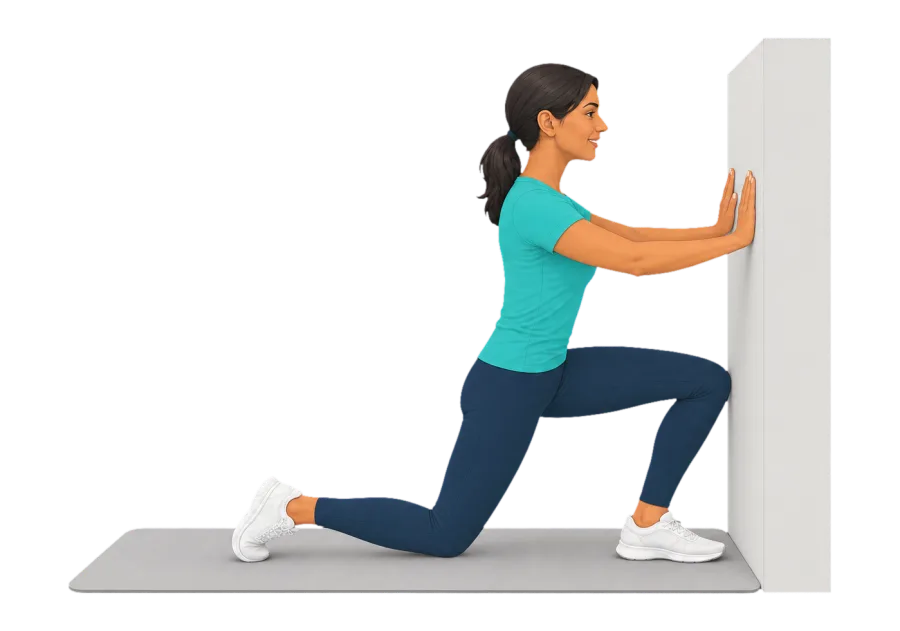
The classic calf stretch. Put your hands on a wall, step one leg back and keep it straight with your heel down, then lean in until you feel it. Bending the back knee moves the stretch lower, towards your Achilles. You should feel it in the back of your lower leg, not in the ankle joint.
- Hands on the wall
- Back leg straight, heel down
- Lean in until you feel it
How It Got Its Name
The name combines the place and the target. Calf is the everyday word for the back of the lower leg. The anatomical names are older and more vivid: gastrocnemius comes from Greek words for belly and leg, after the muscle's bulging shape,[4] and soleus comes from the Latin solea, sandal, probably for its flat shape.[5] Triceps surae means three-headed muscle of the calf.[3]
The Achilles tendon takes its name from Greek myth. The earliest known record of the name is by the Flemish anatomist Philip Verheyen in 1693, who noted that it was commonly called the cord of Achilles. An attribution to Hippocrates of an earlier name, the great tendon, is considered doubtful.[8] The everyday label runner's stretch is informal, and no first use was found.
History
No inventor is recorded, and a stretch this simple may never have had one. Leaning into a wall with a heel down is an obvious thing for a stiff walker or runner to do, though that is a reasonable inference and not a recorded fact. No first description was found in the sources reviewed.
The anatomical thinking behind it can be dated more closely than the exercise itself. The name of the tendon was in common use by the late 17th century.[8] The distinction between gastrocnemius and soleus through knee position is part of clinical examination, as in the Silfverskiöld test.[7] The date of that test could not be confirmed from the sources available here, so none is given.
Formal research came later. A 1998 paper in the Australian Journal of Physiotherapy showed that a weight-bearing lunge towards a wall, which uses a similar leg position, was a very reliable way of measuring ankle dorsiflexion, with intraclass correlations of 0.97 to 0.99.[9] By 2006 enough randomised trials existed for a systematic review of whether calf stretching changes dorsiflexion.[10]
Muscles and Tendons
The calf has two main muscles, known together as the triceps surae. The gastrocnemius is the superficial two-headed muscle, and it arises from the femur just above the knee. The soleus lies beneath it and arises below the knee from the tibia and fibula. Both join the Achilles tendon, which attaches to the heel bone.[3][4][5]
This anatomy explains the two versions of the stretch. Because the gastrocnemius crosses the knee as well as the ankle, a straight knee pulls it tight from both ends. Bending the knee slackens it and passes the stretch to the soleus, which does not cross the knee.[6][5] The difference matters clinically: examiners compare ankle dorsiflexion with the knee extended and flexed to judge gastrocnemius tightness, in what is known as the Silfverskiöld test.[7]
The Achilles tendon is placed under tension in both versions, but this is a mild load and not a true stretch of the tendon. The working muscles are few. The quadriceps are tightened to keep the back knee straight, as clinical instructions specify.[2] The feeling should be in the muscle or low in the calf and not in the front of the ankle joint, where a pinching sensation suggests a joint limit.
Stretched
- Gastrocnemius
- Two-headed superficial calf muscle, stretched with the back knee straight
- Soleus
- Flat muscle under the gastrocnemius, emphasised when the back knee bends
Working
- Quadriceps
- Tightened to keep the back knee straight
- Gluteals and abdominals
- Keep the body in a long line as it leans
- Arm and shoulder muscles
- Support the lean against the wall
Tendons and Fascia
- Achilles tendon
- Joins both calf muscles to the heel bone and is tensioned in the stretch
- Plantar fascia
- May be lightly tensioned under the foot as the ankle bends
What Research Has Looked At
The main question studied has been whether stretching increases ankle range. A 2006 systematic review pooled five randomised trials of static calf stretching against no stretching. Stretching produced small, statistically significant gains of 2 to 3 degrees of dorsiflexion, and the authors said that it was unclear whether the change was clinically important.[10]
A larger 2018 review of 20 studies in uninjured adults found that long-term static stretching increased dorsiflexion by about 5.2 degrees and PNF stretching by about 4.3 degrees. The effect of ballistic stretching was uncertain, as its confidence interval included zero.[11] The authors concluded that stretching with a static component improves ankle mobility in such people. These results concern calf stretching in general, and were not specific to the wall form.
Where It Is Used Today
The stretch is standard in British public advice and clinical practice. The NHS includes a calf stretch in its flexibility exercises,[1] and the Royal Orthopaedic Hospital in Birmingham gives step-by-step instructions for both forms, with 30-second holds.[2] Sports medicine sites describe a similar routine of 30-second holds repeated through the day.[6]
Runners commonly use it before and after training, and it is included in programmes for people on their feet at work. It requires only a wall, and can be done at the side of a track, in an office or in a kitchen.
Variations and Related Moves
A shorter stance is the easier version. Bending the back knee moves the stretch lower, towards the soleus and Achilles tendon, while keeping the heel down.[2][6] Clinical instructions recommend moving the hips further from the wall to do this.[2] Standing with the heel lowered off a step is a common alternative, using body weight in place of the lean.
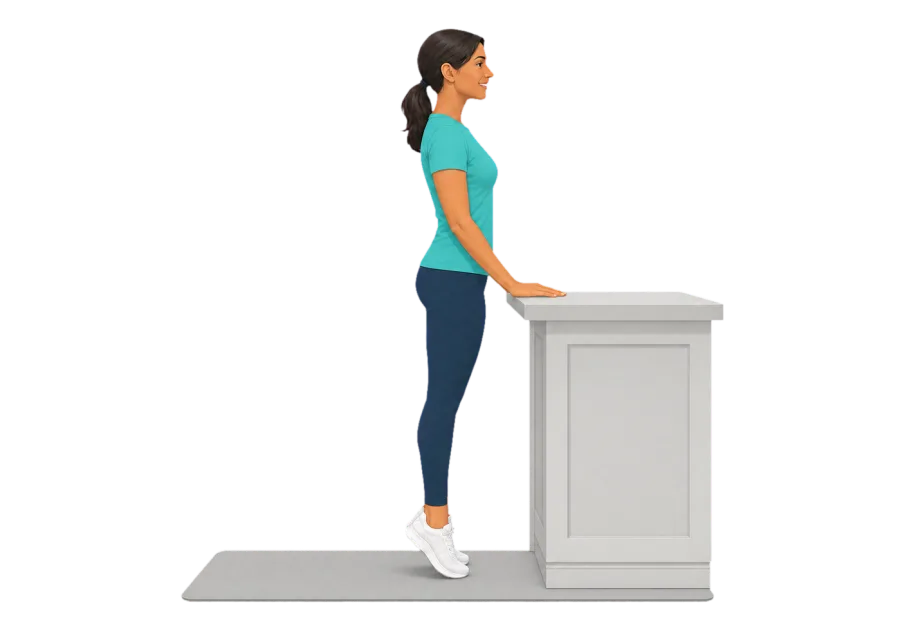
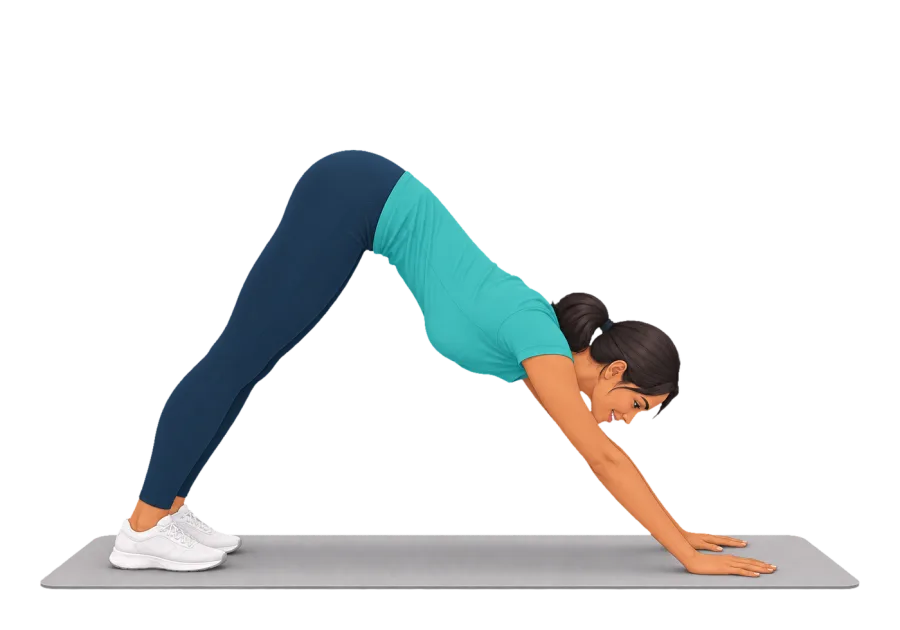
Ankle Rocks are a moving version that takes the same joint through dorsiflexion. The Downward Dog stretches the calves and hamstrings together, and Heel Raises work the same muscles through contraction.
Routines With This Move
- After the Shift
- Calves to Hamstrings
- Fresh Legs
- Long Shift Recovery
- On Your Feet
- Race Prep: Run, Sled and Lunge
- Runner's Legs
- Steady and Strong
- Whole Leg Reset
See Also
Sources
- Flexibility exercises (opens in a new tab). NHS.
- Calf stretching (opens in a new tab). Royal Orthopaedic Hospital NHS Foundation Trust.
- Triceps surae muscle (opens in a new tab). Wikipedia.
- Gastrocnemius muscle (opens in a new tab). Wikipedia.
- Soleus muscle (opens in a new tab). Wikipedia.
- Calf Stretch (opens in a new tab). Sports Injury Clinic.
- Reliability of a new computerized equinometer based on Silfverskiöld test to measure gastrocnemius tightness (opens in a new tab). PLOS ONE, 2023.
- Achilles tendon (opens in a new tab). Wikipedia.
- Intra-rater and inter-rater reliability of a weight-bearing lunge measure of ankle dorsiflexion (opens in a new tab). Australian Journal of Physiotherapy, 1998.
- Does stretching increase ankle dorsiflexion range of motion? A systematic review (opens in a new tab). British Journal of Sports Medicine, 2006.
- Chronic effect of different types of stretching on ankle dorsiflexion range of motion: Systematic review and meta-analysis (opens in a new tab). The Foot, 2018.
Further Reading
- Stretching (opens in a new tab). Wikipedia.
- Plantar fascia (opens in a new tab). Wikipedia.
General information about this move, not medical advice. Stop if something hurts, and read our Safety page before you start. If you have a health condition, ask your doctor or physiotherapist first.