What It Is For
Downward Dog is a loaded stretch. The hands and feet stay on the floor and the hips rise, so the body makes an inverted V. Yoga Journal's anatomy notes place the main stretch in the hamstrings and calves, with the arms working to hold the shape.[1] The American Council on Exercise describes it as a stretch for the spine, hips and hamstrings, and suggests bending the knees when the hamstrings are tight.[2]
The pose also has a practical role in a sequence. In the sun salutation it appears as a stopping point between the plank and lunge positions, and it is held for a few breaths in many flowing classes.[3] A form that starts from hands and knees, with the heels reaching down but not needing to touch, suits people whose calves or hamstrings limit the full shape. The aim is length through the back of the body and a spacious feeling across the shoulders, not flat heels.
How to Do It
A whole-body stretch that makes an upside-down V. From hands and knees, tuck your toes and lift your hips up and back, letting your heels reach towards the floor without needing to touch it. You should feel a long stretch through the backs of your legs and calves, and space across your shoulders.
- Press the floor away
- Lift your hips up and back
- Bend your knees as much as you need
Spread your fingers and keep weight even. Use fists or forearms if your wrists complain.
This move puts your head below your heart. Skip it if you have high blood pressure or glaucoma, or come up slowly.
How It Got Its Name
The Sanskrit name Adho Mukha Svanasana joins words for down, face, dog and posture.[3] The usual explanation is that the shape resembles a dog stretching as it gets up, with its front legs reaching forward and its hips high.[3] English speakers usually shorten this to Downward Dog. In some sun salutation sequences, the same inverted V is called Parvatasana, or mountain pose.[8]
History
The name does not occur in the medieval hatha yoga texts. The nearest early relative usually cited is Gajasana, or elephant pose, in the 18th-century Hathabhyasapaddhati, which was repeated many times from lying face down. A 19th-century Mysore Palace manuscript, the Sritattvanidhi, has a drawing of Gajasana.[3] A likeness of shape does not prove direct descent, and the link should be read as a possibility, not a settled lineage.
Similar shapes also appear outside yoga. The Danish educator Niels Bukh published his system in 1924, and his Primary Gymnastics describes a comparable position.[3][9] Indian dand exercises, used by wrestlers, include a similar movement.[3] The scholar Mark Singleton has argued that Bukh's exercises reached India through the YMCA and influenced Tirumalai Krishnamacharya's teaching, and that at least 28 of Bukh's exercises closely match postures in modern yoga.[9][10] His case has been praised and challenged: one critic, for example, said that it depends too heavily on a small number of sources.[11] The direction of influence for this specific pose is not documented.
The sun salutation gave the pose its modern place. Bhawanrao Pant Pratinidhi, the Rajah of Aundh, popularised and named the sequence in a 1928 book, while saying that it was already a Marathi custom.[12] Krishnamacharya adopted it at the Mysore Palace, and his pupils K. Pattabhi Jois and B. K. S. Iyengar carried its transitions into their own styles.[12] Accounts also say that Swami Kuvalayananda used the pose in his exercises in the early 1930s.[3]
Iyengar's Light on Yoga, first published in English in 1966 and among the most influential yoga books ever issued, gave the pose a wide international audience.[13] It also listed benefits for the pose, and those claims have not been supported by evidence.[3]
Muscles and Tendons
Two groups of muscle lengthen. The true hamstrings arise from the sit bone and cross both hip and knee, so they are stretched when the hip is flexed and the knee is straight.[4] The calf group, the gastrocnemius and soleus, joins the heel through the Achilles tendon.[5] As the gastrocnemius attaches above the knee, bending the knees reduces its stretch and shifts more of the work to the soleus, which attaches below it. This is why a bent-knee version often lets the pelvis tip forward and the spine lengthen. The latissimus dorsi, which arises in part from the thoracolumbar fascia, is also drawn long when the arms are overhead.[6]
Other muscles work to hold the position rather than being stretched. The triceps straighten the elbows, the forearms spread load through the hands, and the quadriceps contract to straighten the knees.[1] The serratus anterior draws the shoulder blades forward around the ribs and assists their upward rotation, an action that fits the overhead arm position.[7] Yoga Journal's notes also credit the erector spinae, quadratus lumborum and psoas with shaping the lower back and hips.[1]
Stretched
- Hamstrings
- Lengthen from the sit bones as the hips lift, most with the knees straighter
- Gastrocnemius
- Two-headed calf muscle, lengthened as the heels reach down with a straight knee
- Soleus
- Lower calf muscle, which stays under stretch when the knees bend
- Latissimus dorsi
- Lengthens along the side of the trunk with the arms reaching overhead
Working
- Serratus anterior
- Holds the shoulder blades forward around the ribs and helps rotate them upwards
- Triceps
- Keep the elbows straight
- Deltoids
- Support the raised arm position
- Forearm muscles
- Spread load through the hands and fingers
- Quadriceps
- Straighten the knees when the legs are long
- External obliques
- Measured as active in one electromyography study
Tendons and Fascia
- Achilles tendon
- Carries the calf stretch to the heel bone
- Thoracolumbar fascia
- Broad sheet at the lower back that includes the latissimus dorsi attachment
What Research Has Looked At
Studies have described the pose rather than tested it as an intervention. A 2012 force-platform study recorded 20 participants performing 28 hatha postures, including Downward Dog. It found low-impact forces across the sequence, with peak force through the arms as the hips lifted, and it called for more work before drawing any conclusions about bone.[14]
A 2014 electromyography study of 30 practitioners measured five trunk and hip muscles across eleven poses, and its authors named Downward Dog with the plank positions as poses that worked the external oblique.[15] A second study from the same group, with 36 practitioners, recorded 14 muscles in the sun salutation and found that muscle use varied by pose and, for five muscles, by skill level.[16] A 2019 motion capture study of ten experienced practitioners recorded joint angles through the whole sun salutation, including this shape. It is a small descriptive sample.[8]
Where It Is Used Today
Downward Dog is a staple of Ashtanga and Iyengar yoga, and of the many flowing styles descended from them.[12] Because it appears twice in the common twelve-posture sun salutation, regular students may meet it many times in a single class.[3]
Outside the yoga studio, fitness professionals use it as a combined stretch for the back of the body. An American Council on Exercise article for trainers lists it among ten poses for clients with low back complaints, held for around five breaths.[2] It is also found in general warm-ups and cool-downs, including those for runners, because it reaches the calves and hamstrings together. Wrist position and head-down posture make it less suitable for some people, which is why many teachers offer a chair or wall version.
Variations and Related Moves
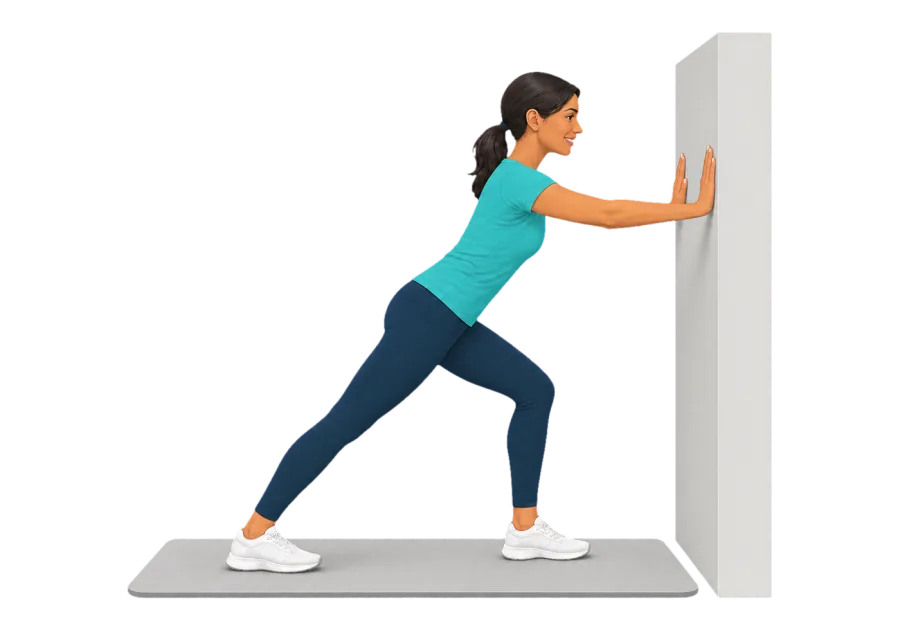
The usual gentler forms bend the knees or use a wall. Yoga Journal lists a bent-knee version, a version with the hands against a wall, and one with the heels against a wall.[1] Placing the hands on a chair seat raises the upper body and reduces the load on the wrists and the head-down position. Pedalling the heels, one at a time, adds a moving calf stretch.
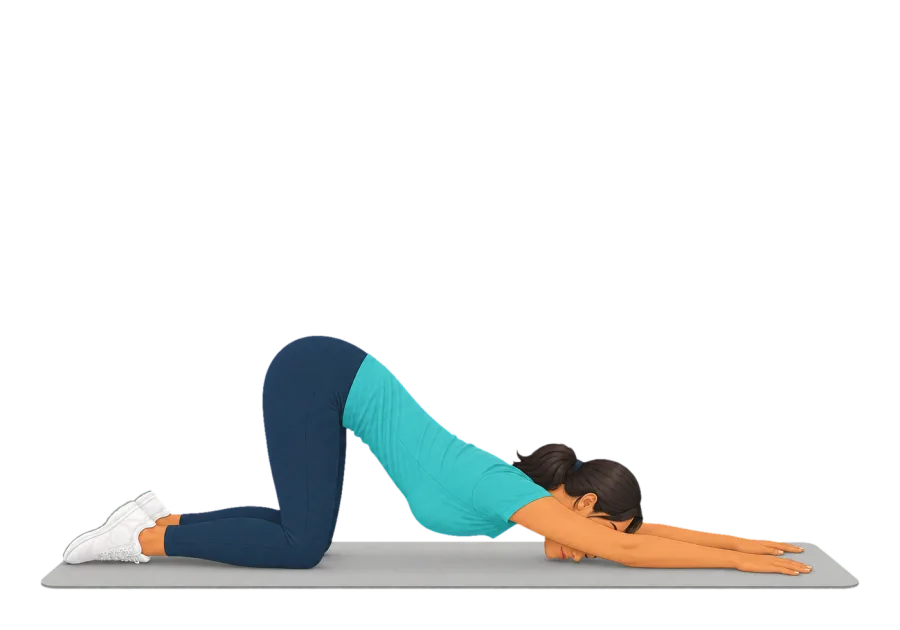
Related shapes include Uttana Shishosana, or Extended Puppy Pose, which sits between this pose and Child's Pose.[17] Upward Dog is its usual partner in a flowing sequence, and a standing calf stretch at a wall reaches much of the same tissue with no load on the arms.
Routines With This Move
- Fifteen Minute Reset
- Five Minute Reset
- Morning Wake Up
- Quick Wake Up
- Slow Morning
- Ten Minute Reset
See Also
Sources
- Downward-Facing Dog: How to Practice Adho Mukha Svanasana (opens in a new tab). Yoga Journal.
- 10 Yoga Poses to Alleviate Low Back Pain (opens in a new tab). American Council on Exercise, 2017.
- Downward Dog Pose (opens in a new tab). Wikipedia.
- Hamstring (opens in a new tab). Wikipedia.
- Triceps surae muscle (opens in a new tab). Wikipedia.
- Latissimus dorsi muscle (opens in a new tab). Wikipedia.
- Serratus anterior muscle (opens in a new tab). Wikipedia.
- Kinematics of Suryanamaskar Using Three-Dimensional Motion Capture (opens in a new tab). International Journal of Yoga, 2019.
- Niels Bukh (opens in a new tab). Wikipedia.
- The Yoga Body (opens in a new tab). Mere Orthodoxy, 2011.
- Yoga Body (opens in a new tab). Wikipedia.
- Surya Namaskar (opens in a new tab). Wikipedia.
- Light on Yoga (opens in a new tab). Wikipedia.
- Ground Reaction Forces Generated by Twenty-eight Hatha Yoga Postures (opens in a new tab). International Journal of Exercise Science, 2012.
- Core muscle function during specific yoga poses (opens in a new tab). Complementary Therapies in Medicine, 2014.
- Muscle utilization patterns vary by skill levels of the practitioners across specific yoga poses (asanas) (opens in a new tab). Complementary Therapies in Medicine, 2014.
- Balasana (opens in a new tab). Wikipedia.
Further Reading
- Tirumalai Krishnamacharya (opens in a new tab). Wikipedia.
- Yoga-Related Injuries in the United States From 2001 to 2014 (opens in a new tab). Orthopaedic Journal of Sports Medicine.
General information about this move, not medical advice. Stop if something hurts, and read our Safety page before you start. If you have a health condition, ask your doctor or physiotherapist first.