What It Is For
The fold is used to take the back of the body through a long, relaxed stretch. Yoga Journal describes Uttanasana as a stretch of the entire back body, from the soles of the feet up the legs and back.[1] The version described here adds generous knee bend, so the trunk can hang without strain, and the emphasis shifts from straight-leg flexibility to letting the head and arms hang.
It also works as a pause between standing tasks. A bend of the knees and a slow roll back up make it accessible on a work break. The slow return matters, since standing quickly from a head-down position can cause brief light-headedness.
Bending the knees is standard teaching rather than a concession. Yoga Journal advises it for anyone who feels strain in the hamstrings, lower back or neck.[1]
How to Do It
A simple standing stretch for the backs of the legs and the back. With your feet about hip width apart, bend your knees generously and fold from your hips, letting your head and arms hang. You should feel your hamstrings and lower back lengthen. Roll up slowly at the end, as you may feel light-headed if you rise quickly.
- Bend your knees generously
- Let your head hang
- Roll up slowly to finish
Round your back gently and only as far as is comfortable. Ease off if pain travels down a leg.
This move puts your head below your heart. Skip it if you have high blood pressure or glaucoma, or come up slowly.
How It Got Its Name
The name Uttanasana is usually broken into ut, meaning powerful, intense or deliberate, tan, to stretch or lengthen, and asana, posture, which explains the common gloss of intense stretch.[1][5] Forward fold is a general English description used by many teachers, and its first use is not documented.
The same Sanskrit name was once used for something else. The 19th-century Sritattvanidhi illustrates an Uttanasana in which the person lies on the back, elbows to knees and hands behind the neck, which has little in common with the standing pose.[5]
History
The modern standing pose appears to be a 20th-century form. Reference summaries give Krishnamacharya's Yoga Makaranda of 1934 as the first description, and the pose was then carried forward by his pupils, including Pattabhi Jois's Ashtanga yoga and B. K. S. Iyengar's Light on Yoga of 1966.[5]
Mark Singleton's work helps to explain the timing. Medieval hatha yoga used few standing poses and mainly seated ones, and much posture practice was developed in the 1920s and 1930s, in contact with gymnastics.[6] A related pose, spelled Padhahasthasana, appears in Theos Bernard's 1944 account of his hatha yoga training, which reference summaries take as a sign of a separate strand of practice.[5]
Nobody is recorded as the inventor of the simple standing bend. Bending forward to reach the floor is an ordinary human action, and no source claims a first use of it as a stretch.
Muscles and Tendons
Forward bending combines two movements: the pelvis tips forward over the thighs, and the lumbar spine rounds. The hamstrings connect the two, running from the ischial tuberosity to the lower leg and crossing both hip and knee.[2] With straight legs they limit how far the pelvis can tip. With bent knees they slacken, so the trunk can reach the thighs and the pelvis moves more freely. The trade-off is a lighter hamstring stretch, which grows if the knees are slowly straightened.
The gluteus maximus lengthens as the hip bends, and it is central to returning upright after stooping.[3] The back extensors lengthen as the spine rounds. Along with the hamstrings and gluteus maximus, the latissimus dorsi also tensions the thoracolumbar fascia, a sheet thought to help transfer load between trunk and limbs in lifting.[4]
Very little muscle work is needed in the hold. The quadriceps help to steady the bent knees, and the feet make small adjustments for balance. The work comes on the return, when the hip and back extensors bring the trunk up.
Stretched
- Hamstrings
- Back of the thigh, less so with bent knees, more as the knees straighten
- Gluteus maximus
- Buttock, as the hips bend
- Erector spinae
- Along the spine, as it rounds
- Gastrocnemius
- Upper calf, mildly, if the knees straighten
Working
- Quadriceps
- Hold the bent knees steady
- Muscles around the ankle and foot
- Keep the weight balanced over the feet
- Gluteals, hamstrings and back extensors
- Work together on the slow return to standing
Tendons and Fascia
- Thoracolumbar fascia
- Across the lower back, tensioned by the gluteus maximus and hamstrings
- Hamstring tendons
- Behind the knee and at the sitting bone
What Research Has Looked At
Research has focused on the forward bending action rather than on the yoga pose. A 2016 study of 12 men measured the effect of six weeks of dynamic hamstring stretching. Finger-to-floor distance and straight leg raise both improved, and the share of movement from the pelvis grew, a shift towards a more pelvis-led bend.[7]
A 2015 cross-sectional study of university students compared those with and without low back pain during forward bending. Hamstring tightness did not differ between the groups. Those with pain had less pelvic tilt and total trunk flexion but more lumbar movement. The design cannot show cause and effect.[8] Both studies were small.
Where It Is Used Today
The pose is a fixed element of many flowing yoga sequences, including those of Ashtanga yoga.[5] Outside yoga, a soft-kneed hang serves as a simple cool-down or standing break.
Yoga Journal lists lower back injury, hamstring tears, sciatica, glaucoma and detached retina as reasons for care or avoidance.[1]
Variations and Related Moves
Hands on a chair seat shorten the distance to the floor and take load from the back. Holding opposite elbows and swaying adds a little arm weight and a gentle side-to-side movement. Ardha Uttanasana is a halfway stage with the trunk horizontal, and Padahastasana places the hands under the feet with palms up.[5]
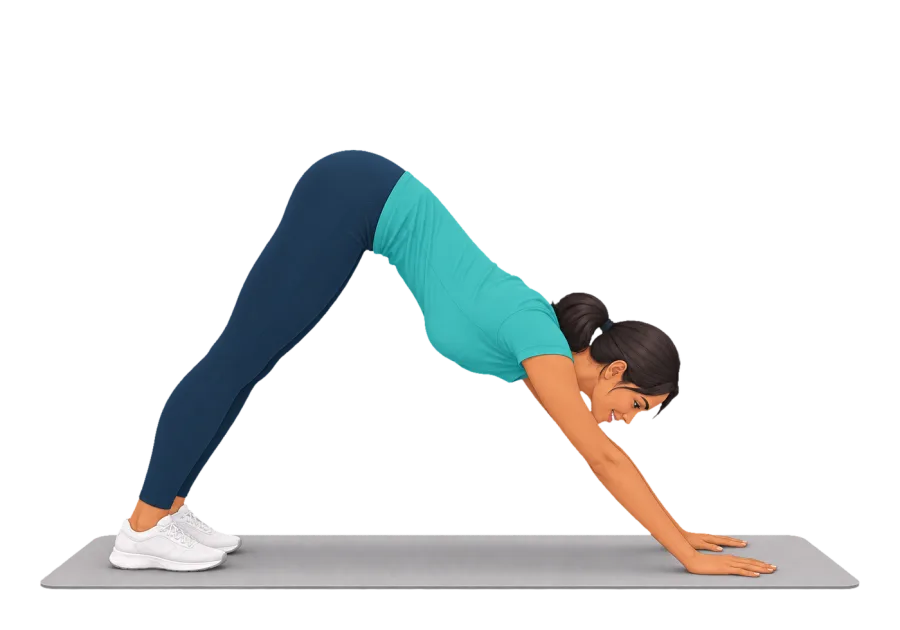
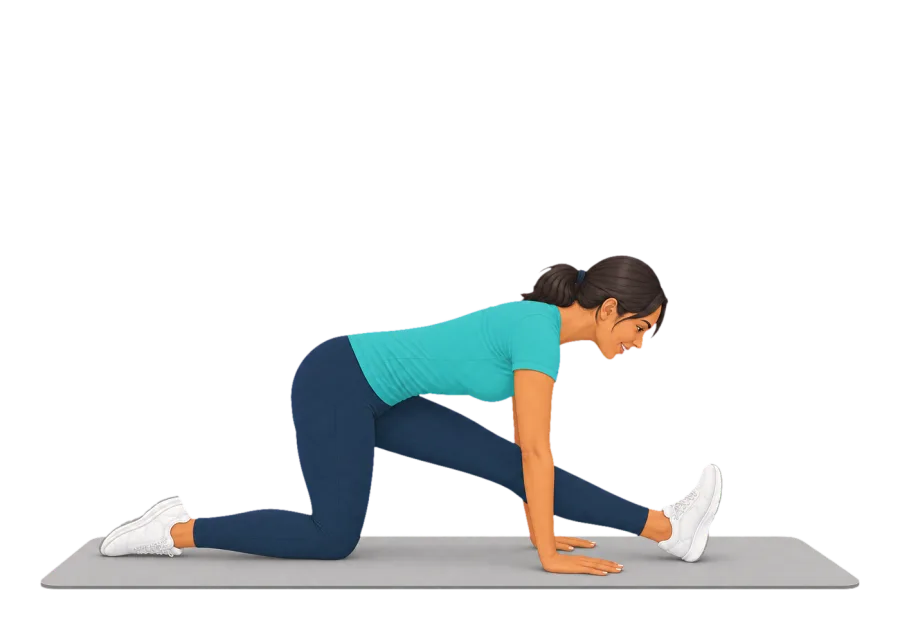
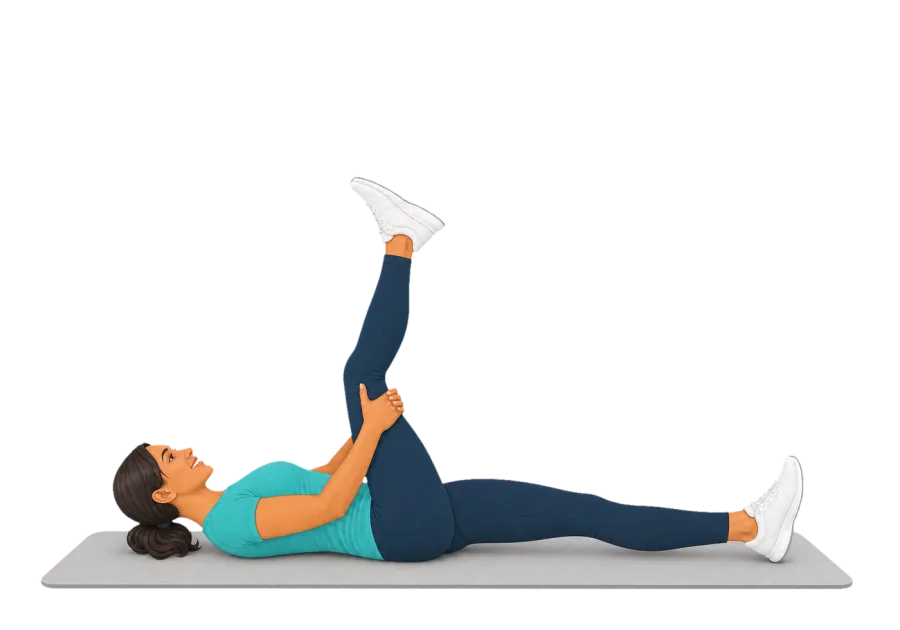
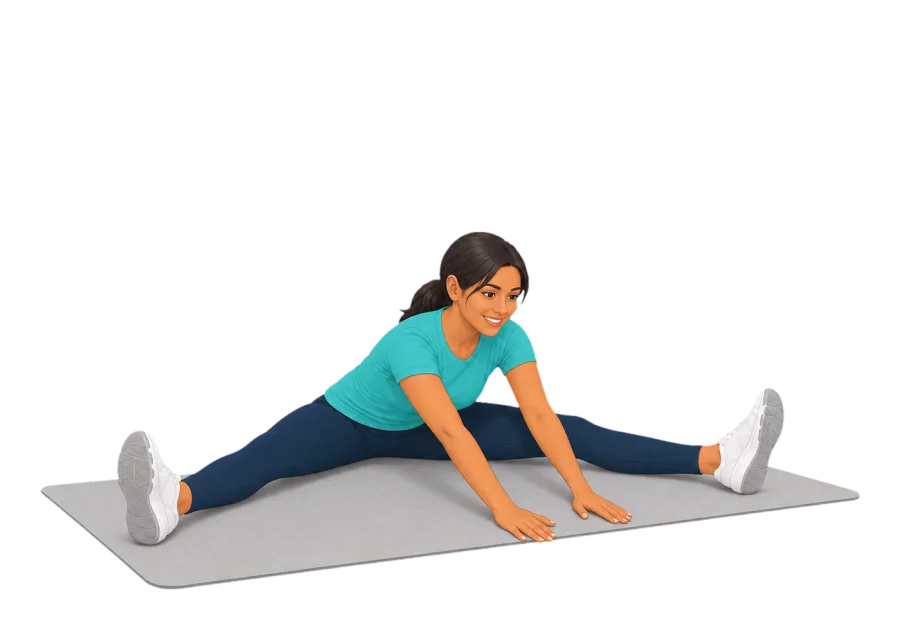
Half Split, Downward Dog and the Hamstring Floss work on the same back-of-leg tissue from different positions. Pancake takes the forward bend to the floor with the legs apart.
Routines With This Move
- Fifteen Minute Reset
- Five Minute Reset
- Fresh Legs
- Long Shift Recovery
- Morning Wake Up
- On Your Feet
- Quick Wake Up
- Slow Morning
- Ten Minute Reset
- Whole Leg Reset
See Also
Sources
- More Than a Toe Touch: Standing Forward Bend (opens in a new tab). Yoga Journal.
- Hamstring (opens in a new tab). Wikipedia.
- Gluteus maximus (opens in a new tab). Wikipedia.
- Thoracolumbar fascia (opens in a new tab). Wikipedia.
- Uttanasana (opens in a new tab). Wikipedia.
- Yoga as exercise (opens in a new tab). Wikipedia.
- The effect of dynamic stretching on hamstrings flexibility with respect to the spino-pelvic rhythm (opens in a new tab). The Journal of Medical Investigation, 2016.
- Influence of Hamstring Tightness in Pelvic, Lumbar and Trunk Range of Motion in Low Back Pain and Asymptomatic Volunteers during Forward Bending (opens in a new tab). Asian Spine Journal, 2015.
Further Reading
- Sritattvanidhi (opens in a new tab). Wikipedia.
- Back pain (opens in a new tab). NHS.
General information about this move, not medical advice. Stop if something hurts, and read our Safety page before you start. If you have a health condition, ask your doctor or physiotherapist first.