What It Is For
The Half Split isolates the hamstrings of one leg. From a low lunge, the hips travel back over the back knee, the front leg straightens with the toes up, and the trunk hinges forward with a long back. Yoga Journal's Ashlee McDougall identifies the front hamstring as the main target.[1]
The kneeling set-up helps to control the pelvis, which many hamstring stretches do not. It is also a preparation for the full split, and Yoga International presents it as a starting point for learning the actions of that pose.[2] Canadian Running recommends it after a run, once warm.[3]
How to Do It
A kneeling hamstring stretch. From a low lunge, shift your hips back over your back knee and straighten your front leg with the toes pointing up, then hinge forward with a long back. You should feel it along the back of the front thigh and into the calf. Rounding your back will not help, so keep it long.
- Front leg straight, toes up
- Hips over the back knee
- Hinge forward with a long back
Pad your knees with a folded towel or cushion. Skip it if kneeling hurts.
How It Got Its Name
Half Split describes the position as half of a front split: one leg is extended and the other is kneeling. The Sanskrit Ardha Hanumanasana uses ardha, meaning half. Hanumanasana takes its name from Hanuman, the deity of the Ramayana, and commemorates his great leap from India to Lanka.[6][7] Half Monkey, also used, reflects Hanuman's monkey form.[8]
The term needs care. In martial arts, half split has another meaning: a front split with the back leg rotated.[9] This is not the same position.
History
No single inventor is recorded for this stretch. A kneeling hamstring stretch is simple enough to have been used in many traditions, and no text can be identified as the first to describe it.
The full split has a longer public history in gymnastics, dance and acrobatics, but its dates are not well recorded.[9] In yoga, Hanumanasana is not described in the medieval hatha yoga texts. It appears in the twentieth century: Light on Yoga, in 1966, teaches it, and rates it 36 out of 64 for difficulty. Swami Yogesvarananda's 1970 First Steps to Higher Yoga has it as Vikatasana.[6] It also features in Pattabhi Jois's Ashtanga yoga.[6]
The half form seems to have come into use as a teaching step towards that pose, and its first appearance under this name is not documented. Yoga Journal uses both Half Splits and Half Monkey, which shows that the English terms are now standard, although not when they began.[1][8]
Muscles and Tendons
The true hamstrings arise from the sit bone and cross the hip and knee, and they lengthen when the knee is straight and the hip is flexed.[4] Straightening the front leg and folding from the hip brings both actions together. The short head of the biceps femoris crosses the knee only, so the folding action does not add to its stretch.[4] Drawing the toes back brings in the calf group, which reaches the heel by the Achilles tendon.[5][3]
Other muscles hold the position. The front quadriceps straighten the knee, and Yoga International points in particular to the vastus medialis, to stop the knee from locking or falling inwards.[2] The hip abductors steady the pelvis, and the back muscles keep the spine long.[1] If the back rounds, the movement comes from the spine and not the hip, and the stretch at the hamstring falls away. For the same reason, McDougall warns against bringing the forehead to the shin.[1]
Stretched
- Hamstrings
- Front leg: lengthen from the sit bone with the knee straight and the hip flexed
- Gastrocnemius
- Front leg: added when the toes draw towards the shin
- Soleus
- Front leg: a smaller contribution at the ankle
Working
- Quadriceps
- Front leg: straighten the knee; teachers often stress the inner part, vastus medialis
- Erector spinae
- Keep the back long during the hinge
- Hip abductors
- Steady the pelvis over the back knee
Tendons and Fascia
- Achilles tendon
- Takes up the calf stretch when the foot is flexed
What Research Has Looked At
No study of this pose was found. The closest evidence concerns the pelvic position that it teaches. A 1992 trial in Medicine and Science in Sports and Exercise assigned two groups of ten people to stretch with an anterior or a posterior pelvic tilt. The anterior tilt group increased hamstring flexibility, measured by active knee extension, while the posterior group did not, and the authors judged pelvic position to matter more than the stretching method.[10] It was a small study, and it did not test this exact pose.
Where It Is Used Today
The pose is standard in flowing yoga, where it often follows Low Lunge. Canadian Running ran it as a pose of the month for runners in 2015, recommending short holds that build to about 30 seconds.[3]
Splits training in dance, gymnastics, martial arts and cheerleading uses the kneeling hamstring stretch as a building block.[9] Runners use it for its focus on one leg at a time, and the kneeling position makes it possible without a raised surface or strap.
Variations and Related Moves
A soft bend in the front knee reduces the stretch. Blocks under the hands bring the floor closer, and McDougall recommends them over rounding the spine.[1] Yoga Journal's Half Monkey also uses a block under the front thigh as a step towards the full split.[8]
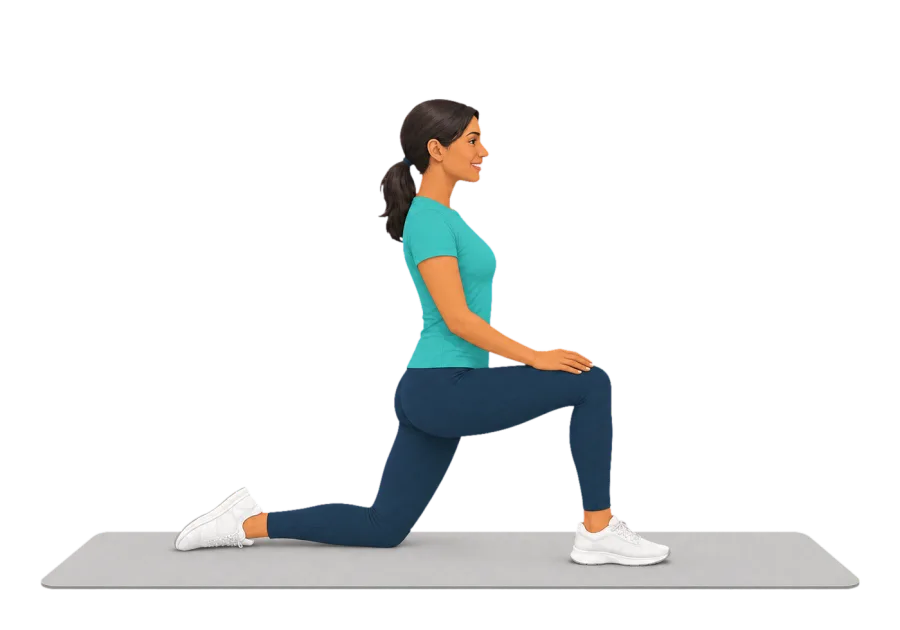
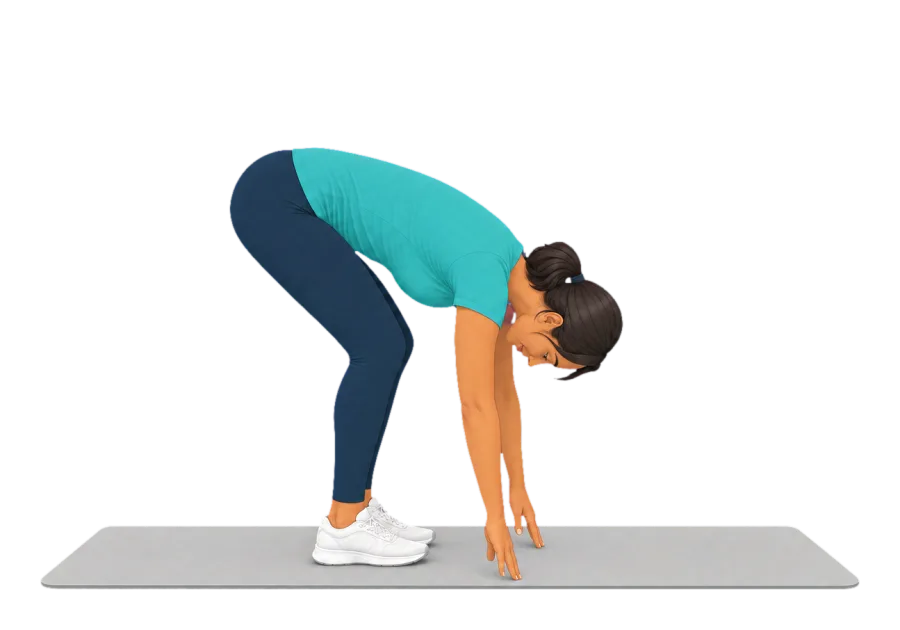
Placing the hands on the floor and lowering the chest makes the stretch stronger. The full Hanumanasana slides both legs out along the floor, and a standing forward fold or Pyramid Pose reaches the same muscles on standing legs.
Routines With This Move
- Calves to Hamstrings
- Fifteen Minute Reset
- Fresh Legs
- Runner's Legs
- Whole Leg Reset
See Also
Sources
- 4 Common Misalignments in Half Splits (opens in a new tab). Yoga Journal.
- 5 Hanumanasana Variations to Empower Your Practice (opens in a new tab). Yoga International.
- Runners Pose of the Month: Half Splits (Ardha Hanumanasana) (opens in a new tab). Canadian Running, 2015.
- Hamstring (opens in a new tab). Wikipedia.
- Triceps surae muscle (opens in a new tab). Wikipedia.
- Hanumanasana (opens in a new tab). Wikipedia.
- Hanuman (opens in a new tab). Wikipedia.
- Monkey Pose (Hanumanasana) (opens in a new tab). Yoga Journal.
- Split (gymnastics) (opens in a new tab). Wikipedia.
- Effect of pelvic position and stretching method on hamstring muscle flexibility (opens in a new tab). Medicine and Science in Sports and Exercise, 1992.
Further Reading
- Tirumalai Krishnamacharya (opens in a new tab). Wikipedia.
- Lunge (exercise) (opens in a new tab). Wikipedia.
General information about this move, not medical advice. Stop if something hurts, and read our Safety page before you start. If you have a health condition, ask your doctor or physiotherapist first.