What It Is For
The Hamstring Floss is a dynamic stretch for the back of the thigh. A person lies on the back, holds behind one thigh, and slowly straightens and bends that knee in a smooth rhythm, stopping short of any strong pull or tingling. Because the hip stays flexed, each straightening of the knee takes the hamstrings towards length and then releases them.
People choose it as a gentler alternative to holding a strong stretch, particularly when the back of the leg feels sensitive. It is used as a warm-up, a recovery movement, and a way of introducing movement into a stiff area. Compared with a held stretch, it asks less of a person's tolerance and it gives constant feedback about how the leg is feeling.
The name also signals a second purpose. The sciatic nerve runs down the back of the thigh and divides near the knee, so it is also moved when the knee straightens.[1] Physiotherapists have developed specific exercises to move nerves relative to surrounding tissues.[2] In informal use the word floss is linked with that work, though the clinical sources cited here do not use it. The version taught here is simpler than a clinical nerve exercise and should be understood as a moving hamstring stretch.
How to Do It
A moving stretch for the back of the leg, gentler than holding still. Lie on your back, hold behind one thigh, and slowly straighten and bend that knee, keeping it smooth. Stop short of any pulling or tingling. You should feel an easy, sliding stretch behind the thigh and knee.
- Hold behind one thigh
- Smooth, no pulling into pain
- Move slowly
How It Got Its Name
Hamstring comes from the Old English ham, originally the bend behind the knee, from a Germanic root meaning crooked. String refers to the tendons that can be felt at either side of the back of the knee.[3] Floss appears to be a modern metaphor, from dental floss sliding between two surfaces. No source was found that records the first use of the term, and it is not a term in the formal literature. Clinical authors prefer sliders, tensioners and neurodynamic mobilisation.[5][2]
History
No single inventor is recorded for this exercise. Its background lies in two separate clinical traditions. The older is the neurological examination of the leg. In 1864 a student of Charles Lasègue, J. J. Forst, described back pain brought on when the knee was straightened with the leg already lifted, and in 1880 the Serbian doctor Laza Lazarević described the straight leg raise test as it is used today.[6] The test uses the same geometry as this move: a straightening knee with the hip flexed.
The second tradition is therapeutic and more recent. Physiotherapists developed exercises that use movement of the nervous system on purpose. David Butler's The Sensitive Nervous System (2000) and Michael Shacklock's Clinical Neurodynamics (2005) are the standard references cited for sliders and tensioners.[2] In 2008 Coppieters and Butler showed in cadavers that sliding techniques move nerves further with much less strain than tensioning techniques.[5]
The stretching side of the story is separate. In 1998 Bandy and colleagues tested dynamic range of motion training, in which subjects lay on the back with the hip at 90 degrees and actively straightened the knee, then held briefly and lowered slowly.[7] This is close to the shape of the Hamstring Floss, though slower and with a hold. How and when the name floss became attached to this kind of movement is not documented.
Muscles and Tendons
The hamstrings are three muscles: semitendinosus, semimembranosus and biceps femoris. All three arise mainly from the ischial tuberosity, the sitting bone, and insert near the knee on the tibia or fibula. The long parts cross both the hip and the knee, which makes them two-joint muscles, while the short head of biceps femoris begins on the femur and crosses only the knee.[3] Holding the thigh up fixes the hip in flexion and so tensions the hamstrings at the top, and straightening the knee then tensions them from the bottom.
The quadriceps do the work of straightening the knee. Their tendons and the hamstring tendons at the back of the knee are placed under modest load. Nerves are also affected. Formed from the L4 to S3 segments, the sciatic nerve passes the back of the thigh to the popliteal fossa, where it splits into the tibial and common fibular nerves.[1] Ultrasound shows that it moves a few millimetres in the mid-thigh during knee extension exercises.[4] A pulling or tingling feeling in the leg can come from nerve tissue, not muscle, which is why the move stops short of any such sensation.
Stretched
- Biceps femoris long head
- Outer hamstring, lengthened as the knee straightens with the hip flexed
- Semitendinosus and semimembranosus
- Inner hamstrings, lengthened in the same way
- Gastrocnemius
- Upper calf, mildly stretched near full knee extension, more if the foot is flexed
Working
- Quadriceps
- Straighten the knee
- Hip flexors and arms
- Keep the thigh vertical, with the hands assisting
Tendons and Fascia
- Hamstring tendons
- Felt at either side of the back of the knee
- Sciatic nerve and tibial nerve
- Not a tendon or fascia. These move and are tensioned within the leg as the knee straightens
What Research Has Looked At
Bandy's 1998 trial enrolled 58 people with limited hamstring flexibility for six weeks. A single daily 30-second static stretch gained 11.4 degrees of knee extension, the dynamic version 4.3 degrees and the control group 0.7 degrees.[7] So the moving form did increase range, but the static stretch did more than twice as much. A move like this may be chosen for comfort or as a warm-up, not because it is the most efficient way of gaining range.
Nerve movement has been measured directly. In a 2012 study of 31 uninjured adults, ultrasound at the mid-thigh recorded the greatest sciatic excursion, 3.2 millimetres, when neck extension was combined with knee extension, and 2.6 millimetres when knee extension was combined with neck flexion.[4] Cadaver work by Coppieters and Butler on arm nerves showed that sliders produced more excursion and much less strain than tensioners.[5] Those findings concern combined movements, and the single-joint Hamstring Floss is neither a true slider nor a true tensioner.
A 2017 systematic review of 40 studies examined neural mobilisation in clinical settings and described a limited evidence base of varying quality.[9] A University of Brighton review of the sciatica literature also called the evidence mixed.[2] Those reviews concern clinical neural exercises, not this simplified stretch.
Where It Is Used Today
Sliders and tensioners are used by physiotherapists, and sciatica is a common context in which they are prescribed.[2] The movement also appears in the clinic as a measure: the active knee extension test, in which a person lies on the back and straightens the knee from a raised thigh position, is used to record hamstring flexibility.[8][7]
Outside the clinic, the simple form is used in warm-ups for running and field sports and in gentle routines. It needs no equipment, though a strap around the foot helps people who cannot comfortably hold the thigh.
Variations and Related Moves
A strap around the foot makes the move easier for people who cannot reach behind the thigh. Pointing and flexing the foot during the movement adds ankle motion, which also increases tension on the calf and the nerves behind the knee, so it is a more intense version and should be slowed down accordingly. Adding a held pause at the top moves it towards Bandy's dynamic range of motion protocol.[7]
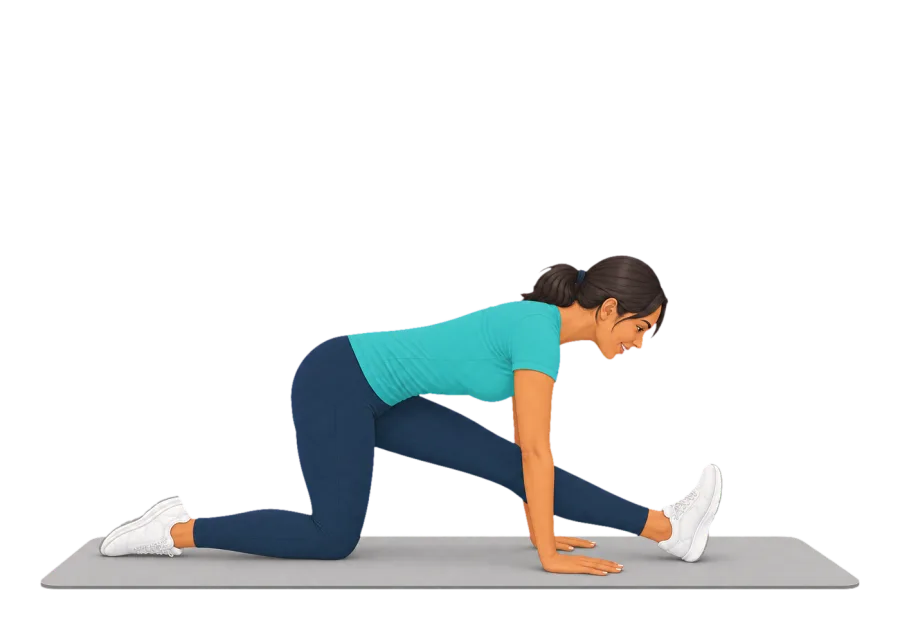
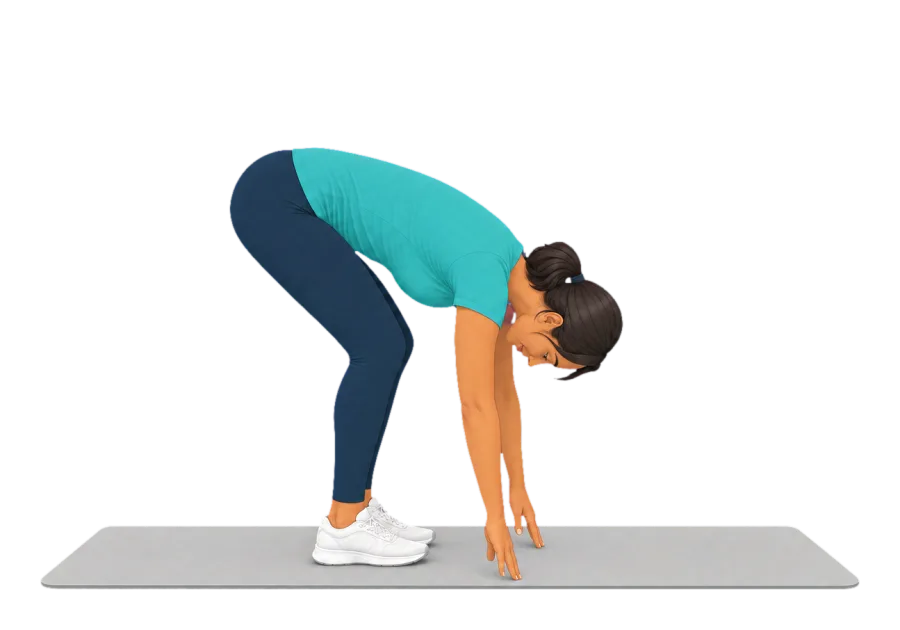
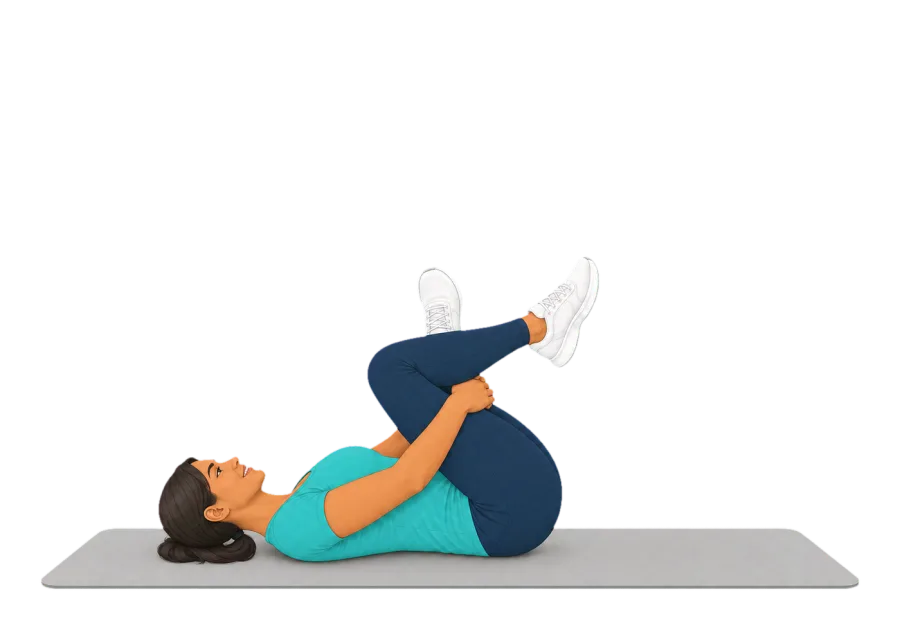
Clinical sliders pair knee extension with neck extension, a form that gave the most nerve excursion in Ellis's study.[4] Held relatives include the Half Split and the Forward Fold. The Figure Four on the back works the outer hip in the same lying position.
Routines With This Move
- Before the Run
- Calves to Hamstrings
- Runner's Legs
- Whole Leg Reset
See Also
Sources
- Sciatic nerve (opens in a new tab). Wikipedia.
- Are Nerve Sliders and Tensioners Effective for Sciatica? (part 1) (opens in a new tab). University of Brighton, Musculoskeletal Physiotherapy blog, 2021.
- Hamstring (opens in a new tab). Wikipedia.
- Comparison of longitudinal sciatic nerve movement with different mobilization exercises: an in vivo study utilizing ultrasound imaging (opens in a new tab). Journal of Orthopaedic and Sports Physical Therapy, 2012.
- Do 'sliders' slide and 'tensioners' tension? An analysis of neurodynamic techniques and considerations regarding their application (opens in a new tab). Manual Therapy, 2008.
- Straight leg raise (opens in a new tab). Wikipedia.
- The effect of static stretch and dynamic range of motion training on the flexibility of the hamstring muscles (opens in a new tab). Journal of Orthopaedic and Sports Physical Therapy, 1998.
- Effect of thoracic mobilization exercises on hamstring flexibility: a randomized controlled trial (opens in a new tab). Turkish Journal of Medical Sciences, 2023.
- The Effectiveness of Neural Mobilization for Neuromusculoskeletal Conditions: A Systematic Review and Meta-analysis (opens in a new tab). Journal of Orthopaedic and Sports Physical Therapy, 2017.
Further Reading
- Gastrocnemius muscle (opens in a new tab). Wikipedia.
- Stretching (opens in a new tab). Wikipedia.
General information about this move, not medical advice. Stop if something hurts, and read our Safety page before you start. If you have a health condition, ask your doctor or physiotherapist first.