What It Is For
Puppy Pose is used to open the shoulders in an overhead position while the spine extends. Yoga Journal describes it as a cross between Child's Pose and Downward-Facing Dog, and as a stretch for the spine and shoulders.[1] Because the hips stay high and the body weight falls through the chest, it gives a stronger shoulder stretch than Child's Pose, while asking less of the wrists than Downward Dog.
People who want more overhead range use similar positions, with the aim of lengthening the tissues under the arm that limit how far it rises.
It also stands in as a change of position during a kneeling sequence, since it moves straight from all fours and needs no props.
How to Do It
Halfway between Child's Pose and Downward Dog, for the shoulders and upper back. From hands and knees, keep your hips over your knees and walk your hands forward until your chest sinks towards the floor. You should feel a stretch under your arms and along your upper back.
- Hips stay over knees
- Walk your hands forward
- Let the chest melt down
Pad your knees with a folded towel or cushion. Skip it if kneeling hurts.
Stay below the point of pinching. Smaller range is fine.
How It Got Its Name
The English name compares the body to a stretching puppy, front low and rear high, and it complements Downward Dog. In Uttana Shishosana, uttana is the word glossed as intense stretch in the name Uttanasana, and pose guides give the second element as puppy, though translations and even spellings vary.[4][1]
The name appears to be a modern coinage, formed to match the dog imagery of Adho Mukha Shvanasana, but that is an inference: no source was found recording who introduced it or when.
History
No single inventor of Puppy Pose is recorded, and no classical text describing it was found. It should not be described as ancient without evidence. Reference summaries list it simply as a variation of Balasana, the midpoint between Child's Pose and Adho Mukha Shvanasana, with the thighs vertical and the forearms and forehead on the floor.[5]
Its parent poses are themselves mostly modern. Child's Pose is not described until the 20th century, as Wikipedia records from Mark Singleton's Yoga Body, and a similar posture appears in Niels Bukh's Primary Gymnastics of 1924.[5] The broader setting is the blend of hatha yoga, wrestling exercises and gymnastics that shaped posture practice from the 1920s onwards.[6] Yoga Journal's pose library has included Extended Puppy Pose since at least 2007, which is the earliest date found for the pose under this name.[5]
Muscles and Tendons
The feeling of stretch under the arms comes mostly from the latissimus dorsi. This broad muscle runs from the lower spine, pelvis and lower ribs to the upper arm, and it normally pulls the arm down and back.[2] With the arm held overhead it is lengthened, with the chest moving towards the floor adding to the effect. It also contributes to the thoracolumbar fascia, so tension can spread along the lower back.[3]
The upper back is taken towards extension rather than twisted, which is why it feels different from Thread the Needle. Yoga Journal's teacher notes describe a stretch across the front of the body, from shoulder to shoulder and from the neck to the pubic bone.[1] Keeping the hips over the knees requires a mild effort from the thighs and gluteals, the only meaningful muscular work in the pose. Those with limited shoulder range may feel compression at the top of the shoulder rather than a stretch, which is a reason to use a chair or wall.
Stretched
- Latissimus dorsi
- From the armpit along the side of the back
- Teres major
- Outer edge of the shoulder blade, alongside the lats
- Pectoral muscles
- Front of the chest as the arms reach overhead
- Spine extensors and thoracic tissue
- Upper back, as the spine extends towards the floor
Working
- Gluteals and quadriceps
- Keep the thighs vertical and the hips over the knees
- Serratus anterior and lower trapezius
- Lightly, to keep the arms reaching and the shoulder blades moving
Tendons and Fascia
- Thoracolumbar fascia
- Latissimus dorsi tensions this sheet, so it may share the stretch
- Long head of the triceps tendon
- Back of the upper arm, with the arms fully overhead
Where It Is Used Today
The pose is taught across general yoga classes, usually as a brief stretch between all-fours work and Downward Dog.[1] It is also used in gyms as a kneeling shoulder stretch, sometimes with the hands on a bench or box. Yoga Journal suggests a rolled blanket between the thighs and calves for comfort in the knees and lower back.[1]
Variations and Related Moves
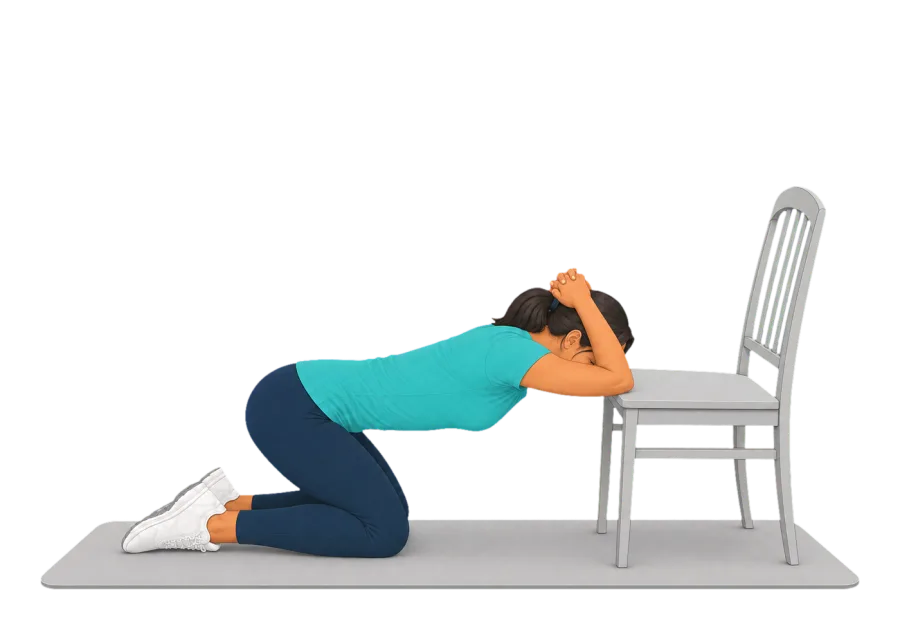
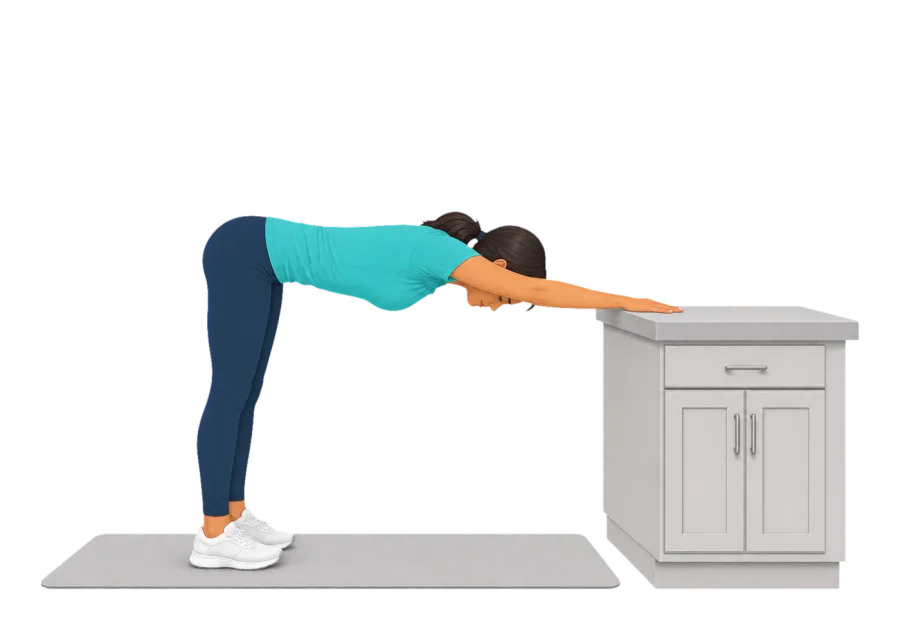
Hands on a chair or a wall bring the same arm-overhead position to people who cannot kneel. Resting the chin rather than the forehead increases the extension through the upper back, and it is a real step up in intensity.
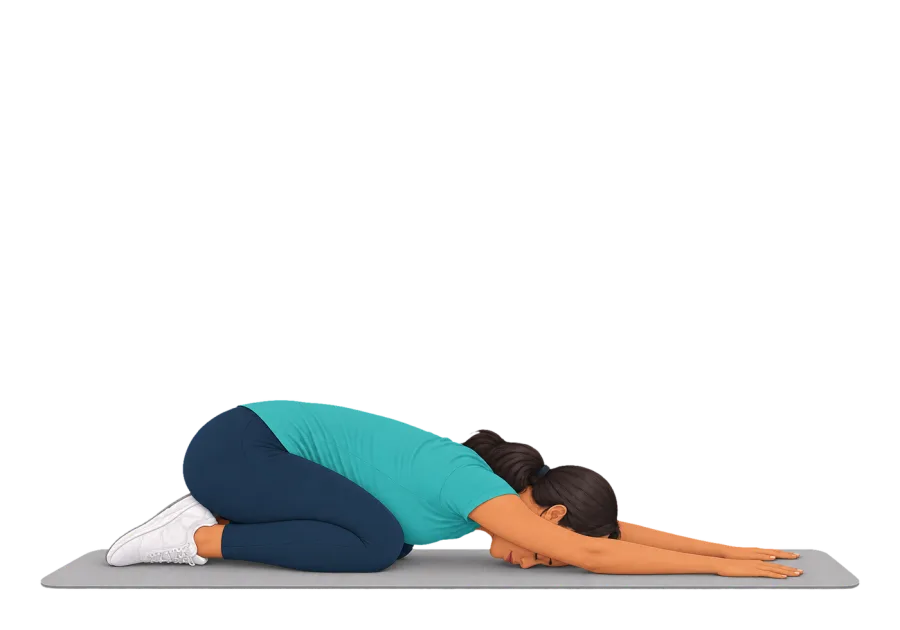
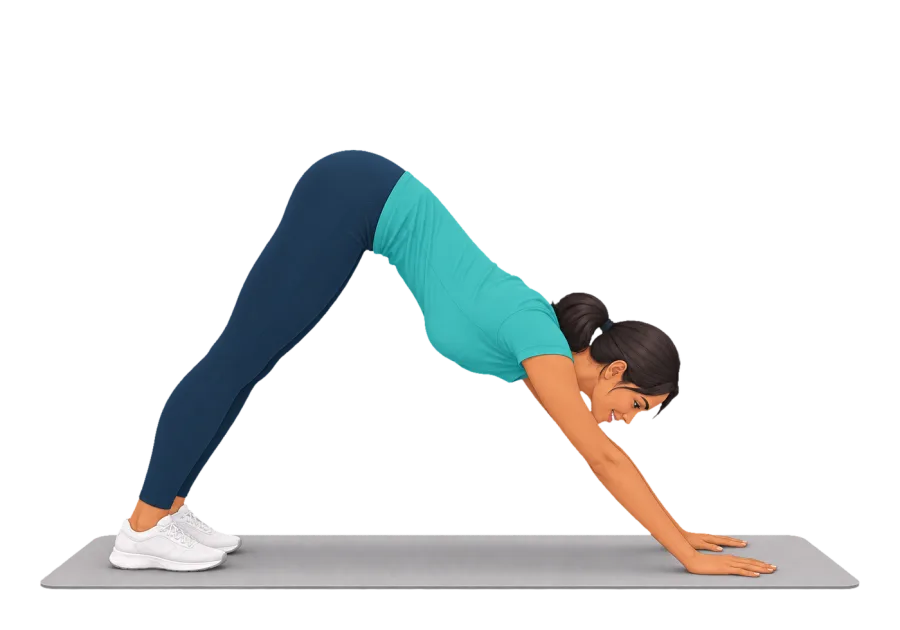
Yoga Journal's blanket or bolster between the thighs and calves makes the kneeling base more comfortable.[1] The nearest relatives are Child's Pose, which lets the hips sink back, Downward Dog, which lifts the knees, and the Lat Stretch, which targets one side at a time.
Routines With This Move
- Fifteen Minute Reset
- Open Shoulders
- Overhead Ready
- Upper Body Unwind
See Also
Sources
- Extended Puppy Pose: How to Practice Uttana Shishosana (opens in a new tab). Yoga Journal.
- Latissimus dorsi muscle (opens in a new tab). Wikipedia.
- Thoracolumbar fascia (opens in a new tab). Wikipedia.
- Uttanasana (opens in a new tab). Wikipedia.
- Balasana (opens in a new tab). Wikipedia.
- Yoga as exercise (opens in a new tab). Wikipedia.
Further Reading
- Yin Yoga (opens in a new tab). Wikipedia.
- Supraspinatus muscle (opens in a new tab). Wikipedia.
General information about this move, not medical advice. Stop if something hurts, and read our Safety page before you start. If you have a health condition, ask your doctor or physiotherapist first.