What It Is For
The Seated Figure Four is a held stretch for the buttock and outer hip. The person sits tall in a chair, rests one ankle on the opposite knee, then hinges forward a little from the hips with a long back. A small forward lean is usually enough to be felt in the buttock of the crossed leg. Cleveland Clinic describes the same position, with a seated option in which the knee is allowed to drop.[1]
It suits offices, trains and cars at rest, because it needs nothing beyond a seat. The Health and Safety Executive says screen users' breaks should allow them to stretch and change posture, and this is one simple way to do that.[2] Physiotherapists often include it in programmes for people with buttock pain, including people told they have piriformis syndrome.[1]
It is also a useful alternative for anyone who cannot easily get down to the floor, or who finds the lying version hard to get into. Placing the ankle lower on the shin makes the position easier on the hip and knee of the crossed leg.
How to Do It
A buttock and hip stretch you can do in an office chair. Sit tall with one ankle resting on the opposite knee, then hinge forward a little from your hips, keeping your back long. Put the ankle lower on your shin if that is more comfortable. You should feel it in the buttock of the crossed leg.
- Ankle over the opposite knee
- Sit tall
- Hinge forward a little
Go gently if you have had a hip replacement, and check with your surgeon or physio first.
How It Got Its Name
The name comes from the shape of the crossed leg, which suggests the numeral 4. Clinicians use the same term for the foot-on-knee position of the FABER test.[7] The word seated separates it from the floor version. No traditional Sanskrit name for the chair form could be confirmed.
History
No inventor is recorded. Resting an ankle on the opposite knee is an ordinary way of sitting, so the stretch may be as old as chairs, and any attempt to date it as an exercise would be guesswork. No source located for this article gives a first description.
Two later developments explain its current popularity. Clinicians have used the figure 4 position in examination through the test named after the American neurologist Hugh Talbot Patrick (1860 to 1938), though that is an assessment and there is no evidence that the stretch derived from it.[7] Separately, adapted yoga spread from the 1970s and 1980s, with Alice Christensen's work with older people and Lakshmi Voelker's Chair Yoga, and floor shapes were taken into chairs.[8] Whether this particular stretch came through that route is not documented.
Muscles and Tendons
The position combines hip flexion with external rotation, as in the lying version, but the trunk moves over the thigh rather than the thigh towards the trunk. Flexion lengthens gluteus maximus, and the crossed shin sets the rotation. Piriformis runs from the front of the sacrum to the greater trochanter, and its tendon merges with those of the neighbouring rotators.[3]
The exact role of piriformis in this position is uncertain. Moment arms at the hip change with flexion, and some muscles switch from external to internal rotation as the hip bends.[4] Anatomy texts generally say this applies to piriformis at about 90 degrees or more of flexion, whereas a 2015 ultrasound study found no consistent evidence for that change.[3][5] The stretch therefore targets the buttock in general, and how much each deep muscle contributes is not known.
The hinge matters more than its size. The erector spinae keep the back long and the movement comes from the hips, covered in the lower and middle back by the thoracolumbar fascia.[6] If the back rounds instead, much of the movement is taken in the spine and less reaches the hip.
Stretched
- Gluteus maximus
- Lengthens at the back of the crossed hip as the trunk hinges forward
- Piriformis
- Deep muscle from sacrum to greater trochanter, usually named in this stretch
- Other deep hip rotators
- Lie alongside piriformis and share the position
Working
- Erector spinae
- Keep the back long during the hinge
- Hip flexors
- Help tip the pelvis forward over the thighs
- Muscles of the crossed leg
- Hold the ankle steady on the knee
Tendons and Fascia
- Common hip rotator tendon
- The piriformis tendon merges with those of the gemelli and obturator internus at the greater trochanter
- Thoracolumbar fascia
- Covers the erector spinae, which work during the hinge
What Research Has Looked At
No study of this exact chair stretch was found. The nearest is a 2014 imaging and modelling study of seven people, which measured piriformis length in stretches that combined hip flexion, adduction and external rotation. Each lengthened the muscle by about 12 per cent, and modelled positions at higher flexion gave about 15 per cent.[9] It supports the general point that more hip flexion can lengthen the muscle further, but its positions include adduction, and it did not test any effect on symptoms.
Where It Is Used Today
The stretch is a standard entry in desk routines and in physiotherapy patient information, which gives a typical dose of a 30-second hold repeated three times each side.[1] It appears in chair yoga classes for older adults and people who avoid the floor, and it is used by travellers and drivers during stops.
Workplace guidance does not name specific stretches, but it does support the wider idea of frequent, short changes of position, and it leaves the choice of break to the user where possible.[2]
Variations and Related Moves
Resting the ankle lower on the shin is the easy option. Pressing lightly on the raised knee adds a little more, and leaning further from the hips adds more again.[1]
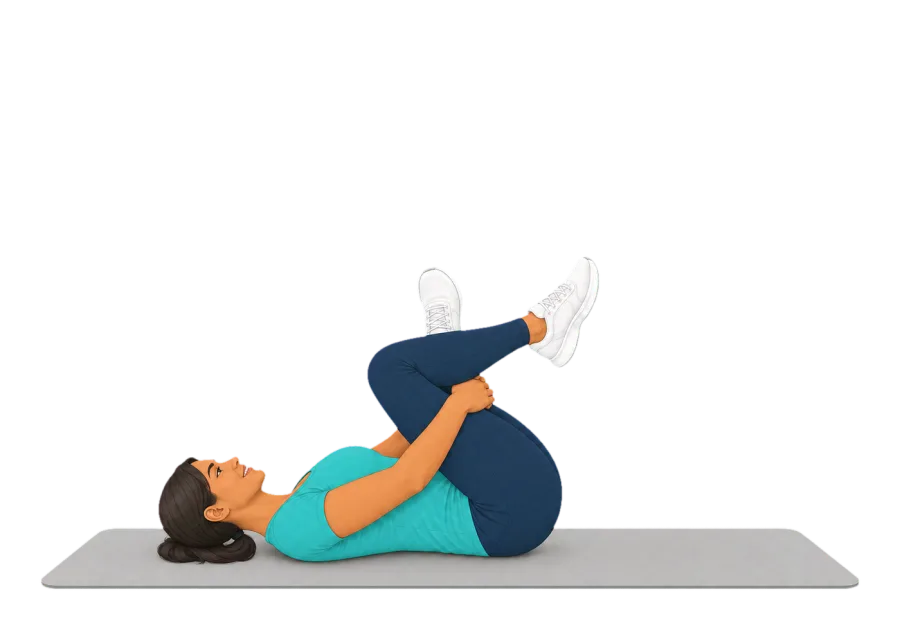
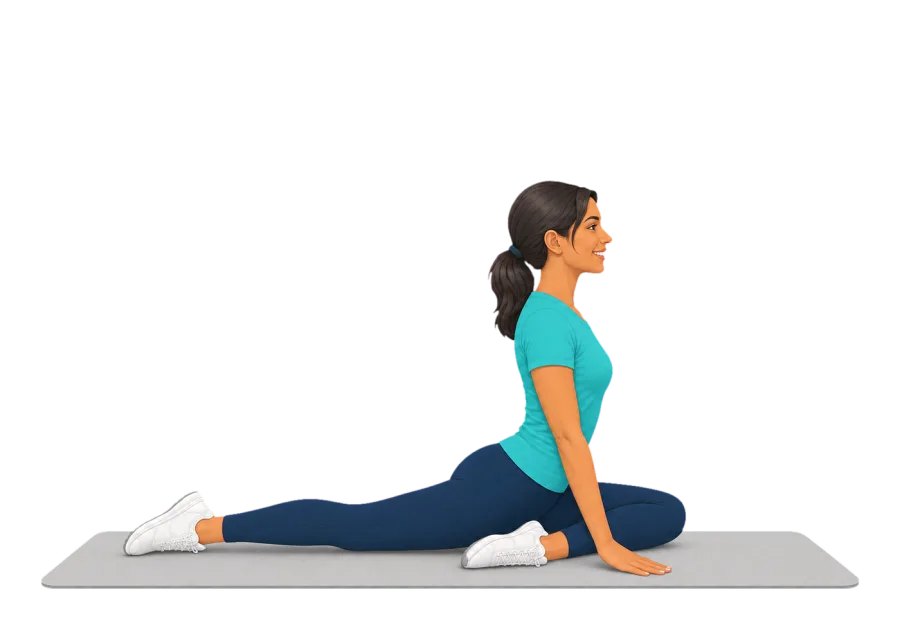
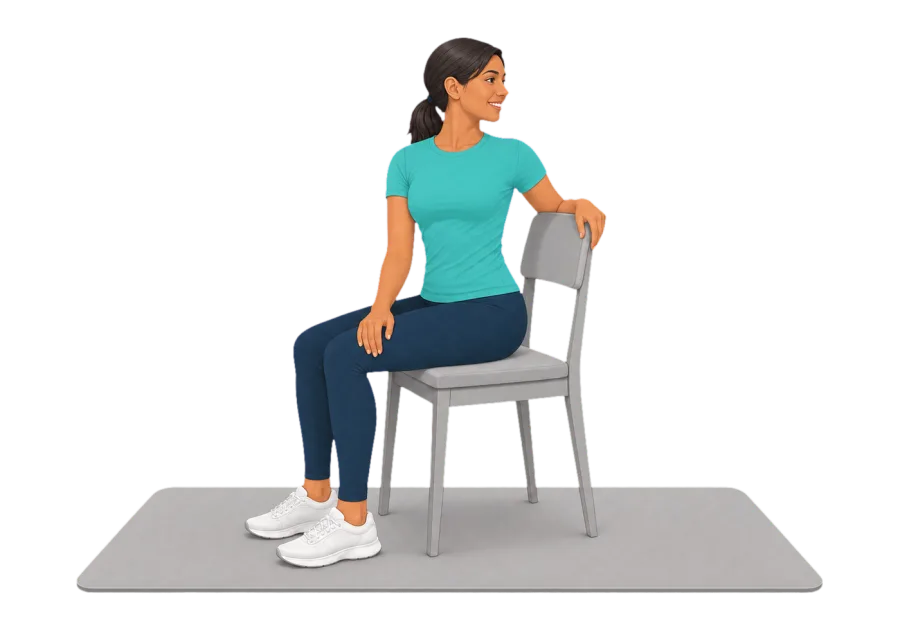
The Lying Figure Four is the floor equivalent and removes the need to hold the back up. Pigeon is the fuller version of the same idea, and Seated Twist suits the same desk routine.
Routines With This Move
- Chair Break
- Desk Reset
- Steady and Strong
- Steady and Strong, Longer
See Also
Sources
- 7 Best Stretches and Exercises for Piriformis Syndrome (opens in a new tab). Cleveland Clinic, 2022.
- Working safely with display screen equipment: work routine and breaks (opens in a new tab). Health and Safety Executive.
- Piriformis muscle (opens in a new tab). Wikipedia.
- Variation of rotation moment arms with hip flexion (opens in a new tab). Journal of Biomechanics, 1999.
- Effect of Hip Rotation Stretch on Piriformis Tendon Thickness: A Diagnostic Ultrasound Study (opens in a new tab). Journal of Student Physical Therapy Research, 2015.
- Erector spinae muscles (opens in a new tab). Wikipedia.
- FABER test (opens in a new tab). Radiopaedia.
- Accessible yoga (opens in a new tab). Wikipedia.
- Comparison of two stretching methods and optimization of stretching protocol for the piriformis muscle (opens in a new tab). Medical Engineering & Physics, 2014.
Further Reading
- Patrick's test (opens in a new tab). Wikipedia.
- "Figure 4" Piriformis/gluteals mobility, supine (opens in a new tab). Physitrack.
General information about this move, not medical advice. Stop if something hurts, and read our Safety page before you start. If you have a health condition, ask your doctor or physiotherapist first.