What It Is For
Pigeon stretches the outer hip and buttock of the front leg, with a secondary stretch across the front of the back hip. The front shin crosses the mat, the back leg extends behind and the trunk stays upright or folds forward. Yoga Journal describes this shape through three stages, from a reclined figure-four on the back to a supported form to the full fold.[1]
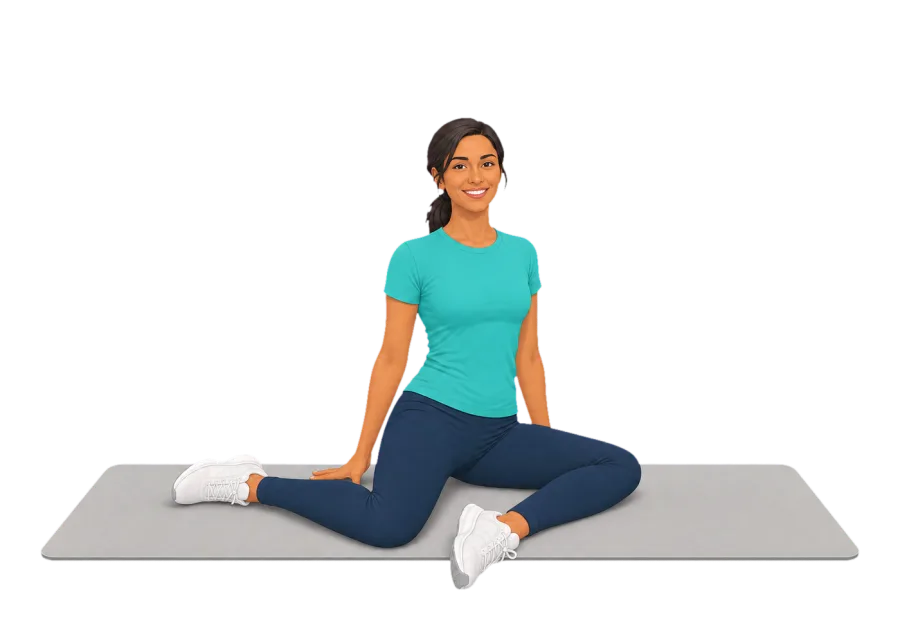
This form leaves out the backbend of the classical pose. The back knee stays straight, and the hands rest on the floor.[2] That makes it a hip stretch and not a backbend. The sensation should stay in the buttock and not the knee, because the knee cannot rotate to make up for a stiff hip.
How to Do It
A well-known hip opener for the outside of the hip and the buttock. From hands and knees, bring one knee forward and lay that shin across the mat, then slide the other leg long behind you. Stay tall or fold forward only as far as is easy. You should feel a stretch deep in the buttock of the front leg, not in the knee.
- Front shin across the mat
- Back leg long behind you
- Fold forward only as far as is easy
Pad your knees with a folded towel or cushion. Skip it if kneeling hurts.
Go gently if you have had a hip replacement, and check with your surgeon or physio first.
How It Got Its Name
The full Sanskrit name, Eka Pada Rajakapotasana, joins words for one, foot, king, pigeon and posture, so it translates as One-Legged King Pigeon Pose.[2] Kapotasana alone means pigeon pose, and it is a different, kneeling backbend.[7] The English word Pigeon has moved from the full pose to the simplified shape in everyday teaching. No source records when this shift began.
History
The full pose has a twentieth-century record. It was described by two pupils of Krishnamacharya, K. Pattabhi Jois in Ashtanga Vinyasa Yoga and B. K. S. Iyengar in Light on Yoga.[2][8] The sources reviewed do not show it in any earlier text, and any claim of great antiquity should be read with caution.
The simplified form is harder to trace. Yoga Journal's material presents it as a route to the full pose, and Wikipedia describes it as Salamba Kapotasana, where the rear leg stays straight and the hands rest on the floor.[1][2] No inventor is recorded, and the date of the first teaching of this form is not documented.
Yin Yoga later brought it into long, passive holds. Paulie Zink introduced long floor holds to North America in the late 1970s, and the style developed through Paul Grilley and Sarah Powers.[9] Yin's Swan is the counterpart of Salamba Kapotasana, and the sleeping form folds the body forward over the bent leg.[2]
Muscles and Tendons
On the front leg, the hip is flexed and turned out. Flexion lengthens the gluteus maximus, and folding the trunk forward adds to this. Yoga Journal's anatomy notes name the gluteus maximus and piriformis on this side, and the psoas on the back leg.[1]
The piriformis needs more care than most guides give it. It runs from the sacrum to the greater trochanter and turns the thigh outwards when the hip is straight. A common teaching is that it becomes an internal rotator once the hip flexes past about 60 degrees, which would alter how it is stretched in this pose.[3] A 2015 ultrasound study of 26 hips did not find the expected change, and its authors questioned the idea.[4] As a result, it is safer to say that the deep rotators may contribute to what is felt than to state exactly which muscle stretches most.
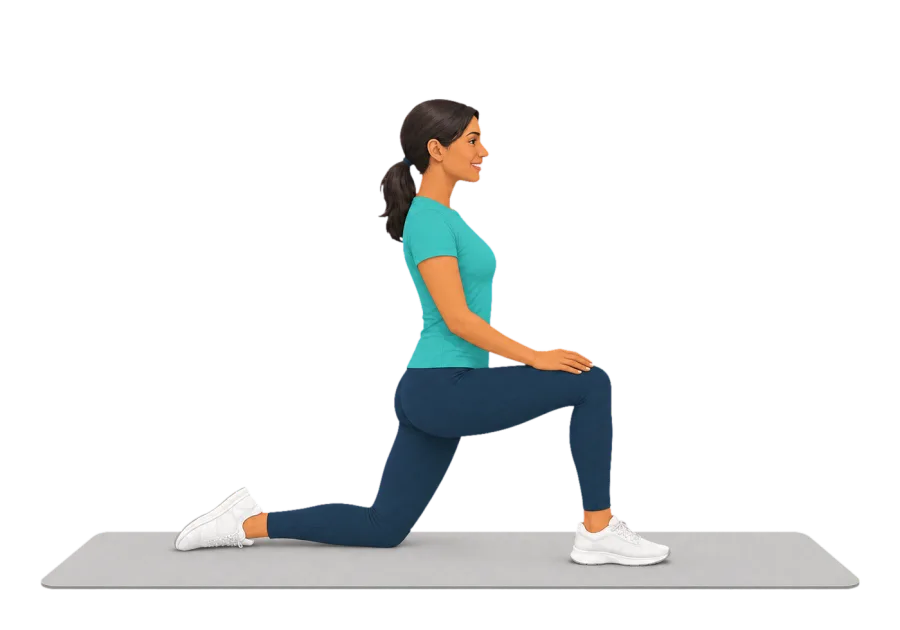
On the back leg, the hip is in extension, which lengthens the iliopsoas.[5] The rectus femoris, which crosses the hip and knee, is lightly stretched too, and more so if the knee bends.[6] When upright, the arms and trunk muscles do the holding work. When folded, most effort falls away.
Stretched
- Gluteus maximus
- Front leg: lengthened by hip flexion, more when folding forward
- Deep hip rotators, including piriformis
- Front leg: a likely contributor, though the piriformis action in a flexed hip is debated
- Psoas and iliacus
- Back leg: lengthened as the hip extends
- Rectus femoris
- Back leg: a mild stretch when the hip is extended
Working
- Arm muscles
- Support the trunk when upright
- Erector spinae
- Hold the trunk tall if not folding
- Trunk muscles
- Steady the pelvis over the front shin
Where It Is Used Today
Pigeon is one of the best known hip stretches in modern yoga, and it is common in flowing and Yin classes. It is also seen in gyms and in hip routines for active people, although no survey of that use was found.
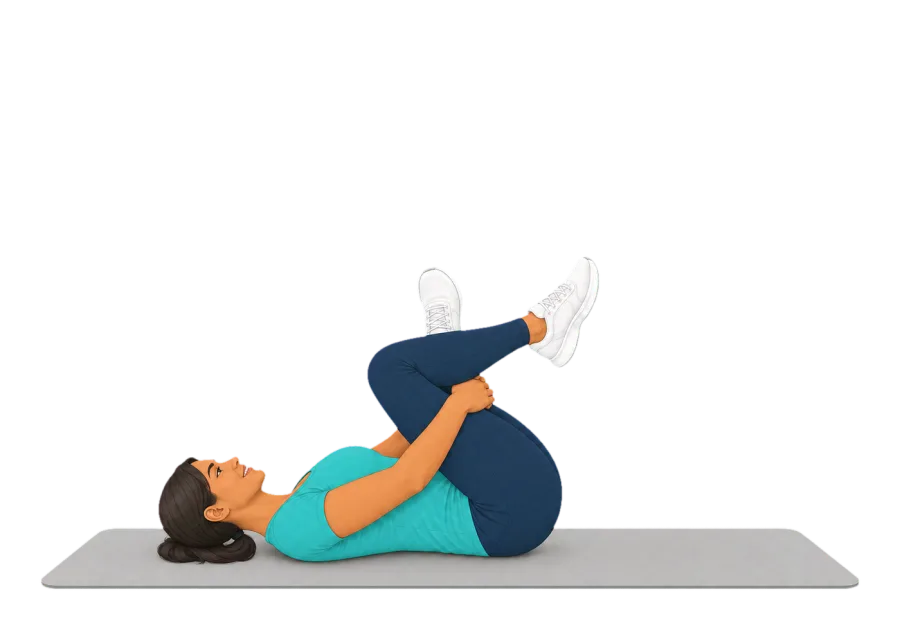
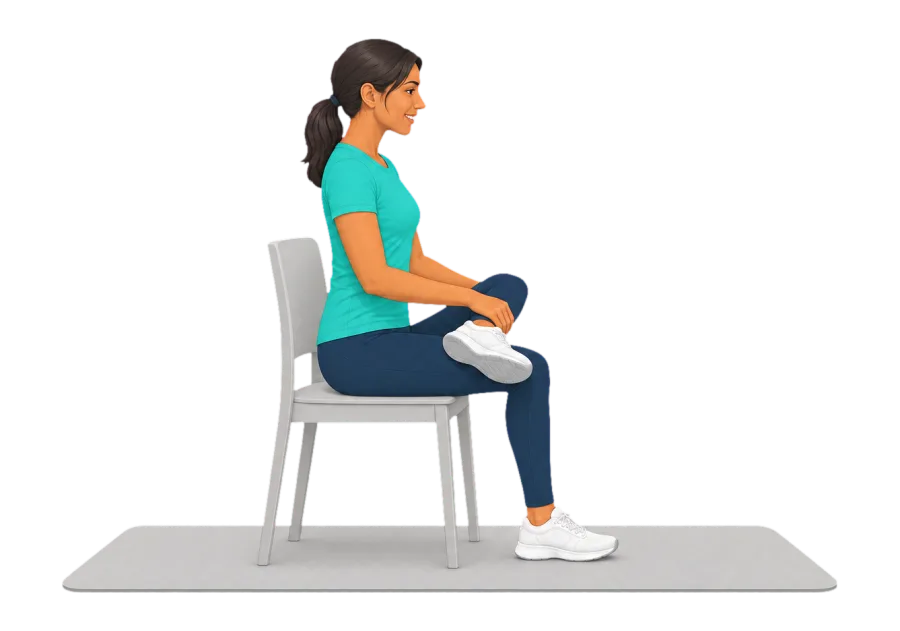
Because it asks a lot of the front knee, trainers often substitute the lying version. An American Council on Exercise article for trainers lists Supine Pigeon, a figure-four shape on the back, with a hold of about five breaths per side.[10]
Variations and Related Moves
The reclined figure-four, also called Dead Pigeon or Eye of the Needle, takes the same hip position while lying on the back, with no weight through the front knee. A supported version places padding under the hip of the front leg.[1] Folding forward on to the forearms increases the stretch of the front hip.
The full pose bends the back knee and takes hold of the foot, adding a large backbend, often with a strap in practice.[2] Eka Pada Rajakapotasana II, III and IV are more advanced forms that change the front leg.[2] The 90/90 sit is a popular strength-training relative with both knees bent.
Routines With This Move
- Hips All Round
- Hips for Sitters
- Lifter's Full Reset
- Runner's Legs
- Squat Depth
See Also
Sources
- How to (Comfortably) Come Into Pigeon Pose (opens in a new tab). Yoga Journal.
- Eka Pada Rajakapotasana (opens in a new tab). Wikipedia.
- Piriformis (opens in a new tab). Learn Muscles, 2020.
- Effect of Hip Rotation Stretch on Piriformis Tendon Thickness: A Diagnostic Ultrasound Study (opens in a new tab). Journal of Student Physical Therapy Research, 2015.
- Iliopsoas (opens in a new tab). Wikipedia.
- Rectus femoris muscle (opens in a new tab). Wikipedia.
- List of asanas (opens in a new tab). Wikipedia.
- Light on Yoga (opens in a new tab). Wikipedia.
- Yin Yoga (opens in a new tab). Wikipedia.
- 10 Yoga Poses to Alleviate Low Back Pain (opens in a new tab). American Council on Exercise, 2017.
Further Reading
- Tirumalai Krishnamacharya (opens in a new tab). Wikipedia.
- Split (gymnastics) (opens in a new tab). Wikipedia.
General information about this move, not medical advice. Stop if something hurts, and read our Safety page before you start. If you have a health condition, ask your doctor or physiotherapist first.