What It Is For
The Short Copenhagen Plank is a hard strength hold for the inner thigh. The trainee lies on one forearm with the top knee on a bench and lifts the hips until the body forms a straight line, so that the top leg's adductors carry a large share of the body's weight. With the bench under the knee, the distance from the hip to the point of support is short, which is what makes this the easier form of the exercise.[1][2]
The exercise is used by athletes who kick, sprint or change direction, because the adductors work hard in those actions and because low adductor strength has been linked with groin problems in football.[3] Coaches also use it as a stepping stone to the long-lever version, in which the support is at the lower leg or foot.[2]
How to Do It
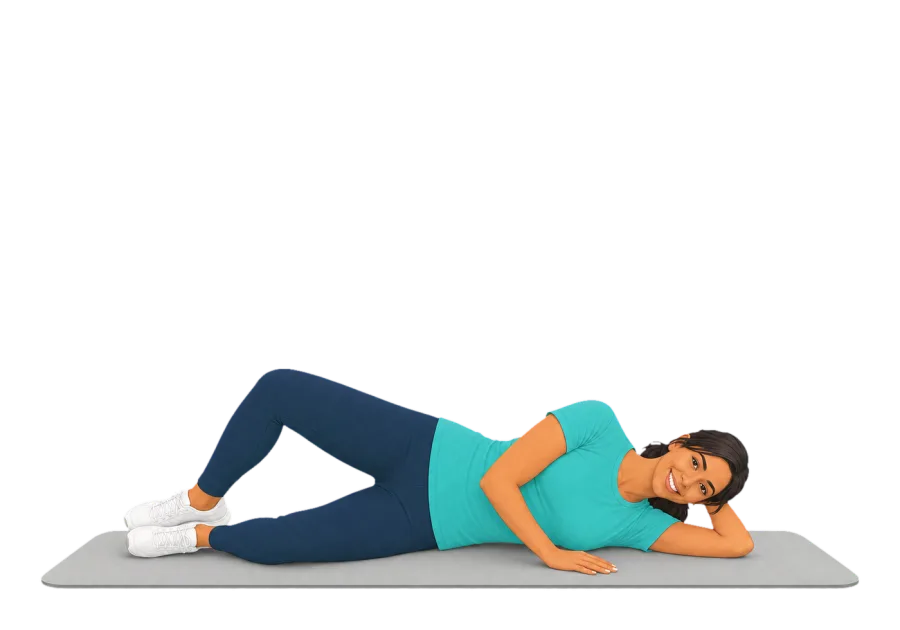
An athletic strength hold for the inner thighs. Lie on your side on one forearm with your top knee on a bench, then lift your hips into a straight line, with your bottom knee down if you need the easier version. Do not hold your breath. You should feel a strong effort along the inside of the top thigh.
- Side plank on your forearm
- Top knee on a bench
- Lift the hips in line
Stay below the point of pinching. Smaller range is fine.
How It Got Its Name
Copenhagen is the city of the researchers who studied it. The 2014 electromyography paper came from Arthroscopic Centre Amager at Copenhagen University Hospital and colleagues.[7] Later papers call it the Copenhagen Adduction exercise, the Copenhagen Adductor Exercise, and, in gyms, the Copenhagen plank.[3][8][9] None of the sources consulted states who coined the name, or when. Short refers to the short lever, a term from exercise libraries and coaching writing.[1][2]
History
The exact origin of the exercise is not documented in the sources consulted. No first description has been verified.
The earliest paper found for this article is Serner and colleagues, published online in 2013 and in print in 2014 in the British Journal of Sports Medicine. It recorded adductor longus activity in 40 male elite soccer players during six traditional and two new hip adduction exercises, with peak values from 14 to 108 per cent of a maximal contraction. The authors named the Copenhagen Adduction as a dynamic, high-intensity exercise that could be used at any training facility.[7]
A randomised trial by Ishøi and colleagues followed in 2016. Over eight weeks in-season, 24 under-19 sub-elite football players were split between a progressive programme and usual training. The intervention group gained 35.7 per cent in eccentric hip adduction strength.[3]
The largest study found for this article came from Norway. Harøy and colleagues randomised 35 semiprofessional teams, 18 of them to an Adductor Strengthening Programme built on one exercise with three progression levels, performed three times a week in preseason and once a week in season. Average prevalence of groin problems across the season was 13.5 per cent in the programme group and 21.3 per cent in the control group.[10]
Adoption brought adaptation. In 2019, Polglass and colleagues reported a six-level progressive version for professional footballers, designed to limit soreness.[11] Lever length has become a common way to scale the exercise, although the sources consulted do not show who first separated out the short version.
Muscles and Tendons
This is a loading exercise and stretches nothing to any useful degree. The adductor longus runs from the pubic body to the linea aspera on the back of the femur, and it draws the thigh inward.[4] In the hold, it works to stop the hips from dropping away from the bench.
Comparisons of lever length are recent. A 2026 study using an EMG-assisted model in Medicine and Science in Sports and Exercise placed the long-lever version in the highest force tier for all adductors, and the short-lever version in that tier for adductor brevis and longus only.[5] A 2026 dynamometer study found that a longer lever raised peak and average eccentric hip torque, while range of motion fell.[6] Neither result comes from a static hold like the one taught here, so they offer only a rough guide.
The trunk is a secondary worker. A 2014 electromyography study found relatively low activity in the gluteals and abdominals across the eight exercises it tested, at 5 to 48 per cent of a maximal reference.[7] The supporting shoulder also has to hold steady.
Working
- Adductor longus and adductor brevis
- Main working muscles of the top leg; a 2026 model placed the short lever in its highest force tier for these two
- Adductor magnus and gracilis
- Also active, with higher modelled forces in the long-lever version
- Obliques and rectus abdominis
- Hold the trunk in line; lower activity than the adductors
- Gluteus medius
- Active around the pelvis, with relatively low activity
- Shoulder muscles
- Steady the supporting arm
Tendons and Fascia
- Adductor longus tendon
- Attaches to the pubic body and carries the load near the groin, under load rather than on stretch
What Research Has Looked At
A 2021 systematic review of five studies found that the exercise increased eccentric adductor strength, eccentric abductor strength and the ratio between them, and increased adductor activity. Its authors said that more research was needed to confirm any link to groin injuries.[8]
The evidence needs careful application here. The main trials used the full Copenhagen Adduction, with repeated lowering, and not a short-lever static hold. Results from Ishøi and Harøy cannot simply be transferred to the 20-second hold taught in this move.[3][10] The Harøy result also concerns the prevalence of reported groin problems in male semiprofessional football players, not other groups.[10]
Where It Is Used Today
Football is the main home of the exercise. A 2024 study of real-world use found that 65 per cent of the teams using it had modified the original programme, changing sets, repetitions, progressions and frequency, mainly to manage overall player load and to suit individuals, while keeping its basic principles.[12]
Its use has spread to endurance athletes. A strength coach writing for the Craftsbury training site recommends holds of 10 to 20 seconds, and a 2025 Canadian Running article reports one physiotherapist's advice for runners of holds of 20 to 30 seconds.[2][9] Physiotherapy exercise libraries include short-lever forms with a chair or bench.[1]
Variations and Related Moves
Keeping the bottom knee on the floor is the easiest form. Moving the bench to the top foot lengthens the lever and is the classic long-lever hold.[2] Moving forms lift the bottom leg to the bench and lower it.[1] The standard Copenhagen Adduction lowers the body to the floor and raises it again. Adductor Rock gives a gentler, unloaded movement for the same region, and Frog and Pancake stretch the adductors, which this move does not.
See Also
Sources
- Short lever Copenhagen hold with lower leg hip adduction (opens in a new tab). Physitrack.
- Move of the Month: Copenhagen Plank Variations and Progressions (opens in a new tab). Craftsbury, 2024.
- Large eccentric strength increase using the Copenhagen Adduction exercise in football: A randomized controlled trial (opens in a new tab). Scandinavian Journal of Medicine and Science in Sports, 2016.
- Adductor longus muscle (opens in a new tab). Wikipedia.
- Hip Adductor Muscle Forces during Strength Training and Rehabilitation Exercises (opens in a new tab). Medicine and Science in Sports and Exercise, 2026.
- Biomechanics of Copenhagen Adduction Exercise and Eccentric Hip Adductor Exercises on a Novel Isokinetic Dynamometer With Within-Session Repeatability (opens in a new tab). Scandinavian Journal of Medicine and Science in Sports, 2026.
- EMG evaluation of hip adduction exercises for soccer players: implications for exercise selection in prevention and treatment of groin injuries (opens in a new tab). British Journal of Sports Medicine, 2014.
- The Neuromuscular Effects of the Copenhagen Adductor Exercise: A Systematic Review (opens in a new tab). International Journal of Sports Physical Therapy, 2021.
- Why runners should care about the Copenhagen plank (opens in a new tab). Canadian Running, 2025.
- The Adductor Strengthening Programme prevents groin problems among male football players: a cluster-randomised controlled trial (opens in a new tab). British Journal of Sports Medicine, 2019.
- Impact of a modified progressive Copenhagen adduction exercise programme on hip adduction strength and postexercise muscle soreness in professional footballers (opens in a new tab). BMJ Open Sport and Exercise Medicine, 2019.
- Real-world implementation of the Copenhagen Adduction Exercise: what do football teams modify and why? (opens in a new tab). BMJ Open Sport and Exercise Medicine, 2024.
Further Reading
- Copenhagen Planks (opens in a new tab). E3 Rehab.
- Hip (opens in a new tab). Wikipedia.
General information about this move, not medical advice. Stop if something hurts, and read our Safety page before you start. If you have a health condition, ask your doctor or physiotherapist first.