What It Is For
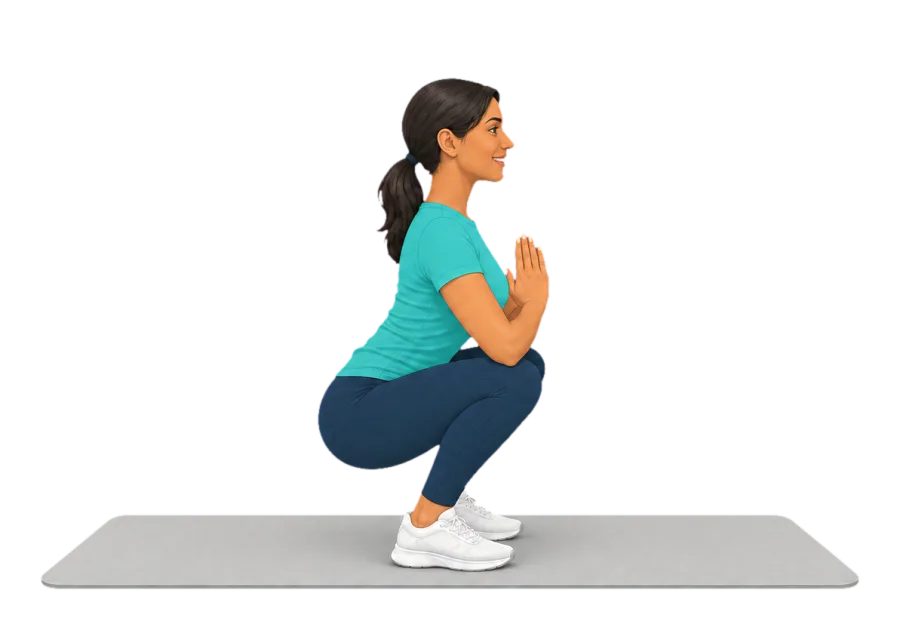
The Yoga Squat is used to explore the full range of the hips, knees and ankles at once. Yoga Journal lists the ankles, groins and back of the torso as what it stretches.[1] Its folded shape is also about as far as the body can get from an office chair.
The hold is also a practical test. A person whose heels rise or whose hips cannot reach low enough learns quickly which joint limits them. Sitting on a low block keeps the heels flat and the position restful.
In many places it is not exercise at all but an ordinary way to rest. Squatting often replaces sitting or standing among many adults in China, Southeast Asia and Eastern Europe.[2]
How to Do It
A deep, resting squat for the hips and ankles. Stand with your feet wider than your hips and your toes turned out, then sink your hips down and bring your hands together, with your elbows gently pressing your knees apart. You should feel your inner thighs and ankles stretching. Sit on a low block if your heels lift.
- Feet wider than hips, toes out
- Sink your hips down
- Elbows gently press the knees
Pad your knees with a folded towel or cushion. Skip it if kneeling hurts.
How It Got Its Name
The word mala means garland, necklace or rosary, joined to asana, posture.[5] In Light on Yoga, Iyengar explains the name by the arms that hang from the neck like a garland, and his Malasana is a much more bound shape than the one taught here, with the feet together and the back rounded.[5] Yoga Journal instead links the name to mala prayer beads and the arm wrap.[1]
The name is disputed in modern writing. The teacher Indu Arora has argued that it comes from mala, meaning bodily waste, and calls the posture the defecation pose. The writer Daniel Simpson disagrees, saying that the two Sanskrit words are distinct, one with long vowels and one with short, and that no evidence was offered for that reading.[6] The sources consulted support the garland reading as the established one. The name Yoga Squat avoids the question.
History
People squatted long before anyone named it. Cross-cultural study of posture goes back at least to Marcel Mauss's work on body techniques in 1934 and Gordon Hewes's survey of postural habits in 1955, and Erik Trinkaus discussed squatting among Neandertals in 1975.[2] The anthropological interest lies partly in the bones, because squatting facets can act as markers of habitual squatting in skeletons.[2]
Within yoga, the name came first and the shape arrived later. The 19th-century Sritattvanidhi uses Malasana for an arm-balancing pose with the knees on the shoulders. Wikipedia, citing Norman Sjoman, equates it with Bhujapidasana; Wisdom Library, citing the same scholar, matches it with what Iyengar calls Tittibhasana.[5][7] The sources disagree on the modern equivalent, but both show a pose unlike a squat.
Light on Yoga, published in 1966, then gave the name to a bound squat with the feet together.[5] The wider, simpler squat with palms together is recorded as Upaveshasana, but in the West it is often called Malasana.[5] When that shift took place is not documented.
Muscles and Tendons
At the bottom of the squat the hips and knees are close to fully bent and the ankles are strongly dorsiflexed. The adductors lengthen because the thighs are held wide and turned out; the elbows add a small, steady pressure. The largest, adductor magnus, is also an important hip extensor.[3]
The calf is the other main stretch. Dorsiflexion takes the shin forward over the foot, which lengthens the Achilles tendon and the muscles above it. With the knee bent, the soleus carries more of this stretch than the gastrocnemius, which crosses the knee as well. Anatomists have linked the extreme position to bone itself: squatting facets, small surfaces on the lower tibia and the talus, form where the bones meet in strong dorsiflexion, a link first drawn by C. H. Barnett in 1954.[2]
In the descent, the quadriceps, gluteus maximus, adductor magnus and soleus are the main working muscles of a squat.[4] At the bottom, much of the load passes through the bent joints, and the work falls mainly to the muscles that keep the chest lifted and the body balanced over the feet.
Stretched
- Adductors
- Inner thigh, with the elbows easing the knees apart
- Soleus and gastrocnemius
- Calf, as the shin moves forward over the foot, soleus especially with the knee bent
- Gluteus maximus
- Buttock, at full hip bend
- Lower back muscles
- Along the spine, if the back rounds
Working
- Quadriceps
- Lower the body and control the squat, resting at the bottom
- Tibialis anterior
- Front of the shin, to draw the body forward over the feet
- Back extensors
- Lift the chest against gravity
- Hip adductors and gluteals
- Support the wide stance
Tendons and Fascia
- Achilles tendon
- Back of the ankle, in the full ankle bend
- Plantar fascia
- Sole of the foot, a light stretch
Where It Is Used Today
The pose appears in many general yoga classes. Yoga Journal suggests holding it for 30 seconds to a minute.[1] Strength coaches also use holds at the bottom of the squat as preparation for loaded squatting.
Outside the gym, deep squatting is used at squat toilets across much of the world.[2] A 2014 Japanese study observed children aged 6 to 12: about 60 percent chose a deep squat in a free drawing task, and a little over 70 percent could do it correctly on request. Bed style and exercise habits were linked to the results.[8]
Variations and Related Moves
A low block under the hips or a folded blanket under the heels reduces the demand on the ankles.[1] Taking the hands to the floor and lifting the chest makes the hold more active. Prapadasana keeps the heels together on tiptoe.[5]
In Iyengar's stricter forms, Malasana I wraps the arms around the back and Malasana II has the hands around the heels, with the chin to the floor.[5] Deep Squat Hold, Ankle Rocks and Frog are the nearest relatives.
Routines With This Move
- Fifteen Minute Reset
- Hip Opener
- Hips All Round
- Squat Depth
- Ten Minute Reset
See Also
Sources
- Malasana or Garland Pose (opens in a new tab). Yoga Journal.
- Squatting position (opens in a new tab). Wikipedia.
- Adductor magnus muscle (opens in a new tab). Wikipedia.
- Squat (exercise) (opens in a new tab). Wikipedia.
- Malasana (opens in a new tab). Wikipedia.
- Garland or excrement? (opens in a new tab). Ancient Futures, 2026.
- Malasana, Mala-asana, Mālāsana: definitions (opens in a new tab). Wisdom Library.
- Influence of lifestyle and exercise habits on the deep squatting posture in Japanese children (opens in a new tab). Anthropological Science (Japanese Series), 2014.
Further Reading
- Sritattvanidhi (opens in a new tab). Wikipedia.
- Yoga as exercise (opens in a new tab). Wikipedia.
General information about this move, not medical advice. Stop if something hurts, and read our Safety page before you start. If you have a health condition, ask your doctor or physiotherapist first.