What It Is For
Low Cobra is an entry-level backbend. The person lies on the front, places the hands under the shoulders and lifts the chest a small way, keeping the hips on the floor and the shoulders away from the ears. The stretch at the front is mild, and the back muscles provide light work.
Its purpose is to move the spine into extension in a small, controlled way, a direction that long hours of sitting rarely offer. Teachers often use it to prepare for larger backbends, and it forms part of many flowing sequences. Unlike the full pose in the sun salutation, the low form does not need straight arms.[1][2]
How to Do It
A small, gentle backbend. Lie on your front with your hands under your shoulders, then lift your chest just a little, keeping your hips on the floor and your shoulders away from your ears. You should feel a mild stretch across your stomach and light work along your back, without any pinching.
- Hands under your shoulders
- Lift your chest a little
- Keep your hips on the floor
Arch only a little at first. Stop if it causes sharp pain or pain down a leg.
How It Got Its Name
Bhujangasana joins the Sanskrit bhujanga, meaning snake, with asana, meaning posture or seat, and the name reflects a snake with its head raised.[1] The English word cobra is a modern, specific choice for a word that means any serpent. In the 19th-century Sritattvanidhi, it is called Sarpasana, or serpent pose.[1] The word low simply marks the small version. Who first used that English label is not documented.
History
The pose has an unusually firm early record for a backbend. It is described in the Gheranda Samhita at chapter 2, verses 42 and 43.[1] That text is usually dated to the late 17th century, probably from northeast India, and it lists 32 asanas.[5] Claims of greater age are not supported by the sources reviewed here.
Later records show its continuity. The Sritattvanidhi includes it as Sarpasana in the 19th century, and Narayana Ghamande illustrated it as Bhujangasana in his 1905 work Yogasopana Purvacatuska.[1]
The pose was then absorbed into the modern sun salutation. Scholars have argued that Krishnamacharya drew partly on the dand exercises of Indian wrestlers, described in the 1896 Vyayama Dipika, and that certain dands closely resemble Bhujangasana.[2] This argument is about the sequence and not the origin of the pose, which is older. Upward Dog was introduced from the sun salutation by Krishnamacharya in the mid-20th century, and his pupils carried both forms forward.[1] B. K. S. Iyengar's Light on Yoga, published in 1966, helped to standardise the pose internationally.[1][6]
The low version seems to be a teaching adaptation, not a historical form. No source records when it was first separated from the full pose.
Muscles and Tendons
The front of the trunk lengthens as the spine extends. The rectus abdominis, which flexes the lumbar spine, is drawn long by the opposite movement.[3] The erector spinae shorten and work to extend the back, so this pose loads those muscles and does not stretch them.[4] The arms share the work: the higher the chest, the more the triceps and shoulders help.
Hip position matters too. Keeping the pelvis on the floor means the lower back and upper spine must supply the movement. In the larger Upward Dog variant, the hips lift off the ground and the weight moves on to straight arms, which is a substantially different load.[1]
Stretched
- Rectus abdominis
- Lengthens as the chest lifts and the spine extends
- Obliques
- Mildly lengthened along the sides of the abdomen
- Hip flexors
- A small stretch at the front of the hips, which stay on the floor
Working
- Erector spinae
- Hold the spine in extension
- Triceps
- Help to support the chest, more as the arms straighten
- Shoulder blade muscles
- Keep the shoulders down away from the ears
- Gluteals and hamstrings
- Lightly keep the legs long
What Research Has Looked At
Little research isolates the low form. A 2019 motion capture study of ten experienced practitioners recorded the sun salutation, including full Cobra. The average spinal extension was about 30 degrees, with a very wide spread between people, and neck extension was large.[9] These figures describe trained practitioners in a full version, not beginners in a low one. The authors' own data also contain a large spread, so they should be read with care.
Where It Is Used Today
Cobra is taught in most yoga styles. It is part of the Sivananda sun salutation and of the Bikram sequence.[1] In Yin Yoga, a passive form called Seal uses straight arms and relaxed legs, with a very different intent from the active pose.[7]
A similar movement appears in clinical settings. A Cambridge University Hospitals NHS exercise sheet includes lying face down with the hands under the shoulders and the elbows straightening, listed as a lumbar spine extension exercise.[8] These sheets do not use yoga names, and each person's suitability depends on individual advice.
Variations and Related Moves
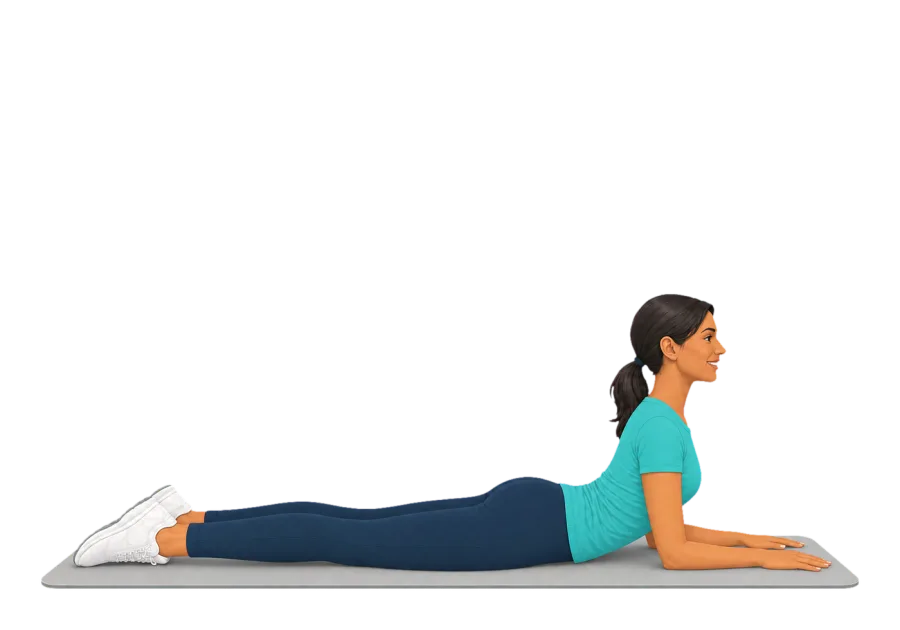
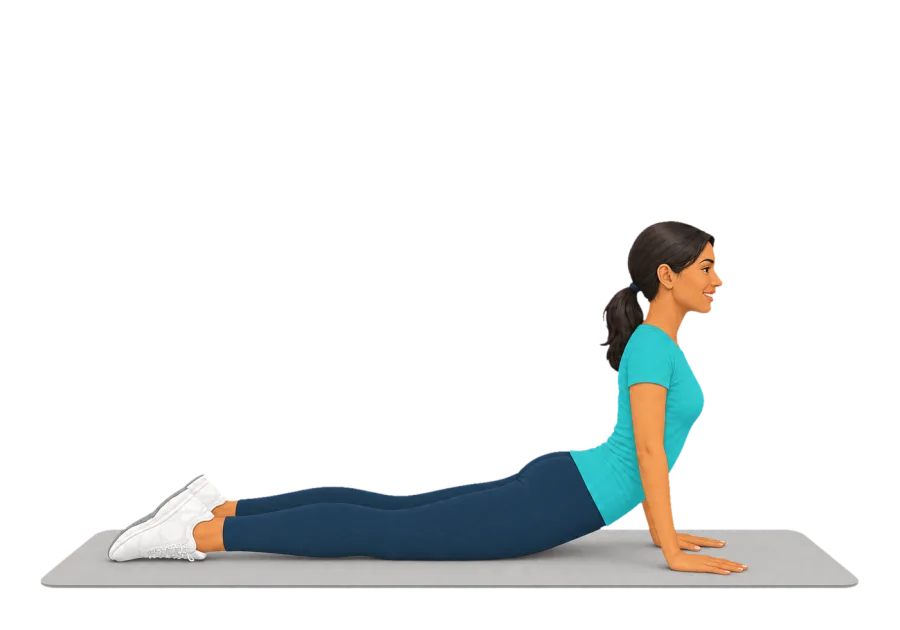
Resting on the forearms gives Sphinx, an easier form with a gentler backbend.[1] Straightening the arms a little more makes the backbend larger. Keeping the hips down is the clearest difference from Upward Dog, where the hips and thighs lift.[1]
King Cobra, or Raja Bhujangasana, is an advanced form in which the head, neck and chest arch much further back.[1]
See Also
Sources
- Bhujangasana (opens in a new tab). Wikipedia.
- Surya Namaskar (opens in a new tab). Wikipedia.
- Rectus abdominis muscle (opens in a new tab). Wikipedia.
- Erector spinae muscles (opens in a new tab). Wikipedia.
- Gheranda Samhita (opens in a new tab). Wikipedia.
- Light on Yoga (opens in a new tab). Wikipedia.
- Yin Yoga (opens in a new tab). Wikipedia.
- Back mobility exercises (opens in a new tab). Cambridge University Hospitals NHS Foundation Trust.
- Kinematics of Suryanamaskar Using Three-Dimensional Motion Capture (opens in a new tab). International Journal of Yoga, 2019.
Further Reading
- Tirumalai Krishnamacharya (opens in a new tab). Wikipedia.
- Yoga Body (opens in a new tab). Wikipedia.
General information about this move, not medical advice. Stop if something hurts, and read our Safety page before you start. If you have a health condition, ask your doctor or physiotherapist first.