What It Is For
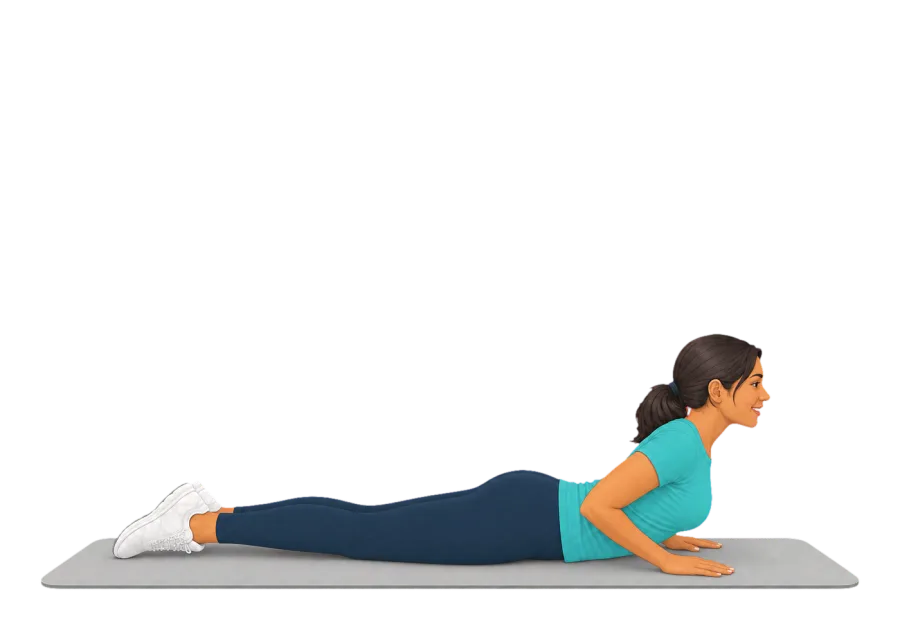
Press-Ups From Lying is a repeated, gentle backward bend of the lower spine. The person lies on their front with hands under the shoulders, straightens the arms as far as is comfortable, leaves the hips on the floor, then lowers. The aim is that the arms do the work and the back stays relaxed. It should not be confused with the gym press-up, in which the whole body leaves the floor.
People use it to move the lower back into extension, often after long periods of sitting or bending forward. Physiotherapists often include it in programmes for people with low back pain, particularly those trained in the McKenzie method, where the choice of exercise depends on how a person's symptoms respond to movement.[1] It is not given to everyone, and McKenzie's approach also includes flexion and sideways movements.[1]
Whether the method improves outcomes is disputed, and the evidence is set out below. The exercise itself is simply a way of moving the spine, and comfort is the guide to how far it goes.
How to Do It
A gentle extension move for your lower back. Lie on your front with your hands under your shoulders, press up through your arms while your hips stay on the floor, then lower slowly. Go only as far as is comfortable and let your back stay relaxed. You should feel an easy bend in your lower back, with your arms doing the work.
- Hands under shoulders
- Hips stay down
- Only as high as is easy
Arch only a little at first. Stop if it causes sharp pain or pain down a leg.
How It Got Its Name
Prone press-up simply means a press-up done lying face down, and research papers use the term press-up for this movement.[2] Extension exercises are often just called McKenzie exercises, although the method covers more than extension.[1] Clinicians also speak of extension in lying, which describes the position plainly.
History
An influential earlier programme took the opposite view. In 1937 the Dallas orthopaedic surgeon Paul Williams published a programme that encouraged lumbar flexion and avoided extension, intended to flatten the lower back curve.[3]
The McKenzie Institute's account of its founder dates the change of direction to 1956 at Robin McKenzie's clinic in Wellington. A patient, known in the story as Mr Smith, had right-sided low back pain reaching his knee and had not improved after three weeks. He lay face down with his back overstretched for about five minutes. He reported feeling better, with the leg pain gone and the back pain moved towards the middle.[4] This is the institute's own story, repeated widely, and no independent record of the day was found. McKenzie went on to call this shift of pain towards the spine centralisation.[1]
McKenzie spent the following years testing how positions and repeated movements affected his patients.[4] In 1980 he published a self-care book for the public, and in 1981 he published The Lumbar Spine: Mechanical Diagnosis and Therapy, launching the name Mechanical Diagnosis and Therapy.[1] His ideas spread to the United States in the 1970s through work with the Kaiser hospitals, according to the institute, and he founded the McKenzie Institute for training and research in 1982.[4]
McKenzie did not necessarily invent the movement. Yoga has a similar shape in Bhujangasana, Cobra, which the Gheranda Samhita describes and Iyengar set out in Light on Yoga in 1966.[5] No source shows that McKenzie took it from yoga, and his version differs: Iyengar's Cobra keeps the buttocks and thighs tight, while McKenzie's aim is a relaxed lower back.[5]
Muscles and Tendons
The movement is unusual because the muscles that normally extend the spine are meant to stay quiet. The triceps straighten the arms, helped by the chest and front of the shoulders, and serratus anterior steadies the shoulder blades. The lower back is taken into extension passively, by the arms lifting the trunk while the pelvis stays down. Dynamic MRI has been used to measure this extension segment by segment.[2]
The stretch is mild and spread across the front of the body. The abdominal wall lengthens, and the hip flexors may be felt slightly at the top. The anterior longitudinal ligament, on the front of the vertebral bodies, comes under tension as the spine extends, as standard anatomy would predict.
Stretched
- Rectus abdominis
- Lengthens gently across the front of the trunk as the spine extends
- Hip flexors
- Slight lengthening at the top, with the pelvis left on the floor
Working
- Triceps brachii
- Straighten the elbows and do most of the lifting
- Pectoralis major and anterior deltoid
- Help the press from the floor
- Serratus anterior
- Steadies the shoulder blades on the ribcage
Tendons and Fascia
- Anterior longitudinal ligament
- Runs down the front of the vertebral bodies and is tensioned in extension
What Research Has Looked At
A trial published in 2004 screened 312 people with low back pain, found that 230 had a preferred direction of movement, and assigned them to matching, opposite or non-directional exercises. The matched group did better on all outcomes measured, and about a third of the others withdrew early. The authors said the result needed repeating.[6]
A 2023 Cochrane review of five trials reached a less favourable conclusion for recent-onset low back pain. It found low to very low certainty evidence, effects on pain and disability that were not clinically important, and no trial that measured adverse events. It concluded that the method was not an effective approach for that group.[7] Reviews of chronic low back pain report small to moderate effects with methodological weaknesses, and they differ in their conclusions.[1]
One 2008 trial looked at the exercise itself in 30 adults. After a single session of press-ups or spinal mobilisation, both groups had more lumbar extension on dynamic MRI and lower pain scores, with no difference between groups. The authors questioned the clinical importance of the pain change.[2]
Where It Is Used Today
The McKenzie Institute reports 28 branches and trains physiotherapists in many countries, and the method remains in wide use for spinal and limb complaints.[4][1] The movement is also taught outside that system in general back exercise routines.
In a method clinic it is one step in an assessment, with the clinician watching whether symptoms move towards the spine or away from it. Used on its own, as in a general mobility routine, it is just a simple extension exercise, and it should not be mistaken for the full assessment.
Variations and Related Moves
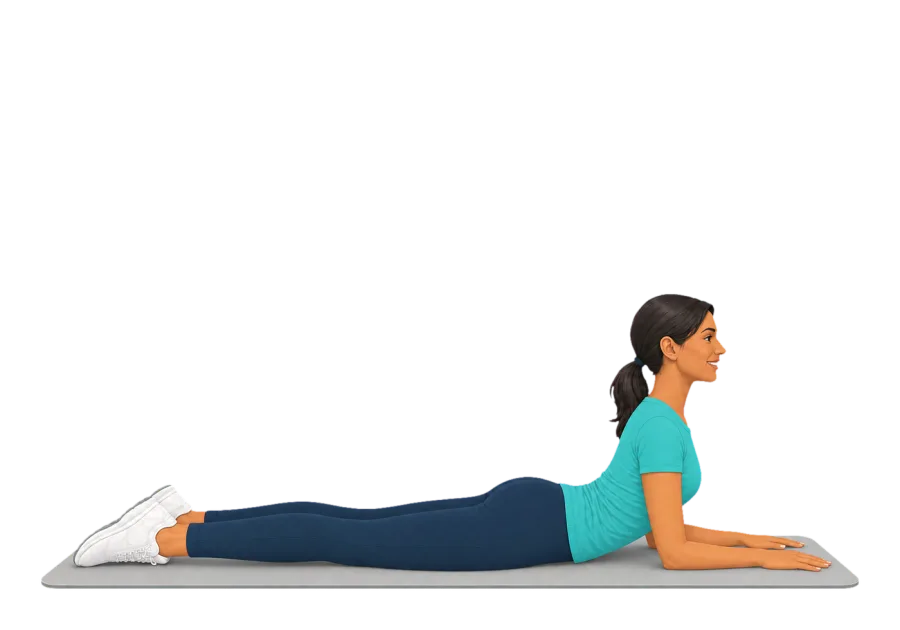
A milder version stays on the forearms, similar to Sphinx. A long breath out at the top is a simple addition. Standing back bends are the upright equivalent.
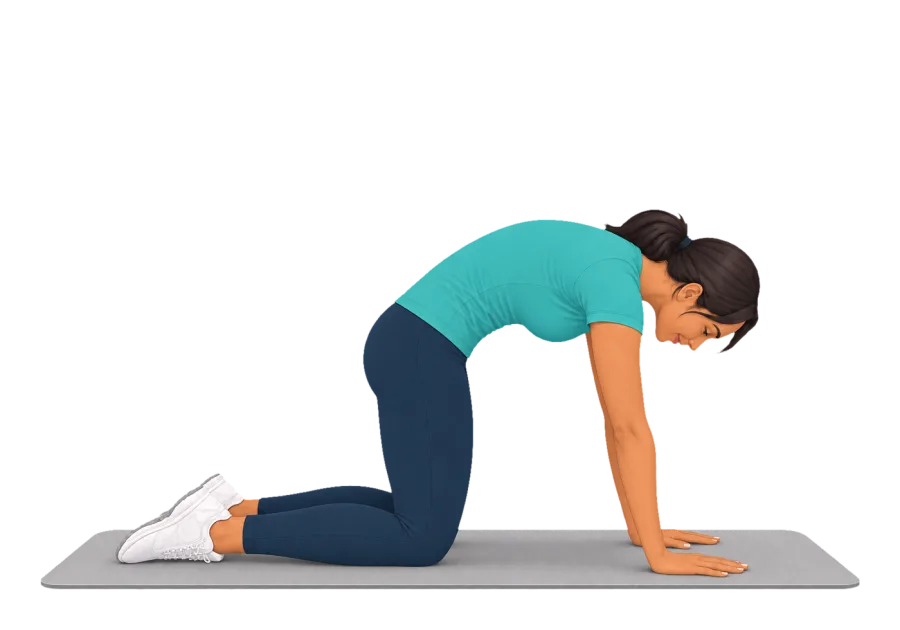
Cobra and Sphinx look similar, but both are usually held and use the back and leg muscles more actively.[5] Cat Cow and Pelvic Tilt move the lower back through a smaller range in both directions.
See Also
Sources
- McKenzie method (opens in a new tab). Wikipedia.
- Effects of a single session of posterior-to-anterior spinal mobilization and press-up exercise on pain response and lumbar spine extension in people with nonspecific low back pain (opens in a new tab). Physical Therapy, record on PEDro, 2008.
- Williams Flexion Exercises (opens in a new tab). Wikipedia.
- The McKenzie Method: How it all Began (opens in a new tab). McKenzie Institute New Zealand.
- Bhujangasana (opens in a new tab). Wikipedia.
- Does it matter which exercise? A randomized control trial of exercise for low back pain (opens in a new tab). Spine, 2004.
- Is the McKenzie method effective for the treatment of (sub)acute non-specific low back pain? (opens in a new tab). Cochrane, 2023.
Further Reading
- Three moves for better spine health (opens in a new tab). Harvard Health Publishing.
- Erector spinae muscles (opens in a new tab). Wikipedia.
General information about this move, not medical advice. Stop if something hurts, and read our Safety page before you start. If you have a health condition, ask your doctor or physiotherapist first.