What It Is For
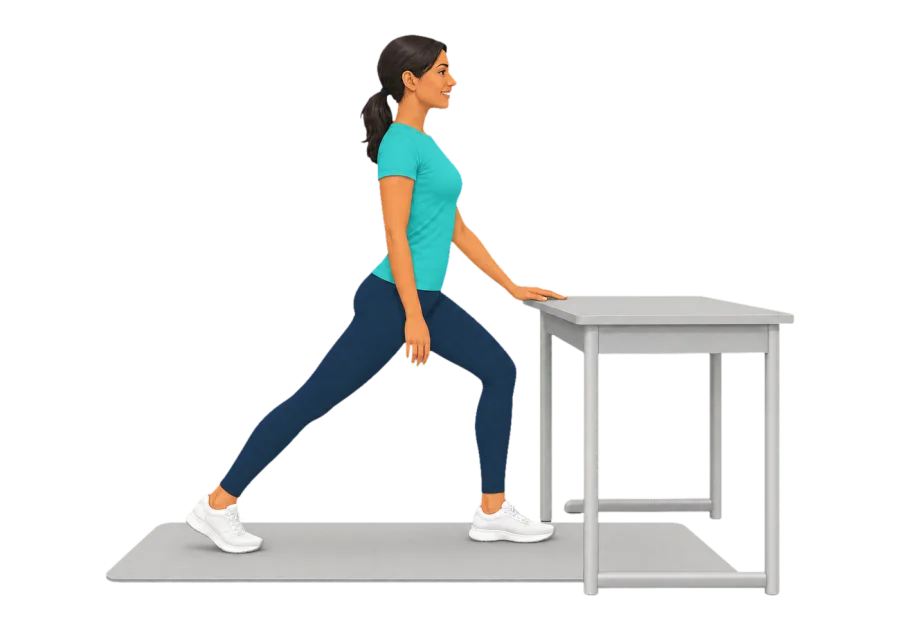
The Low Lunge lengthens the front of the back leg's hip. One foot steps forward with the knee over the ankle, the back knee rests on something soft, and the hips move gently forward.[1] Yoga Journal describes it as a stretch for the thighs and groin.[2]
The small tuck of the tail is the key detail. It tilts the pelvis backwards, which keeps the lower back from arching and takes the stretch to the front of the hip. People who sit for long periods often use it because sitting keeps the hip flexed, and the stretch moves it the other way.
How to Do It
A kneeling stretch for the front of the hip, which gets tight from sitting. Step one foot forward with your knee over your ankle and rest the back knee on something soft. Tuck your tail slightly, then shift your hips forward. You should feel the stretch at the front of the back leg's hip and thigh.
- Back knee down, padded
- Tuck your tail slightly
- Shift your hips forward gently
Pad your knees with a folded towel or cushion. Skip it if kneeling hurts.
How It Got Its Name
Anjaneya means son of Anjana, and refers to Hanuman, the deity of the Ramayana, through his mother.[5][1] The name is a devotional reference and does not describe the shape. Crescent Moon, the other common English name, seems to describe the curved line of the raised arms and back, although the sources do not explain it.[1] The plain name Low Lunge simply distinguishes it from a lunge with the back knee lifted.
History
The lunge has no single history. As a general body position, it belongs to many exercise traditions, including strength training, sports practice and yoga, and no source records an inventor.[6]
The yoga form is modern. Anjaneyasana was unknown in medieval hatha yoga, and Wikipedia reports that it came into modern yoga during the twentieth century from Indian martial arts, although this claim rests on limited sources.[1] The Sivananda Yoga Centre's 1983 Book of Yoga is among the earlier sources listed for it, and a list of asanas gives this as its first description.[7] Earlier use may have gone unrecorded.
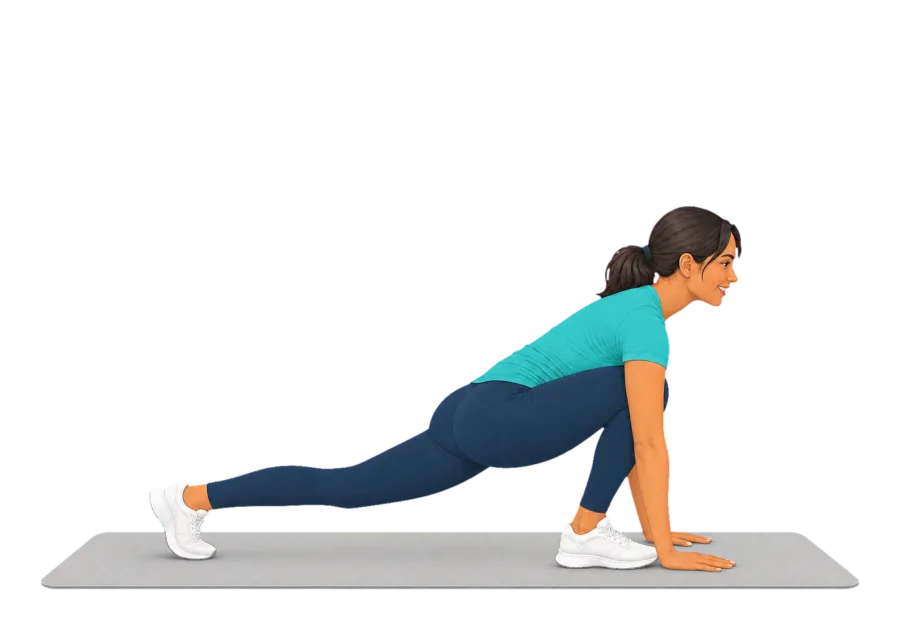
A very similar shape has been in the sun salutation from an early stage, as the sequence popularised by Bhawanrao Pant Pratinidhi in 1928 and later taught by Krishnamacharya.[8] This step is often known as Ashwa Sanchalanasana, or Equestrian Pose.[9] It usually has the back leg extended, but the two are sometimes regarded as the same pose.[1]
The half-kneeling stretch, with the arms relaxed and the pelvis tucked, is the version favoured in rehabilitation and coaching. Its first appearance is not documented.
Muscles and Tendons
The main target is the iliopsoas, formed by the psoas major and the iliacus, the strongest hip flexor. The psoas arises from the T12 to L3 vertebrae and discs, and the iliacus from the inside of the pelvis, and both reach the lesser trochanter of the femur.[3] Moving the back thigh behind the trunk draws them long.
The rectus femoris also crosses the front of the hip, from the pelvis to the patella and then the shin, so it is stretched at the hip as well. It can flex the hip and extend the knee, which means that the stretch becomes greater if the back knee bends further.[4] The gluteals and abdominals work to hold the pelvis, and the front quadriceps support the bent knee. Because the psoas attaches to the lumbar spine, letting the back arch can use up the available movement, and this explains the tuck.
Stretched
- Iliopsoas
- Back leg: lengthens as the hip moves into extension
- Rectus femoris
- Back leg: crosses both hip and knee, and lengthens at the hip
- Other front-of-hip muscles
- Back leg: share the stretch, depending on pelvic position
Working
- Gluteals
- Back leg: help to tuck the pelvis; front leg: steady the hip
- Abdominals
- Hold the slight pelvic tuck
- Quadriceps
- Front leg: support the bent knee
Tendons and Fascia
- Patellar tendon
- The rectus femoris reaches the shin through this tendon, and the back knee rests near it, which is why padding is advised
What Research Has Looked At
A 2024 crossover trial in BMC Musculoskeletal Disorders compared two half-kneeling stretches in 26 active adults without known problems, covering 52 hips. Each stretch was held for 30 seconds, twice. The version with an added posterior pelvic tilt lowered a measure called reactive hip flexor force by 4.85 newton metres, and the difference from the conventional stretch was statistically significant. A commentary notes that the study did not measure hip extension range directly, so the result may reflect changes in stretch tolerance.[11]
A 2019 motion capture study recorded the related Ashwa Sanchalanasana in ten experienced practitioners, and it reported joint angles for both legs. It has a small sample and some internally inconsistent figures.[9]
Where It Is Used Today
In yoga, the pose appears in Sivananda practice and in versions of the sun salutation.[1] It is common in classes for its simple set-up and its adaptations.[2]
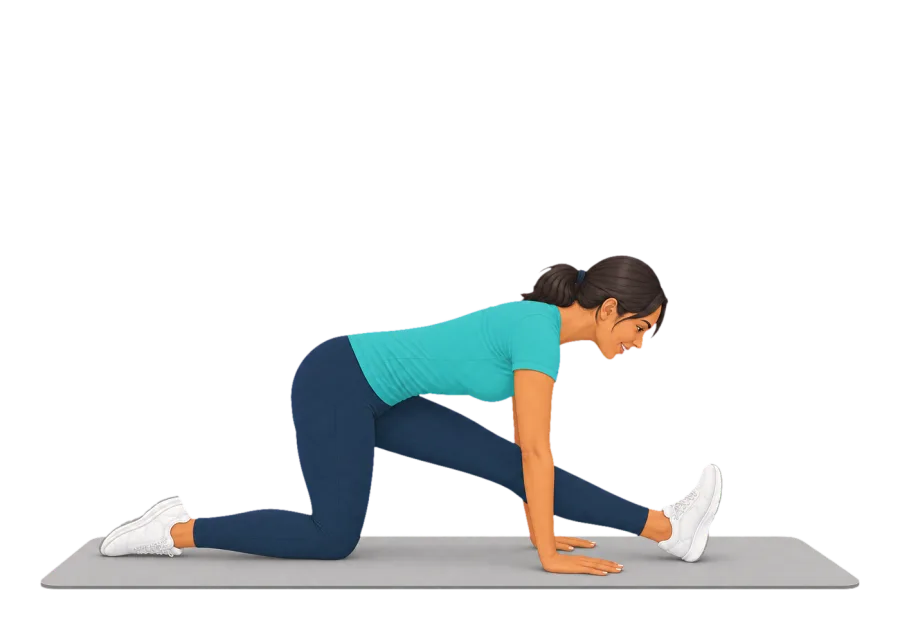
Coaches and therapists use the half-kneeling form as a standard hip flexor stretch. It suits runners and other athletes, who use their hip flexors heavily, and desk workers, who sit for most of the day. It is also a preparation for fuller splits and for the Half Split, which begins from the same position.[10]
Variations and Related Moves
Hands on blocks or a chair give support, and a blanket under the back knee adds padding. Reaching the same-side arm overhead adds a stretch along the side of the trunk. Yoga Journal also shows hands on hips, arms reaching up and the back gently arching.[2]
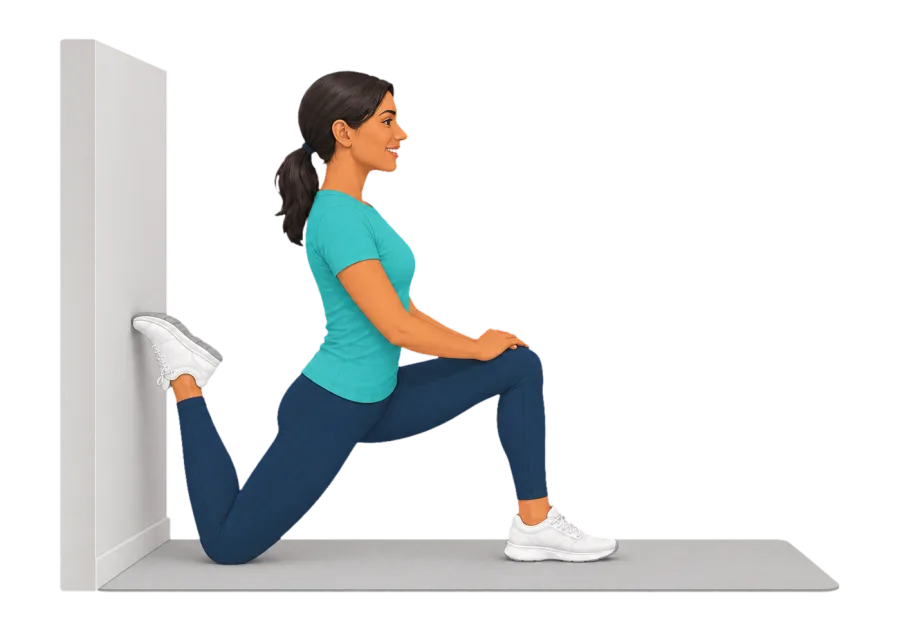
Parivritta Anjaneyasana adds a twist. Raja Anjaneyasana lifts and holds the rear foot, and the High Lunge lifts the back knee to make a strength and balance exercise.[1] The Couch Stretch raises the back foot on a surface, which increases the stretch of the rectus femoris, and Lizard moves the front foot outside the hand.
Routines With This Move
- Calves to Hamstrings
- End of the Working Day
- Fifteen Minute Reset
- Five Minute Reset
- Hip Opener
- Hips All Round
- Hips for Sitters
- Morning Wake Up
- Quick Wake Up
- Runner's Legs
- Slow Morning
- Whole Leg Reset
See Also
Sources
- Anjaneyasana (opens in a new tab). Wikipedia.
- Low Lunge (Anjaneyasana) (opens in a new tab). Yoga Journal.
- Iliopsoas (opens in a new tab). Wikipedia.
- Rectus femoris muscle (opens in a new tab). Wikipedia.
- Hanuman (opens in a new tab). Wikipedia.
- Lunge (exercise) (opens in a new tab). Wikipedia.
- List of asanas (opens in a new tab). Wikipedia.
- Surya Namaskar (opens in a new tab). Wikipedia.
- Kinematics of Suryanamaskar Using Three-Dimensional Motion Capture (opens in a new tab). International Journal of Yoga, 2019.
- Hanumanasana (opens in a new tab). Wikipedia.
- The Best Stretch to Improve Hip Extension Mobility (opens in a new tab). Physiotutors, 2025.
Further Reading
- Tirumalai Krishnamacharya (opens in a new tab). Wikipedia.
- Muscle utilization patterns vary by skill levels of the practitioners across specific yoga poses (asanas) (opens in a new tab). Complementary Therapies in Medicine.
General information about this move, not medical advice. Stop if something hurts, and read our Safety page before you start. If you have a health condition, ask your doctor or physiotherapist first.