What It Is For
The Bridge is mainly a strength exercise for the back of the hips, done lying down with little load on the spine. Because the feet stay on the floor and the body weight is only partly lifted, it is a low-skill way to learn to use the buttocks. It can be repeated or held still, with the hips lifted to a straight line.
In yoga the aim differs. Yoga Journal describes Bridge Pose as a backbend that can be done actively or restoratively, with the chest and front of the body opened and the shoulders drawn under.[1] A version that keeps the lower back from arching sits closer to the gym exercise.
The gluteus maximus is central to standing up from a stoop and to climbing, and the same muscle does the lifting here.[2] For that reason, trainers often use it as a stepping stone to single-leg work and heavier hip extension.
How to Do It
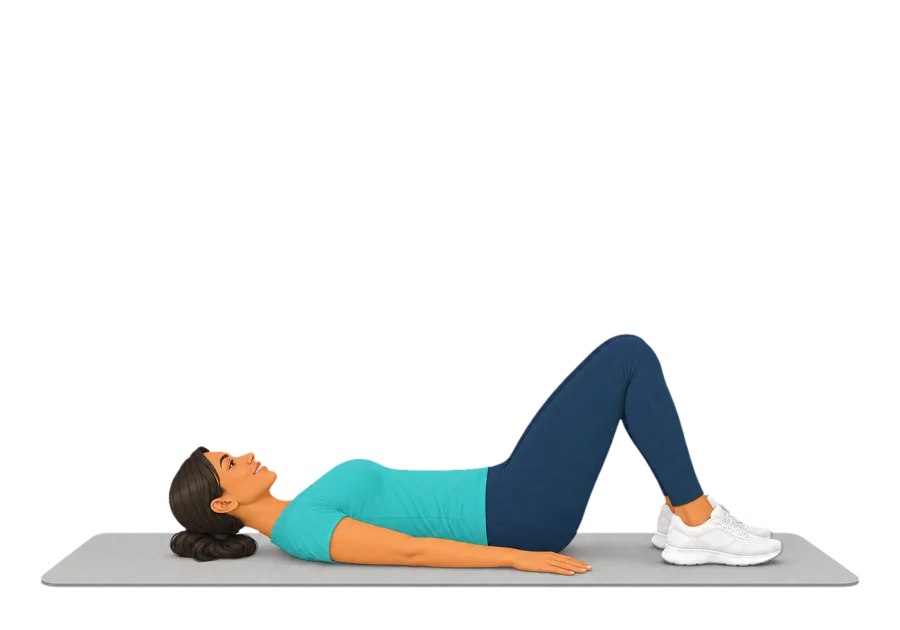
A gentle strength move for the buttocks. Lie on your back with your knees bent and feet flat, hip width apart. Press through your heels and lift your hips until your body makes a long line from shoulders to knees, without arching your lower back. You should feel the work in your buttocks and the backs of your thighs.
- Feet flat, hip width
- Press through your heels
- Lift your hips to a long line
How It Got Its Name
Bridge is a plain image: the body arches like a span, feet and shoulders forming the piers. The Sanskrit Setu Bandha Sarvangasana combines setu, bridge, bandha, usually given as caught, lock or binding, and sarvanga, all the limbs, reflecting its link with Sarvangasana, the shoulderstand.[4][1]
The gym term glute bridge simply names the muscle. Its first use is not documented.
History
The yoga form is illustrated in the Sritattvanidhi, a work compiled at the Mysore Palace before 1868, under the name Kamapithasana.[4][5] Manuals from Light on Yoga of 1966 onwards teach it as a pose entered from the shoulderstand or by lifting the back from the floor, and in the full form the knees are bent and the hands hold the ankles.[4]
The gym and clinic form has a less clear history. No single inventor is recorded, and whether it came from yoga, from exercise therapy or from both is not documented. By the 2010s it was a familiar enough exercise for physiotherapy researchers to compare its variants with electromyography.[6]
Muscles and Tendons
Hip extension raises the pelvis. The gluteus maximus, the main hip extensor, runs from the ilium, sacrum and coccyx to the femur and the iliotibial band.[2] The hamstrings help, since they also extend the hip, but with the knee bent they work at a short length, so their contribution varies with foot position.[3]
The front of the hip is the only area lengthened. Yoga Journal lists the hip flexors and quadriceps among the stretched areas in its active backbend form, as well as the chest and abdomen.[1] In the long-line form this is mild, and the move should not be thought of as a stretch. Press through the heels is a common cue, and the erector spinae and abdominals work together to keep the trunk long, so the movement comes from the hips rather than the lumbar spine.
The gluteus medius helps to hold the pelvis level and the knees from falling in, and its role becomes clear in the single-leg version.
Stretched
- Hip flexors
- Front of the hip, gently, as the hip opens
- Quadriceps (rectus femoris)
- Front of the thigh, mildly
Working
- Gluteus maximus
- Main hip extensor, lifting and holding the pelvis
- Hamstrings
- Assist the hip, more with the feet further away
- Erector spinae
- Hold the trunk in line
- Abdominals
- Stop the lower back from arching
- Gluteus medius
- Keep the pelvis level, and the knees apart
Tendons and Fascia
- Patellar tendon
- Takes light load as the quadriceps steady the bent knee
- Iliotibial band
- Gluteus maximus inserts partly into it
What Research Has Looked At
The bridge has been measured several times with surface electromyography. In a study of 26 adults by Youdas and colleagues, published in 2017, a single-leg bridge to neutral produced gluteus maximus activity of about 34 percent of maximum, equal to a supine resisted hip extension, but much less hamstring activity, about 28 percent against 51 percent.[6]
A 2019 Korean study of 23 subjects compared knee angles. With the knee at 135 degrees rather than 90, gluteus maximus activity was greater and hamstring and erector spinae activity lower. Turning the hips out increased gluteus maximus and medius activity.[7] A 2025 conference poster on 20 male athletes reported that a two-leg bridge on a ball produced the lowest gluteus maximus activity of ten exercises, and that a single-leg version on a ball strongly engaged the hamstrings.[8] These studies are small, and surface measurements of activity do not show training results.
Where It Is Used Today
Physiotherapy researchers regularly study the bridge as a hip extension exercise, and the variants in the research below reflect its place in clinics.[6] In gyms it is a standard exercise for the gluteus maximus, alongside squats, hip thrusts and deadlifts.[2]
Yoga classes use it near the end of a session, often in a supported form with a block under the sacrum, which replaces effort with rest.[1] Yoga Journal advises against it for people with a neck or shoulder injury.[1]
Variations and Related Moves
A smaller lift, lowered slowly, is the easier form. The single-leg bridge is the standard progression. Eka Pada Setu Bandha Sarvangasana is the yoga version of the same idea, with one leg raised straight up, and arms can extend along the floor with the fingers interlocked.[4]
A block under the sacrum turns it into a rest.[1] The heavier gym relative is the barbell hip thrust, with the upper back on a bench. Pelvic Tilts teach the first part of the movement, and the Hip Flexor stretch works the opposite side of the same joint.
Routines With This Move
- Hip Opener
- Hips All Round
- Hips for Sitters
- Long Wind Down
- Low Back Long Ease
- Low Back Quick Ease
See Also
Sources
- Bridge Pose: How to Practice Setu Bandha Sarvangasana (opens in a new tab). Yoga Journal.
- Gluteus maximus (opens in a new tab). Wikipedia.
- Hamstring (opens in a new tab). Wikipedia.
- Setu Bandha Sarvangasana (opens in a new tab). Wikipedia.
- Sritattvanidhi (opens in a new tab). Wikipedia.
- Electromyographic analysis of gluteus maximus and hamstring activity during the supine resisted hip extension exercise versus supine unilateral bridge to neutral (opens in a new tab). Physiotherapy Theory and Practice, summary by Brookbush Institute, 2017.
- Electromyographic Analysis of Gluteus Maximus, Gluteus Medius, Hamstring and Erector Spinae Muscles Activity During the Bridge Exercise With Hip External Rotation in Different Knee Flexion Angles in Healthy Subjects (opens in a new tab). Physical Therapy Korea, 2019.
- Can the gluteus maximus and hamstrings be activated during core strengthening exercises? A comparison of muscle activity in male athletes (opens in a new tab). World Physiotherapy Congress, 2025.
Further Reading
- Pilates (opens in a new tab). Wikipedia.
- Video exercises for back pain (opens in a new tab). Chartered Society of Physiotherapy.
General information about this move, not medical advice. Stop if something hurts, and read our Safety page before you start. If you have a health condition, ask your doctor or physiotherapist first.