What It Is For
The Frog is a stretch for the adductors, the muscles of the inner thigh. On the forearms, the knees slide wide apart, the shins stay parallel and the ankles stay in line with the knees. The hips then rock slowly back. The Yin Yoga site yinyoga.com, which is linked to the teacher Bernie Clark, calls Frog a strong groin opener, especially for the adductors.[1]
Because gravity supplies most of the load, the person can stay for some time. Yin Yoga teaches holds of three to five minutes, far longer than a typical warm-up stretch.[1] Dimensions describes shorter holds of about 30 seconds in a general yoga setting.[2] The app uses a free-breathing hold.
It sits at the stronger end of adductor stretches. The knees take body weight against the floor, so padding is standard advice.[1]
How to Do It
A strong inner-thigh stretch on the floor. On your forearms, slide your knees wide with your shins parallel and your ankles in line with your knees, then rock your hips slowly back. Use padding under your knees. You should feel a stretch high on the insides of your thighs, and it should never hurt the knees.
- Knees wide, shins parallel
- Forearms down
- Rock the hips back slowly
Pad your knees with a folded towel or cushion. Skip it if kneeling hurts.
Go gently if you have had a hip replacement, and check with your surgeon or physio first.
How It Got Its Name
The name is pictorial: wide knees and bent legs resemble a frog's legs. Yoga has two Sanskrit words for this. Mandukasana comes from manduka, frog.[6] Bhekasana comes from bheka, also frog, and refers in most modern practice to a different pose, a prone position in which the hands press the feet down.[7] English writers often mix the two terms, and Dimensions gives both for the same pose.[2]
The more precise name for the app's form is Adho Mukha Mandukasana, Downward-Facing Frog, which describes the forearm position with knees and feet wide.[6]
History
Mandukasana is one of the 32 asanas in the Gheranda Samhita, a late 17th-century text probably from northeast India, where it stands at verse 2.34, followed by Uttana Mandukasana at 2.35.[8][9] It does not appear in the Hatha Yoga Pradipika or the Shiva Samhita.[8] The Gheranda Samhita was translated into English by Srisa Chandra Vasu, and James Mallinson published a Sanskrit and English edition in 2004.[9]
Sharing a name does not mean sharing a shape. Modern yoga uses Mandukasana for several different postures, including a kneeling form with the buttocks on the feet, and Swami Vishnudevananda's book describes a version with the buttocks resting on the ground.[6] The verse itself was not read for this article. The forearm stretch taught here should not be assumed to be the 17th-century pose, and no text has been found that records its first appearance.
Bhekasana offers a parallel warning. Wikipedia's account says it is absent from medieval hatha yoga texts and first appears in 20th-century manuals, among them Vishnudevananda's 1960 book, Pattabhi Jois's Ashtanga yoga and Iyengar's 1966 Light on Yoga.[7]
The wide-kneed floor stretch owes much of its present popularity to Yin Yoga. Paulie Zink introduced long-held floor poses to North America in the late 1970s. Paul Grilley studied with him in the 1980s, and Sarah Powers, who suggested the name Yin Yoga, carried the approach further in the 2000s, by which time it had spread across North America and Europe.[10] Frog became a standard Yin pose, and Yin teachers describe a prone variant with the chest lowered, held for several minutes.[6][1]
Muscles and Tendons
The adductor group runs from the pubic bone and ischium down to the femur, and in the Frog the thighs are held apart, which lengthens it. The adductor longus and brevis, the pectineus and the adductor portion of the adductor magnus are tensioned most directly. The adductor magnus has a second, hamstring-like part arising from the ischial tuberosity, and it responds as the hips rock back and flex further.[3]
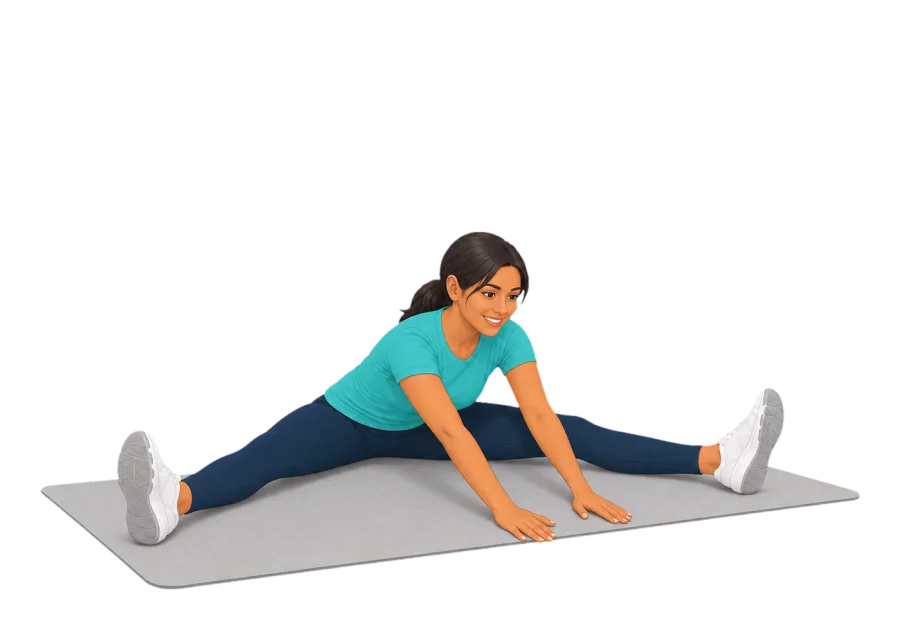
One useful contrast is with the Pancake. The gracilis, a long adductor, crosses the knee, so bending the knee to ninety degrees takes much of the tension off it.[4] The Frog therefore mainly reaches the shorter adductors high in the groin. The hamstrings are also largely spared. One medically reviewed guide lists the hips, groin and inner thighs along with the shoulders, lower back and core.[5]
Rocking the hips back adds flexion at the hip and changes where the stretch is felt. The same site notes that the position also brings a slight back bend, which compresses the lower back, and that letting the hips move forward eases groin or hip pressure.[1] Little muscular work is needed, though the shoulders and abdominals carry some effort in holding the forearm position and limiting the arch in the back.
Stretched
- Adductor longus and brevis
- High on the inner thigh, with the thighs held wide
- Pectineus
- At the top of the inner thigh near the groin
- Adductor magnus
- The large rear adductor, tensioned by the wide thighs and by rocking back
Working
- Shoulder and upper back muscles
- Support the forearms
- Abdominals
- Limit arching of the lower back
- Hip muscles around the joint
- Control the slow rock back and return
Tendons and Fascia
- Adductor tendons
- Attach near the pubic bone, where the stretch is often felt
- Medial knee structures
- Not a target. Any pulling at the inside of the knee is a reason to ease off
Where It Is Used Today
Frog appears in Yin Yoga and general yoga, where it is regarded as an intermediate to advanced pose.[2] It also features in general fitness writing.[5] Teaching notes on the yoga side recommend a bolster under the chest for shoulder comfort and padding under the knees.[1]
Yoga teachers advise care for certain people. YogaUOnline's guide flags those with back or knee pain and those in the second and third trimesters of pregnancy as people who may do better to skip it.[11] No peer-reviewed study of this exact stretch was found.
Variations and Related Moves
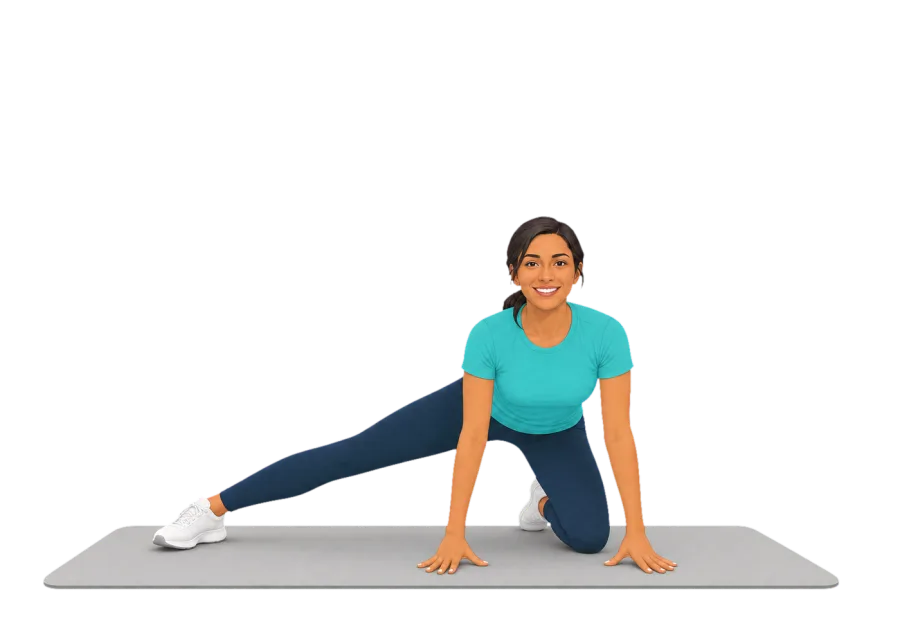
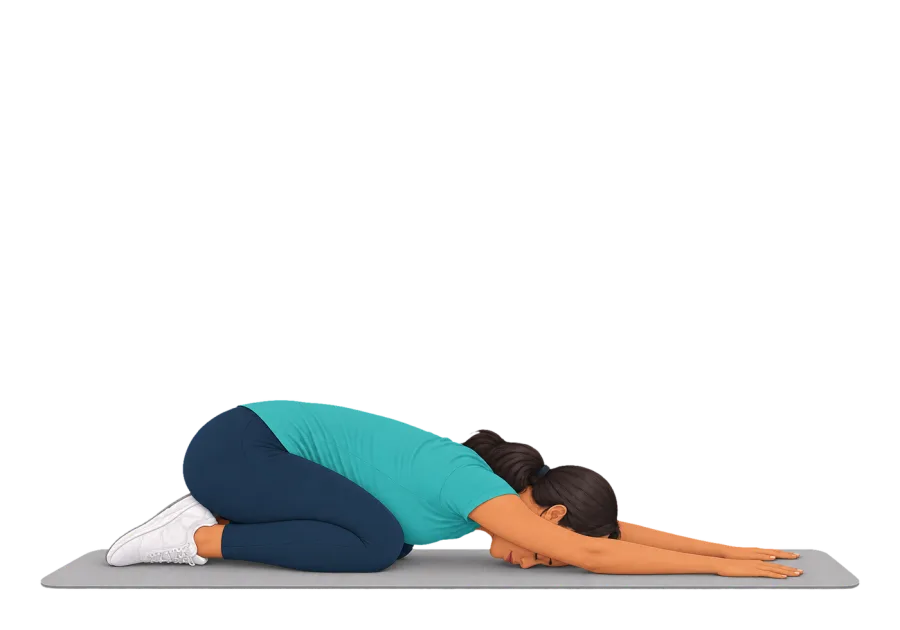
The app's easier option, Half Frog, stretches one leg out to the side while the other stays bent, which reduces the load and lets each side work separately. Terminology differs: yinyoga.com uses Half Frog for hips lifted to knee height with feet together, and Whole Frog for feet as wide as knees. Its Tadpole stays closer to Child's Pose, sitting on the heels with knees apart.[1]
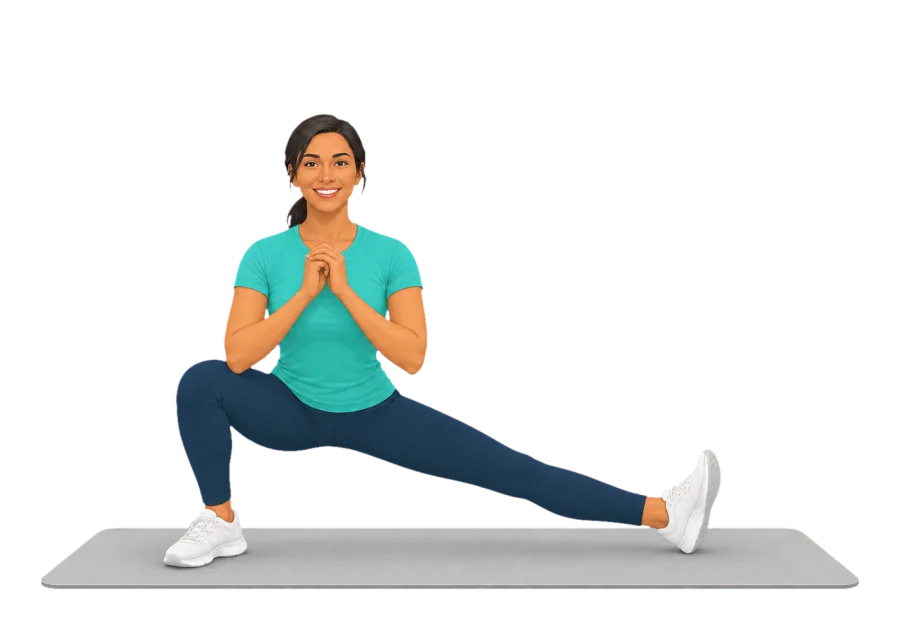
The harder version lowers the chest towards the floor. Related moves include the Adductor Rock, which uses a similar shape in a moving drill, the Pancake, which adds straight knees and hamstrings, and the Cossack Squat, which stretches the adductors while standing.
Routines With This Move
- Lifter's Full Reset
- Squat Depth
See Also
Sources
- Frog Pose (opens in a new tab). YinYoga.com.
- Frog Pose (Bhekasana / Mandukasana) (opens in a new tab). Dimensions.
- Adductor magnus muscle (opens in a new tab). Wikipedia.
- Gracilis muscle (opens in a new tab). Wikipedia.
- Frog Pose Benefits: How to Get the Most from Mandukasana (opens in a new tab). Healthline, 2024.
- Mandukasana (opens in a new tab). Wikipedia.
- Bhekasana (opens in a new tab). Wikipedia.
- Gheranda Samhita (archived copy with table of asanas) (opens in a new tab). Wikipedia mirror, Budapest University of Technology and Economics.
- Gheranda Samhita (opens in a new tab). Wikipedia.
- Yin Yoga (opens in a new tab). Wikipedia.
- Ribit! The Many Benefits of Frog Pose: A Step-by-Step Guide for Adding It to Your Yoga Practice (opens in a new tab). YogaUOnline, 2023.
Further Reading
- Paul Grilley's Discovery of Yin Yoga (opens in a new tab). YinYoga.com.
- Adductor muscles of the hip (opens in a new tab). Wikipedia.
General information about this move, not medical advice. Stop if something hurts, and read our Safety page before you start. If you have a health condition, ask your doctor or physiotherapist first.