What It Is For
The Seated Twist takes the spine into rotation, a direction that long periods of sitting rarely call for. The sitter keeps the hips facing forward, lengthens through the spine and then turns the rib cage to one side. A hand on the back of the chair marks the position and does not lever the body further. It is meant as a short break in a working day and needs nothing more than a chair.
The NHS includes a closely related upper-body twist in its sitting exercises: arms crossed, hips still, a turn as far as is comfortable, held for five seconds.[1] A CU Boulder guide for desk workers lists seated or standing back rotations in an hourly stretching routine.[2] These sources describe the movement as a way to keep the trunk moving, not as a remedy for any complaint.
A second use is respiratory. A patient leaflet from Royal Devon University Healthcare NHS Foundation Trust gives a seated twist to people whose rib cage has grown stiff, including people with neuromuscular disease, because the ribs and the thoracic spine move together in breathing. The aim it states is to help preserve range of movement.[3]
How to Do It
A quick way to turn your spine at a desk. Sit tall with both feet on the floor, then turn from your ribs and rest one hand on the back of the chair. Grow taller as you breathe in and turn a little as you breathe out, without forcing it with your arm. You should feel your mid and upper back rotating.
- Sit tall
- Turn from the ribs
- Hand on the chair back
How It Got Its Name
The name is plain description, and no first use has been traced. Sources give small variations: the NHS says upper-body twist, Royal Devon says seated twist and the CU Boulder guide says seated back rotation.[1][3][2]
The yoga pose it most resembles has a far more elaborate name. Ardha Matsyendrasana means half pose of Matsyendra, a founding figure of hatha yoga whose name means lord of the fishes.[6] Yoga Journal retells the legend behind the name, in which a fish overhears Shiva teaching yoga, is blessed as Matsyendra and takes a seated twist on land.[7] That is a story, not a history, and it belongs to the floor pose, not the chair move.
History
No inventor of the chair twist is recorded, and no first description has been found. It is probably better understood as an obvious movement that many teachers arrived at than as a technique with a single source.
Seated twisting does have a documented past in yoga. The Hatha Yoga Pradipika describes Matsyendrasana at verses 1.26 and 1.27, and the Gheranda Samhita describes it at 2.22 and 2.23.[6] Dates vary between sources: Wikipedia, citing Mallinson and Singleton's Roots of Yoga, places the Pradipika in the 15th century, while Yoga Journal calls it a 14th-century manual.[6][7] The claims those texts make for the pose, including the destruction of disease, are traditional statements and not findings. In 1966 B. K. S. Iyengar's Light on Yoga set out half and full forms of the pose, and in 1905 a Bombay book by Yogi Ghamande used it on its cover in an early realistic halftone plate.[6]
The chair became a teaching tool much later. Alice Christensen's Easy Does It Yoga for Older People of 1979 included chair exercises, and Lakshmi Voelker developed an approach she called Chair Yoga in 1982 after a student with arthritis could not manage floor poses.[8] Iyengar Yoga separately made chairs one of its props.[8] Whether the desk twist descends from this work or arose independently in physiotherapy and workplace advice is not documented.
Muscles and Tendons
The twist belongs mainly to the thoracic spine, the twelve vertebrae that carry the ribs.[3] A 2012 study used three-dimensional CT scans of thirteen volunteers at full trunk rotation. It found about 25 degrees of rotation to each side between the first thoracic and the first lumbar vertebrae, with the largest movement at the mid-thoracic levels, from T6 to T11.[4] This fits the cue to turn from the ribs. The feeling of rotating through the mid and upper back has a measurable basis.
The abdominal obliques produce the turn, working as a crossed pair. The external oblique turns the trunk towards the opposite side and the internal oblique towards its own side, so a turn to the left draws on the right external and the left internal oblique.[5] The erector spinae muscles hold the upright position against the tendency to slump. Stretch is mild: the obliques, the intercostal muscles between the ribs and the small rotators close to the spine lengthen a little at the end of the range. The thoracolumbar fascia, which spans the lower back, is lightly tensioned as the rib cage turns over a pelvis that stays still.
Stretched
- External and internal obliques
- A mild lengthening around the waist, felt towards the end of the turn
- Intercostal muscles
- Between the ribs, as the rib cage turns over the pelvis
- Small rotators of the spine
- Multifidus and rotatores on the side being turned from
Working
- External oblique, opposite side
- Turning left uses the right external oblique
- Internal oblique, same side
- Turning left uses the left internal oblique
- Erector spinae
- Holds the trunk tall so that the turn does not collapse into a slump
Tendons and Fascia
- Thoracolumbar fascia
- The broad sheet across the lower back, lightly tensioned as the trunk turns on the fixed pelvis
Where It Is Used Today
The move appears in office wellbeing programmes, in NHS public guidance aimed at people who find standing exercises difficult, and in hospital leaflets.[1][2][3] Chair yoga classes for older adults use versions of it.[8]
Advice for people with low bone density is more careful. Osteoporosis Canada lists twisting as far as possible among the movements to modify, flags seated twists in particular because sitting adds load through the spine, and suggests lying down for twists.[9] A review in Mayo Clinic Proceedings of 89 people with injuries linked to yoga found that the poses most often involved were extreme forward and backward bends of the spine, not twists, and its advice centred on avoiding extreme flexion.[10] The two sources differ in emphasis, and neither studied a gentle chair twist directly.
Variations and Related Moves
The easiest form is a smaller turn. Crossing the arms and reaching for the shoulders, as in the NHS version, removes the arm from the equation altogether.[1] The more intense form adds a look over the shoulder, which brings in neck rotation. Some clinical instructions use the opposite hand on the outside of the knee to draw the trunk further round; others, such as the CU Boulder guide, use the arms against the chair.[3][2] Using the arm in this way changes the move from an active turn into a partly passive one.
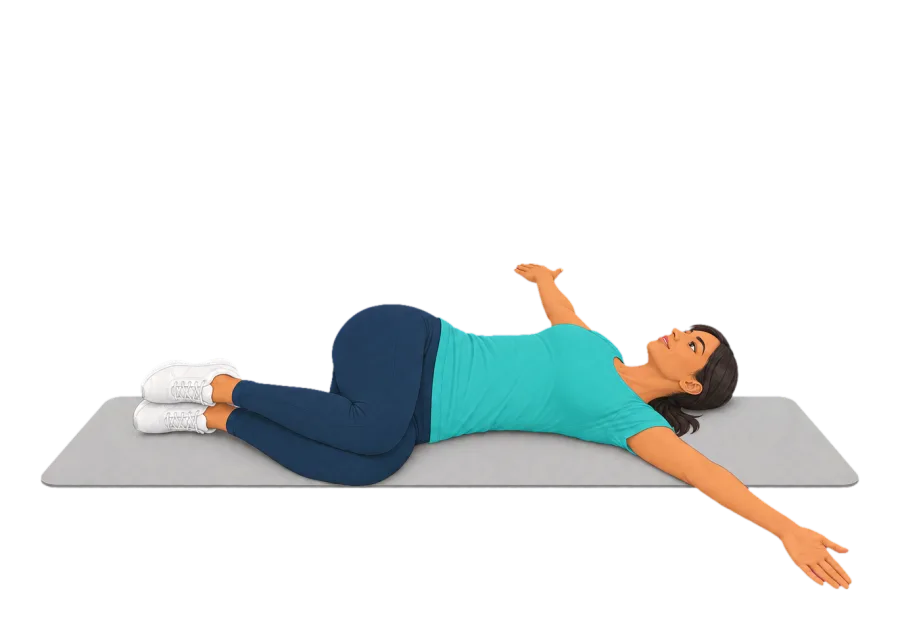
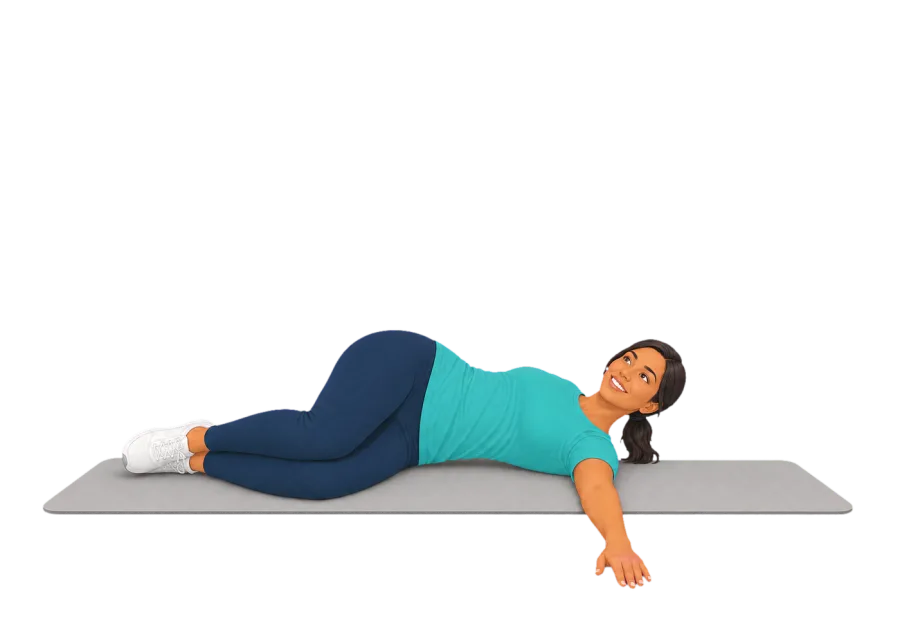
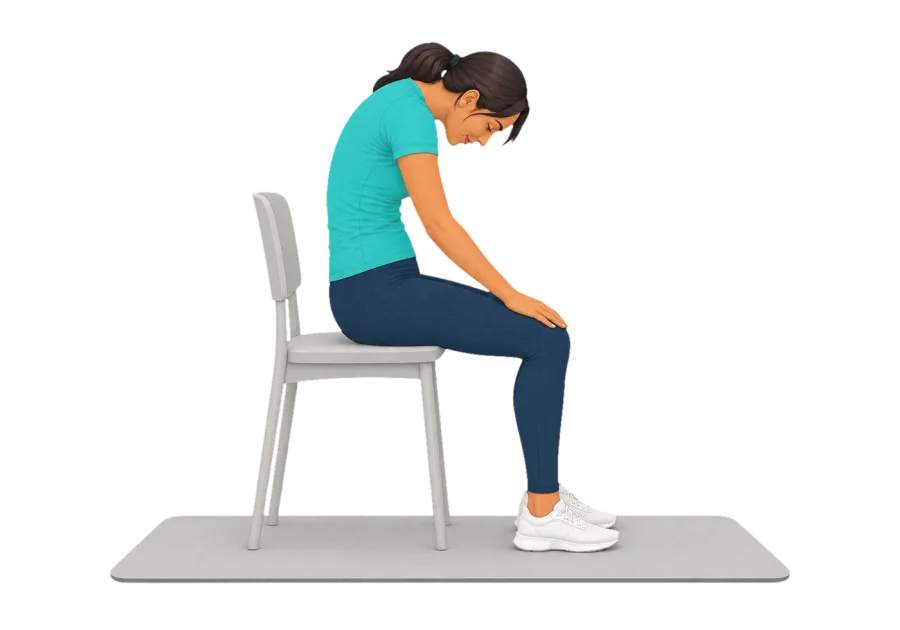
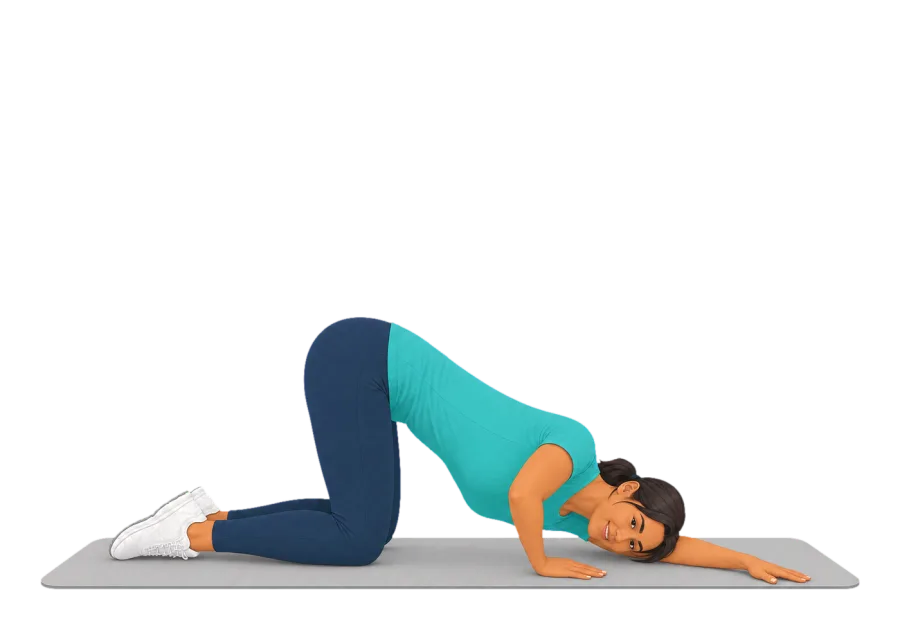
Related moves include the Lying Twist, in which gravity does the work, and the thoracic rotation of the Open Book. Ardha Matsyendrasana is the classical floor relative, with one leg crossed over the other, and it has several forms in Light on Yoga.[6]
Routines With This Move
- Chair Break
- Desk Reset
- End of the Working Day
- Neck Release
- Steady Five
- Steady and Strong, Longer
See Also
Sources
- Sitting exercises (opens in a new tab). NHS.
- Stretching: For Seated, Office, and Desk Workers (opens in a new tab). CU Boulder Environmental Health and Safety.
- Thoracic range of movement (ROM) exercises (opens in a new tab). Royal Devon University Healthcare NHS Foundation Trust.
- Kinematics of the thoracic spine in trunk rotation: in vivo 3-dimensional analysis (opens in a new tab). Spine, 2012.
- Abdominal external oblique muscle (opens in a new tab). Wikipedia.
- Matsyendrasana (opens in a new tab). Wikipedia.
- Twist Your Spine: Ardha Matsyendrasana (Half Lord of the Fishes Pose) (opens in a new tab). Yoga Journal.
- Chair yoga (opens in a new tab). Wikipedia.
- Yoga and Osteoporosis: Suggestions for Safe and Appropriate Practice, Part 2 (opens in a new tab). Osteoporosis Canada.
- Soft Tissue and Bony Injuries Attributed to the Practice of Yoga: A Biomechanical Analysis and Implications for Management (opens in a new tab). Mayo Clinic Proceedings, 2019.
Further Reading
- Hatha Yoga Pradipika (opens in a new tab). Wikipedia.
- Thoracic vertebrae (opens in a new tab). Wikipedia.
General information about this move, not medical advice. Stop if something hurts, and read our Safety page before you start. If you have a health condition, ask your doctor or physiotherapist first.