What It Is For
This stretch lengthens the muscles at the front of the hip of the back leg, using a long split stance. The person stands tall, tucks the tail under and presses the back hip forward. It suits a setting where getting down to the floor is awkward or impossible: an office, a gym floor, a bus stop, or a home without a mat.
Sitting keeps the hips bent for hours, and people often use this stretch as a short counter-position. Exercise libraries describe much the same recipe, including a lunge stance, a tucked pelvis, an upright trunk and hips facing forward.[1] It is also a common choice for runners and others who want to take the hip into extension after activity, though the evidence for such use is limited.
How to Do It
A standing stretch for the front of the hip, handy when the floor is not an option. Take a long split stance, holding a desk for balance, then tuck your tail under and press your back hip forward. A small tuck goes a long way. You should feel it at the top of the back leg's thigh.
- Long split stance
- Tuck the tail under
- Press the back hip forward
Stand next to a counter, wall or sturdy chair and hold on whenever you need to.
How It Got Its Name
The name combines the position with the anatomical target. Hip flexor is a functional label for any muscle that bends the hip, not the name of a single muscle, and the word flexor comes from the Latin for to bend. The specific phrase standing hip flexor stretch is a common exercise-library title with no traced first use.[1]
History
No inventor of this stretch is recorded. It is a standing adaptation of a lunge, and lunge positions occur in many traditions, so tracing one source is not realistic.
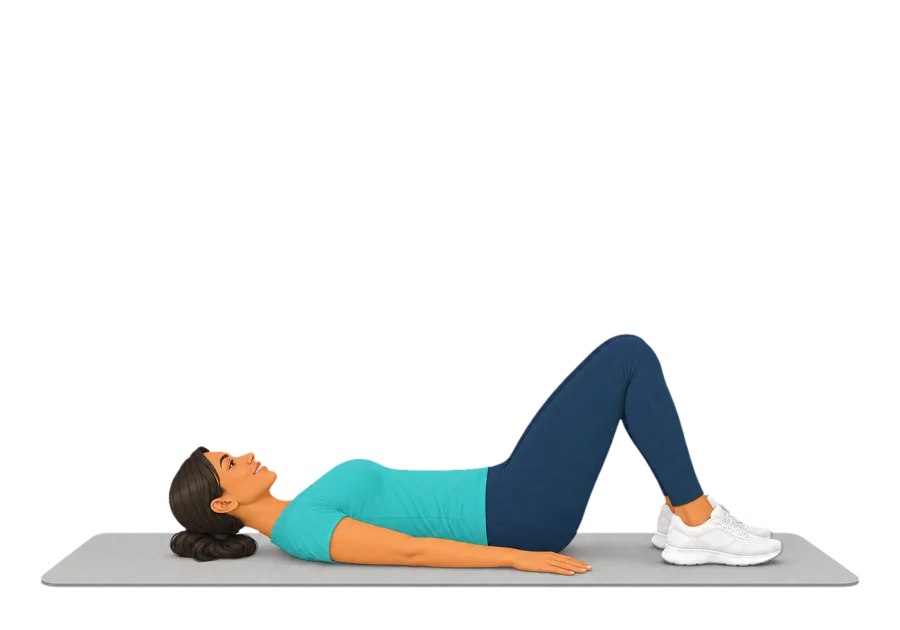
Interest in the length of the hip flexors has a clearer medical history. The Thomas test is named after the Welsh orthopaedic surgeon Hugh Owen Thomas, who lived from 1834 to 1891, and it is illustrated in his 1875 book on diseases of the hip, knee and ankle. It was used to reveal a hip held in fixed flexion, and clinicians still use a modified form to assess the iliopsoas and rectus femoris.[4]
Yoga's nearest relative is younger than is often assumed. The low lunge Anjaneyasana was, according to Wikipedia's account, unknown in medieval hatha yoga and entered modern yoga in the 20th century, with possible roots in Indian martial arts. It appears in the Sivananda system and in versions of Surya Namaskar.[5] This article could not independently confirm the martial arts link. The clinical literature on hip flexor stretching itself dates back at least to the early 1990s, when a controlled study tested passive hip extension stretching in college athletes.[6]
Muscles and Tendons
The main target is the iliopsoas. Psoas major arises from the twelfth thoracic and upper lumbar vertebrae, iliacus from the inner bowl of the pelvis, and the two meet at the lesser trochanter of the femur. Together they form the strongest flexor of the hip.[2] Extending the hip moves these attachments apart.
Rectus femoris is the one head of the quadriceps that crosses both hip and knee.[3] With the back knee nearly straight it is only moderately loaded, and bending the back knee adds tension. That is why a person may feel the stretch at the top of the thigh or further down it.
The pelvic tuck is the key to the move. Without it, the lower back tends to arch and the pelvis tips forward, which allows the leg to go back with little real change at the hip. Tilting the pelvis backwards, with the abdominals and the gluteus maximus of the back leg working, raises the tension on muscles attached to the pelvis and spine. The iliofemoral ligament at the front of the hip also tightens as the hip extends. A small tuck is often enough, which is why the stretch can feel strong in a short stride.
Stretched
- Psoas major and iliacus
- Together the iliopsoas, from lumbar spine and pelvis to the inner upper thigh of the back leg
- Rectus femoris
- The quadriceps head that crosses the hip, more so if the back knee bends
- Tensor fasciae latae and sartorius
- Secondary hip flexors at the outer and front hip
Working
- Gluteus maximus, back leg
- Squeezes to extend the hip and tuck the pelvis
- Abdominals
- Help tilt the pelvis backwards and limit arching of the lower back
- Quadriceps and calf, front leg
- Support body weight on the bent front leg
Tendons and Fascia
- Iliopsoas tendon
- Passes across the front of the hip to the lesser trochanter of the femur
- Iliofemoral ligament
- The strong front hip ligament, which tightens as the hip extends
What Research Has Looked At
Research has tested hip flexor stretching in general, and few if any trials isolate this standing form. In a 1993 study of 25 male college students, a short passive stretching programme increased hip extension range but did not change the economy of walking or running.[6]
A 2004 randomised trial of 33 young patients with limited hip extension found that active and passive home stretching improved range to a similar degree over six weeks.[8] Two 2011 trials ran a ten-week, twice-daily, supervised stretching programme for older adults. In the fit group, passive range improved, and those who began with limited hip extension increased their stride length and peak hip extension when walking.[9] In a frail group, walking speed and stride length rose, without consistent change in hip movement during walking.[10] A small 2012 study of 24 young men found that stretching programmes increased hip range, and that a group doing core and motor control work also improved in some measures.[11]
Where It Is Used Today
Commercial exercise libraries and physiotherapy software include versions of this stretch, some with advice to stay close to a wall or to use chairs for balance.[1][7] Clinicians also use the Thomas test position to check whether the hip can reach neutral.[4] Physiotherapists include hip flexor stretching in programmes for people with low back pain and lower limb problems, which was the population in one randomised trial.[8]
Researchers have also given it to older adults, on the reasoning that hip extension during walking tends to shrink with age.[9] It is widely used in warm-downs by runners and gym users. Standing versions suit people who find kneeling uncomfortable, as well as anyone who cannot easily get up from the floor.
Variations and Related Moves
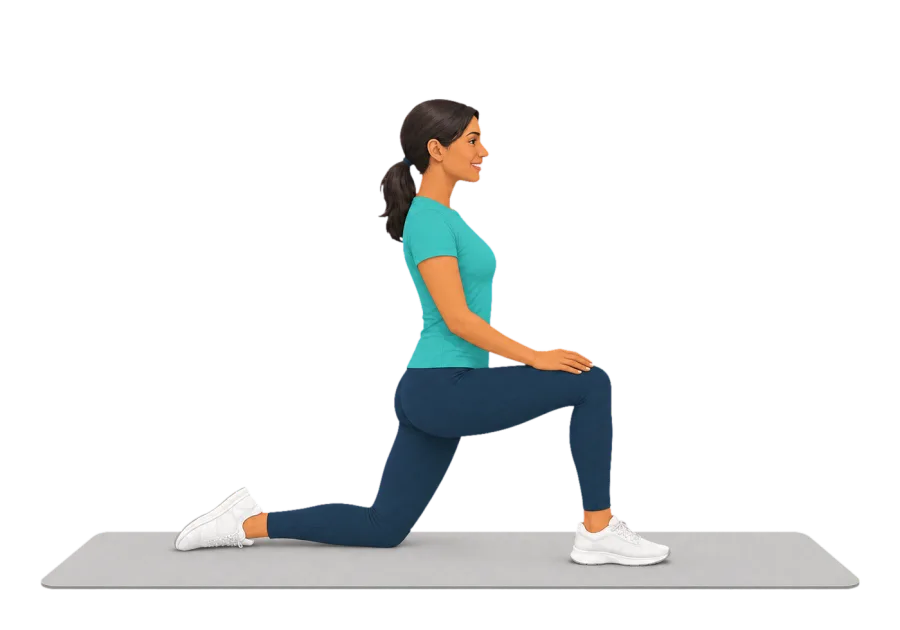
The easier form keeps a hand on a desk. In the more intense form, the arm on the back leg's side reaches overhead, which draws the trunk and the fascia of the side body into the line of the stretch. Clinical software also lists a half-kneeling version between two chairs with a side bend added.[7]
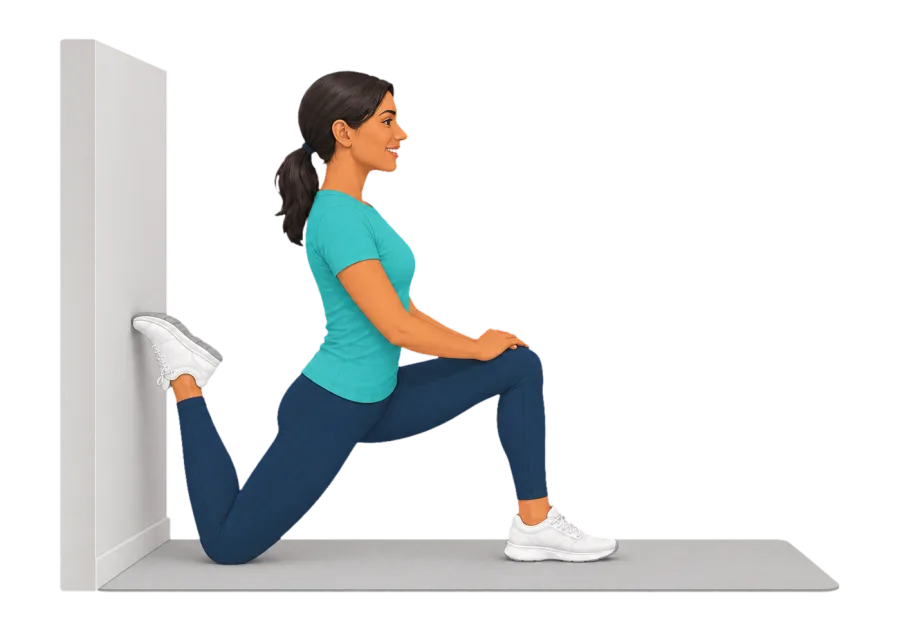
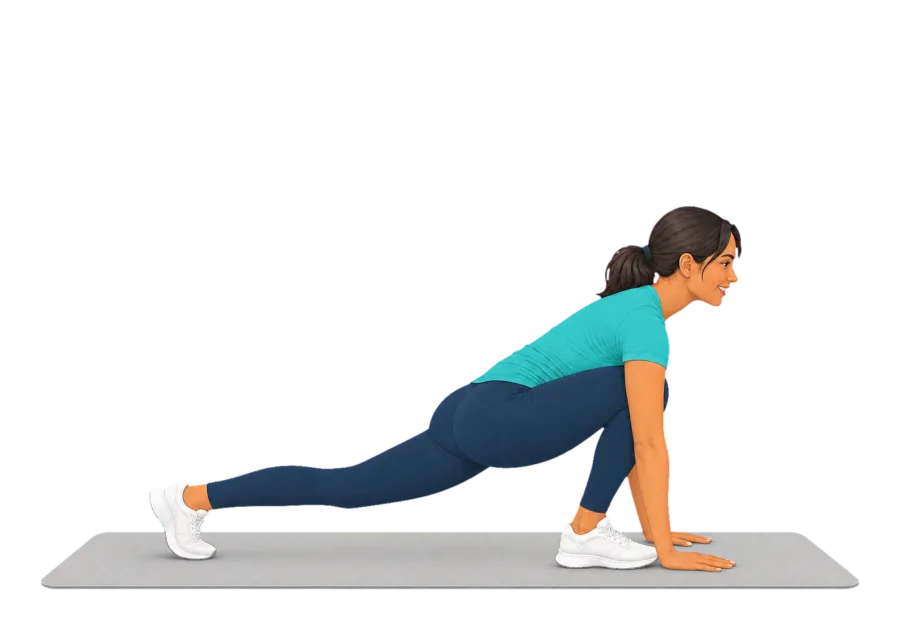
Close relatives include the Low Lunge, the Couch Stretch, which adds a strongly bent back knee for more rectus femoris tension, and the Lizard. Anjaneyasana has many forms, including a high lunge with the back knee lifted, which is close to this move with the arms raised.[5]
Routines With This Move
- Before the Run
- Desk Reset
- End of the Working Day
- On Your Feet
- Whole Leg Reset
See Also
Sources
- Standing Hip Flexor Stretch (opens in a new tab). Motra.
- Iliopsoas (opens in a new tab). Wikipedia.
- Quadriceps (opens in a new tab). Wikipedia.
- Thomas test (opens in a new tab). Wikipedia.
- Anjaneyasana (opens in a new tab). Wikipedia.
- Effects of exercise on hip range of motion, trunk muscle performance, and gait economy (opens in a new tab). Physical Therapy, 1993.
- Hip Flexor and Psoas Stretch with Bilateral Support (opens in a new tab). Physitrack.
- Passive versus active stretching of hip flexor muscles in subjects with limited hip extension: a randomized clinical trial (opens in a new tab). Physical Therapy, 2004.
- Effect of a supervised hip flexor stretching program on gait in elderly individuals (opens in a new tab). PM&R, 2011.
- Effect of a supervised hip flexor stretching program on gait in frail elderly patients (opens in a new tab). PM&R, 2011.
- Hip joint range of motion improvements using three different interventions (opens in a new tab). Journal of Strength and Conditioning Research, 2012.
Further Reading
- Stretching (opens in a new tab). Wikipedia.
- Gluteus maximus (opens in a new tab). Wikipedia.
General information about this move, not medical advice. Stop if something hurts, and read our Safety page before you start. If you have a health condition, ask your doctor or physiotherapist first.