What It Is For
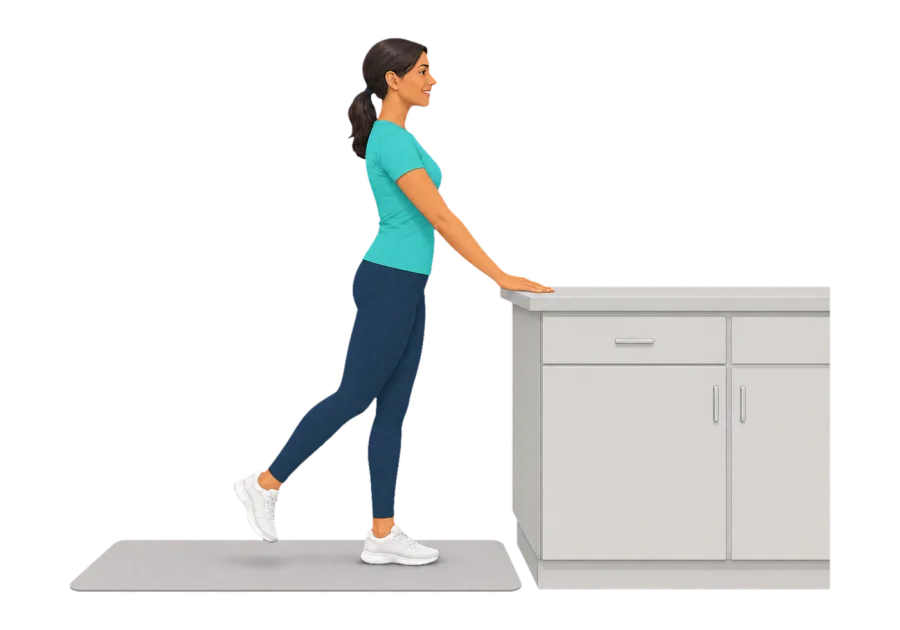
The Heel Raise strengthens the muscles that point the foot downward, the plantar flexors. The person stands holding a counter, rises slowly onto the balls of the feet and lowers even more slowly. It needs no equipment and is an easy way to fatigue the calves.
These muscles matter because walking, climbing stairs and balancing all rely on them. Lunsford and Perry's 1995 paper made the point directly, describing walking as an endurance task for the plantar flexors.[1] The NHS includes calf raises among its strength exercises, with a chair for support.[2] Athletes use heavier versions, and rehabilitation clinicians use them to load the Achilles tendon.
How to Do It
Simple strength for your calves and ankles. Hold a counter, rise slowly onto the balls of your feet, then lower even more slowly. Keep your ankles straight rather than rolling outwards. You should feel your calves working, and they will tire quickly if you take your time on the way down.
- Hold a counter
- Keep your weight even
- Lower slower than you rise
Stand next to a counter, wall or sturdy chair and hold on whenever you need to.
How It Got Its Name
The move has several names, each stressing something different. Heel raise and heel rise describe what the foot does, and calf raise names the muscle being trained. Clinical papers use both standing heel-rise test and calf-raise test for the same procedure.[1][8] The NHS uses calf raises.[2] Toe raise is sometimes used too, but it is confusing, since the Otago booklet lists toe raises as a separate exercise.[9] No first use of any of these names has been traced.
History
No inventor is recorded, and the move is too simple for one to be plausible. Older drill and physical culture manuals may contain early printed versions, but none could be checked for this article.
Its clinical story is clearer. Manual muscle testing has long relied on an examiner's hands to resist a muscle, but examiners cannot apply resistance effectively to the ankle plantar flexors, so clinicians turned to a standing test using body weight. The standard for a Normal grade had been one to five raises. In 1995 Lunsford and Perry measured 203 people without known weakness and found an average of 27.9. They proposed 25 as the new mark.[1]
A 1998 study changed how the Achilles tendon was thought about. Alfredson and colleagues gave 15 recreational athletes with chronic Achilles tendinosis 12 weeks of heavy-load eccentric calf training. Calf strength and pain during activity improved, and all returned to their earlier activity levels, while a comparison group given conventional care did not improve and went on to surgery.[10] The study was small and not randomised, but it drew lasting attention to heavy, slow lowering in tendon rehabilitation.
Later work widened the picture. A 2009 review found no universal agreement about how to run the calf-raise test.[8] A 2015 randomised trial found that heavy slow resistance training gave results as good as eccentric training.[11]
Muscles and Tendons
Two muscles do most of the work, together called the triceps surae. The gastrocnemius starts above the knee on the femur, so it crosses two joints.[3] The soleus lies beneath it, starts below the knee, and has a high share of slow-twitch fibres suited to sustained work.[4] Tibialis posterior and the peroneal muscles assist.[5] All of this force passes through the Achilles tendon to the heel bone. It is the thickest tendon in the body.[6]
Knee position changes the share of work. A 1995 study of ten men found that gastrocnemius activity fell as the knee bent while soleus activity stayed the same, and estimated that the gastrocnemius supplied at least 40 per cent of plantar flexor torque with the leg straight.[7] A standing raise, with straight knees, therefore uses both muscles, and a seated raise shifts the emphasis to the soleus.[5]
Lowering slowly is the eccentric phase, in which the muscle lengthens under load. As done on flat ground the move does not stretch the calf in any significant way: the heels only return to the floor. Letting the heels sink below a step is what adds a stretch.[5]
Working
- Gastrocnemius
- Crosses the knee and ankle, and works strongly with the knee straight
- Soleus
- A fatigue-resistant muscle beneath the gastrocnemius
- Tibialis posterior and peroneal muscles
- Assist and steady the ankle from side to side
Tendons and Fascia
- Achilles tendon
- Carries the calf's pull to the heel bone. Loaded, not stretched, in this form
- Plantar fascia
- Tightens as the toes bend at the top of the rise
What Research Has Looked At
Besides the test and tendon work above, one recent study drew wide attention to a seated variant. In 2022 Marc Hamilton and colleagues at the University of Houston described a seated contraction they called the soleus pushup, in which the heel rises and the foot is then released.[13] They reported that the soleus could keep local oxidative metabolism high for hours with little glycogen use, and measured a 52 per cent smaller rise in blood glucose after eating, in a small laboratory study.[14] The university notes that the method used wearable technology and practice to optimise it, so it should not be equated with an ordinary calf raise.[13]
Where It Is Used Today
Clinicians use the raise as a test and as an exercise. A 2017 study found the heel-rise test highly reliable, with a median of 24 repetitions for men and 21 for women.[12] Rehabilitation programmes use it for calf and Achilles loading, at first with both legs and later with one.
It appears in fall prevention programmes, including an Otago booklet in which older adults rise onto the toes while holding a chair.[9] Bodybuilders and gym users load it with machines, barbells or a leg press, on standing and seated stations.[5] Runners use single-leg versions as part of strength work.
Variations and Related Moves
The easier form keeps both hands on the counter, and the NHS suggests removing the hands as a progression.[2] The harder form rises on one leg at a time, and in the Otago booklet support reduces from two hands to one and then none.[9] Raising from a step and sinking the heels adds range, as does the bent-knee seated form, which changes the emphasis to the soleus.[5]
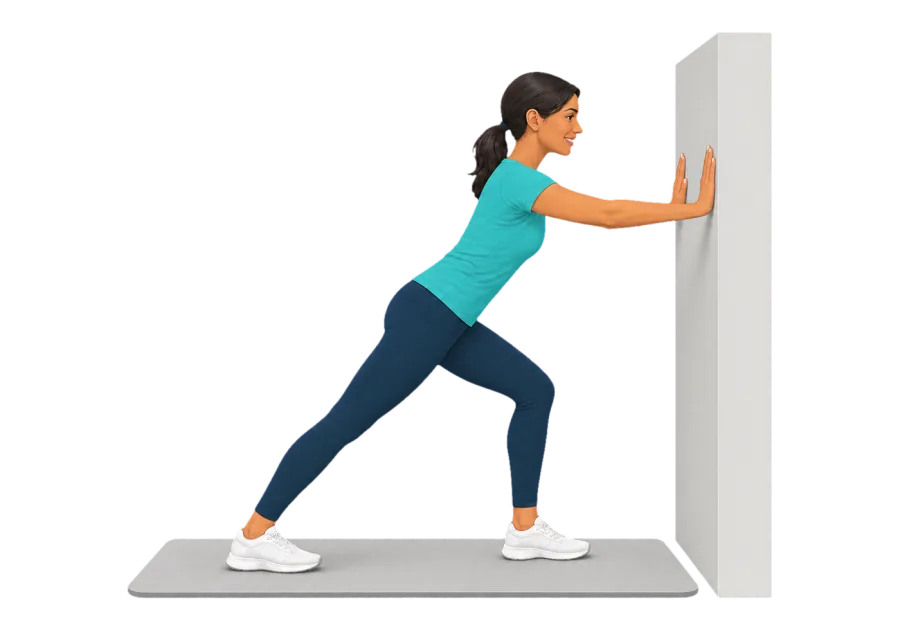
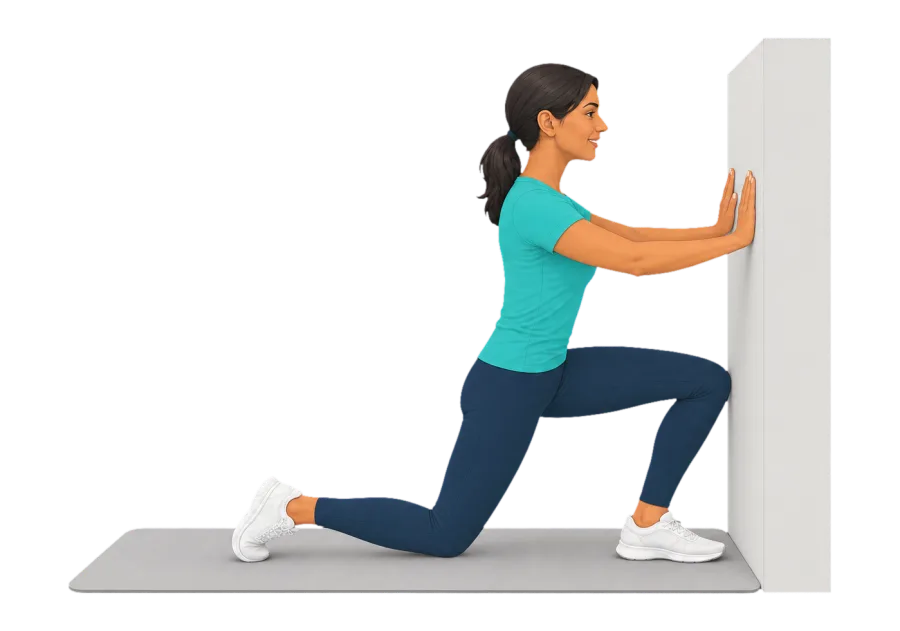
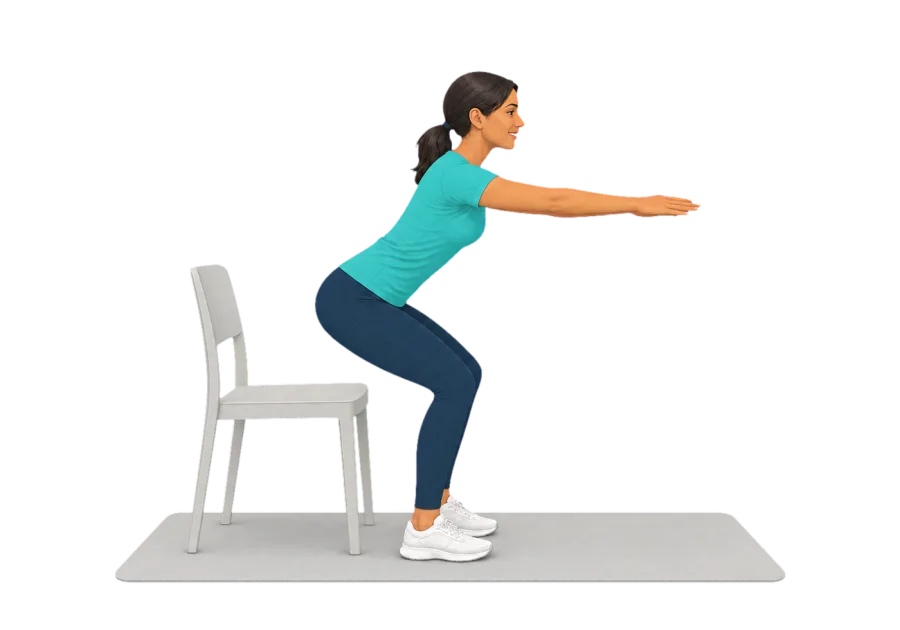
The Wall Calf Stretch is the natural partner: it lengthens what this exercise loads. Knee-to-Wall Ankle Rocks work the same joint without load. Sit to Stand and Single-Leg Stand often appear with it in strength and balance programmes.[9]
Routines With This Move
- Before the Run
- Fresh Legs
- On Your Feet
- Steady Five
- Steady and Strong
- Steady and Strong, Longer
- Whole Leg Reset
See Also
Sources
- The standing heel-rise test for ankle plantar flexion: criterion for normal (opens in a new tab). Physical Therapy, 1995.
- Strength exercises (opens in a new tab). NHS.
- Gastrocnemius muscle (opens in a new tab). Wikipedia.
- Soleus muscle (opens in a new tab). Wikipedia.
- Calf raises (opens in a new tab). Wikipedia.
- Achilles tendon (opens in a new tab). Wikipedia.
- Influence of gastrocnemius muscle length on triceps surae torque development and electromyographic activity in man (opens in a new tab). Experimental Brain Research, 1995.
- Scientific bases and clinical utilisation of the calf-raise test (opens in a new tab). Physical Therapy in Sport, 2009.
- Otago Exercise Program Activity Booklet (opens in a new tab). University of North Carolina School of Medicine, 2024.
- Heavy-load eccentric calf muscle training for the treatment of chronic Achilles tendinosis (opens in a new tab). American Journal of Sports Medicine, 1998.
- Heavy Slow Resistance Versus Eccentric Training as Treatment for Achilles Tendinopathy: A Randomized Controlled Trial (opens in a new tab). American Journal of Sports Medicine, 2015.
- Updated reliability and normative values for the standing heel-rise test in healthy adults (opens in a new tab). Physiotherapy, 2017.
- Discovery Unlocks Potential of 'Special' Muscle (opens in a new tab). University of Houston, 2022.
- A potent physiological method to magnify and sustain soleus oxidative metabolism improves glucose and lipid regulation (opens in a new tab). iScience, 2022.
Further Reading
- About STEADI (opens in a new tab). CDC.
- Plantar fascia (opens in a new tab). Wikipedia.
General information about this move, not medical advice. Stop if something hurts, and read our Safety page before you start. If you have a health condition, ask your doctor or physiotherapist first.