What It Is For
Hip Circles is a loosening exercise, not a strength or stretching exercise in the strict sense. The aim is to take the pelvis slowly through a wide, continuous path so that the hips and lower back move in every direction in a short time. Hip joints allow flexion, extension, abduction, adduction, rotation and circumduction, and a circling pelvis draws on several of these in sequence.[1]
Its usual place is at the start of a session, or as a break from sitting or standing still. Controlled movement of this kind fits within what researchers call dynamic stretching. A 2018 review of the literature concluded that dynamic stretching seems a suitable alternative to static stretching in a warm-up aimed at joint range and at force or power, while noting that inconsistent descriptions of protocols prevent a firm consensus.[2] That review did not examine Hip Circles specifically, so its conclusions apply only by extension.
How to Do It
A loosening move for your hips and lower back. Stand with your hands on your hips and your feet a little apart, then draw slow, wide circles with your hips, and reverse. Keep your upper body fairly still. You should feel your hips and lower back warming up.
- Hands on hips
- Now reverse the circles
- Keep them slow and wide
How It Got Its Name
The name is purely descriptive: the hips draw a circle. No first use has been documented. The same words are used for a different thing in dance, where horizontal or tilting hip circles are among the fluid movements of belly dance.[6] The phrase should also be kept apart from hip controlled articular rotations, often shortened to hip CARs, which are slow circles of one joint through its full range while the rest of the body stays still.[7] In the standing warm-up the pelvis circles over both legs and neither leg leaves the floor.
History
No inventor or founding text is recorded for Hip Circles as an exercise, and no source consulted for this article gives a date for it. It appears to be one of the generic loosening movements of general physical training, passed along by teachers without attribution, but that is an inference from its absence in the record and not a documented history.
Circular movement of the hips is also part of dance. The French term danse du ventre, the source of the English phrase belly dance, first appeared in 1864, and hip circles feature in the dance as it is described today.[6] No source consulted shows that the warm-up was borrowed from dance, so the resemblance remains just that.
Muscles and Tendons
With the feet fixed, the pelvis moves over the thigh bones, so both ball and socket hip joints move at once, each in a different direction at any given moment.[1] The hip is formed by the femoral head and the acetabulum, reinforced by three ligaments outside the joint: the iliofemoral, ischiofemoral and pubofemoral.[1]
The work is light and shared. Gluteus medius abducts the hip and steadies the pelvis in the coronal plane, which matters as the weight shifts from side to side.[3] Quadratus lumborum, which runs from the iliac crest to the twelfth rib and the lumbar transverse processes, side-bends the lumbar spine and lifts the pelvis when one side contracts.[4] The iliopsoas, the main hip flexor, crosses the front of the joint.[5] Because the range is modest and nothing is held, the move is better described as moving tissues through their range than as stretching any one muscle.
Stretched
- Hip capsule and surrounding muscles
- Taken gently toward the end of their range at each point of the circle, rather than held on stretch
Working
- Gluteus medius
- Helps control the pelvis side to side
- Quadratus lumborum
- Side-bends the lumbar spine and lifts one side of the pelvis as the circle passes
- Abdominal muscles
- Control the forward and backward tilt of the pelvis
- Iliopsoas
- Active as the hips flex at the front of the circle
Tendons and Fascia
- Hip joint capsule and ligaments
- The iliofemoral, ischiofemoral and pubofemoral ligaments reinforce the joint and are moved through a range of positions
Where It Is Used Today
Hip Circles turns up in warm-ups for general fitness classes and at-home routines, and as a short movement break for people who sit or stand for long periods. It needs no equipment or floor space beyond standing room. Published guidance from large public bodies tends to favour other simple mobility exercises: the NHS flexibility page, for example, lists neck, side bend and calf exercises and does not include it.[8]
The more structured relative, hip CARs, is taught within Functional Range Conditioning, a training method that uses slow joint circles as one of its tools.[7]
Variations and Related Moves
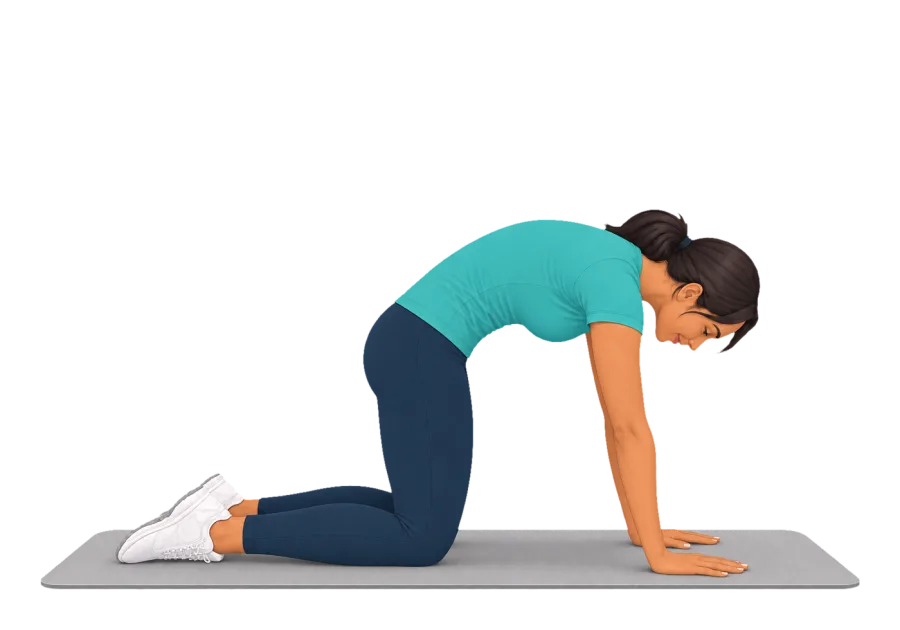
The easier form uses smaller circles and the harder form uses bigger ones. Hip CARs isolate one hip at a time and ask for far more control.[7] Pelvic tilts reduce the circle to its forward and backward part, and Cat Cow moves the same lower back through a similar arc on hands and knees.
Routines With This Move
- Before the Run
- Fresh Legs
- Hip Opener
- Hips All Round
- On Your Feet
- Quick Wake Up
- Slow Morning
See Also
Sources
- Hip (opens in a new tab). Wikipedia.
- Acute Effects of Dynamic Stretching on Muscle Flexibility and Performance: An Analysis of the Current Literature (opens in a new tab). Sports Medicine, 2018.
- Gluteus medius (opens in a new tab). Wikipedia.
- Quadratus lumborum muscle (opens in a new tab). Wikipedia.
- Iliopsoas (opens in a new tab). Wikipedia.
- Belly dance (opens in a new tab). Wikipedia.
- Controlled Articular Rotations (CARs): What They Are and Why You Should Do Them (opens in a new tab). Physio Inq.
- Flexibility exercises (opens in a new tab). NHS.
Further Reading
- Strength exercises (opens in a new tab). NHS.
- Hula (opens in a new tab). Wikipedia.
General information about this move, not medical advice. Stop if something hurts, and read our Safety page before you start. If you have a health condition, ask your doctor or physiotherapist first.