What It Is For
Thread the Needle is used mainly to add rotation to the upper back while the hips stay roughly still. Kneeling on all fours limits how far the pelvis can turn, so most of the visible turning comes from the ribcage and shoulder girdle. The American Council on Exercise describes a closely related version as a thoracic mobility drill, done with the lower back braced, and suggests slow repetitions on each side.[1]
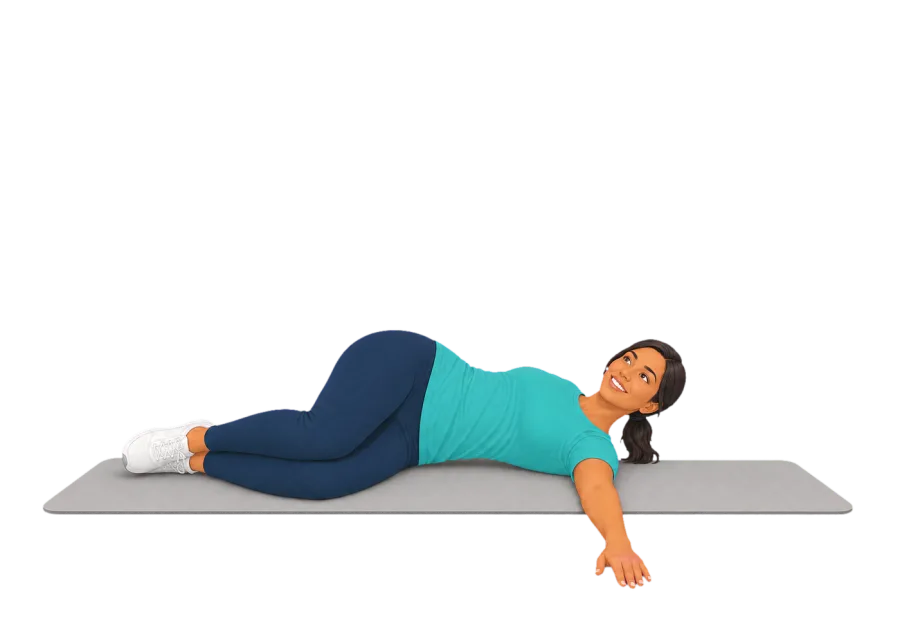
The resting form taught here is a passive hold. The weight of the shoulder and head on the floor takes the arm across the body and draws the shoulder blade away from the spine. Pose guides describe it as a beginner posture for the shoulders, the area between the shoulder blades and the neck.[2]
Fitness writers also tie the drill to overhead work. The same ACE article suggests thoracic mobility exercises as part of a warm-up before vertical pressing and pulling, on the reasoning that a stiff upper back can limit how the arm travels overhead.[1]
How to Do It
A gentle twist for the upper back and shoulders. On hands and knees, slide one arm underneath the other, palm up, and let that shoulder and the side of your head rest on the floor. You should feel your upper back turning and a stretch around the back of the shoulder.
- Slide one arm under the other
- Rest your shoulder and ear down
- Breathe into your upper back
Pad your knees with a folded towel or cushion. Skip it if kneeling hurts.
Stay below the point of pinching. Smaller range is fine.
How It Got Its Name
The English name is a plain image: one arm passes through the gap between the other arm and the body, as a thread passes through a needle. No source explains who first used it.
The Sanskrit labels vary. Parsva Balasana means Side Child Pose, placing it as a sideways relative of Balasana, and the alternative Sucirandhrasana is rendered as Eye of the Needle.[5] Neither name has been traced to a historical text in the sources consulted, and both are best read as modern labels.
History
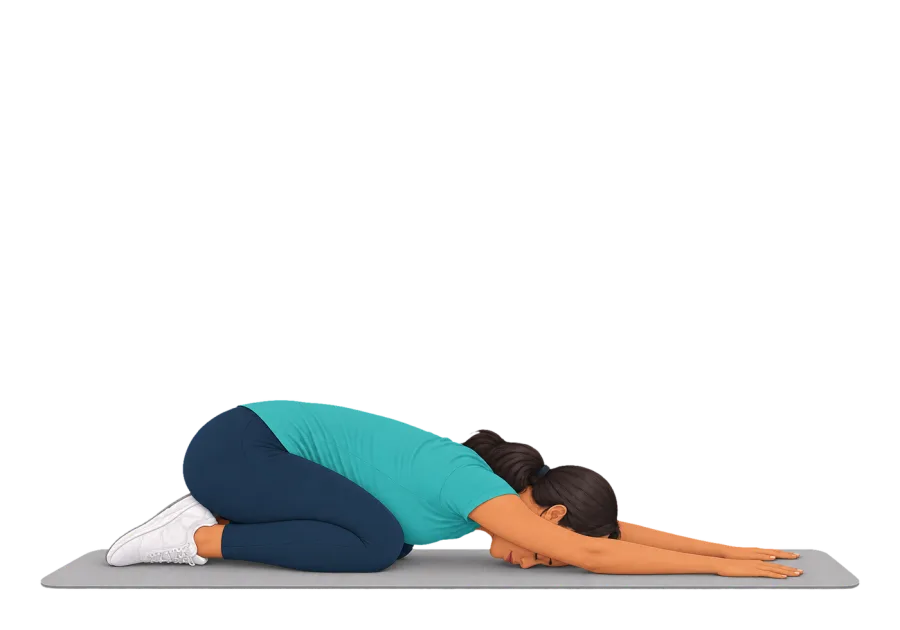
No single inventor of Thread the Needle is recorded, and no classical text describing it was found. Its parent pose offers some context: Child's Pose itself is not described until the 20th century, as Wikipedia records from Mark Singleton's Yoga Body, and a similar kneeling posture appears in the Danish gymnast Niels Bukh's Primary Gymnastics of 1924.[5]
That timing fits the wider picture. Medieval hatha yoga had few of the floor and standing sequences now taught, and much of modern posture practice took shape in the 1920s and 1930s, drawing on gymnastics as well as Indian sources.[6] Thread the Needle sits comfortably in that modern repertoire, but when it entered it is not documented. The ACE article of 2021 shows it in fitness education, but its first use outside yoga is also unrecorded.[1]
Muscles and Tendons
The stretch is felt on the threading side. As the arm slides under the body it moves across the chest, which lengthens the posterior deltoid and, with the shoulder blade drawn outwards, the rhomboids and the middle trapezius. The rhomboids run from the spinous processes of C7 to T5 to the inner border of the shoulder blade, and they normally pull the blade towards the spine, so the sliding movement opposes their usual action.[3]
The working muscles are mostly on the other side. The planted arm supports part of the trunk, with the serratus anterior helping to hold the shoulder blade against the ribs. The obliques take part in the twist: the external oblique rotates the trunk towards the opposite side, working with the internal oblique of the side turned towards.[4] Because the shoulder and head rest on the floor in the full position, these muscles work far less in the hold than in the moving, reach-to-the-ceiling version.
Stretched
- Posterior deltoid
- Back of the threading shoulder, as the arm crosses the body
- Rhomboids
- Between the spine and the shoulder blade, as the blade slides away from the spine
- Middle trapezius
- Across the upper back on the threading side
- Infraspinatus and teres minor
- Back of the shoulder blade, mildly, depending on arm position
Working
- Serratus anterior and supporting shoulder muscles
- Steady the arm that stays planted
- Abdominal obliques
- Help turn the ribcage and control the return
- Gluteals and quadriceps
- Lightly hold the hips over the knees
Tendons and Fascia
- Posterior shoulder capsule
- Tissue at the back of the shoulder joint, under gentle tension when the arm crosses the body
Where It Is Used Today
The pose is common in general yoga classes, usually as a gentle moment on all fours between stronger work.[2] Personal trainers use the moving version in warm-ups, particularly before overhead pressing and pulling.[1]
It also suits people who sit for long periods, because the ACE article links prolonged sitting with a more rounded upper back, and the drill needs nothing but floor space.[1] Dimensions.com advises care for people with knee problems or degenerative disc disorder, a reminder that the kneeling position does not suit everyone.[2]
Variations and Related Moves
The main difference between versions is whether the move is a hold or a repetition. In the fitness form the arm threads under, then opens to the ceiling with the eyes following the hand, five to ten times a side.[1] Reaching the top arm to the ceiling before threading is a simple way to add range to the yoga form.
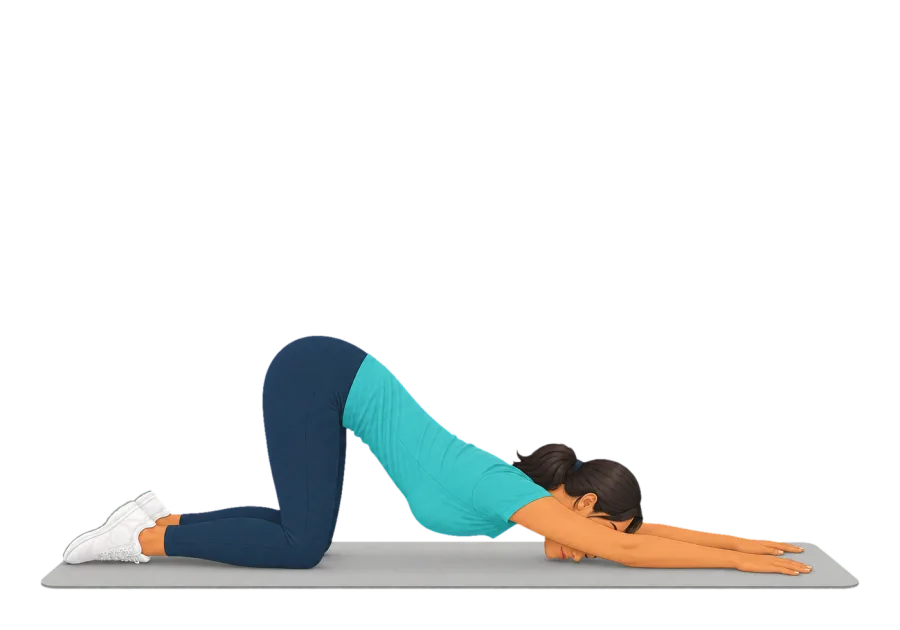
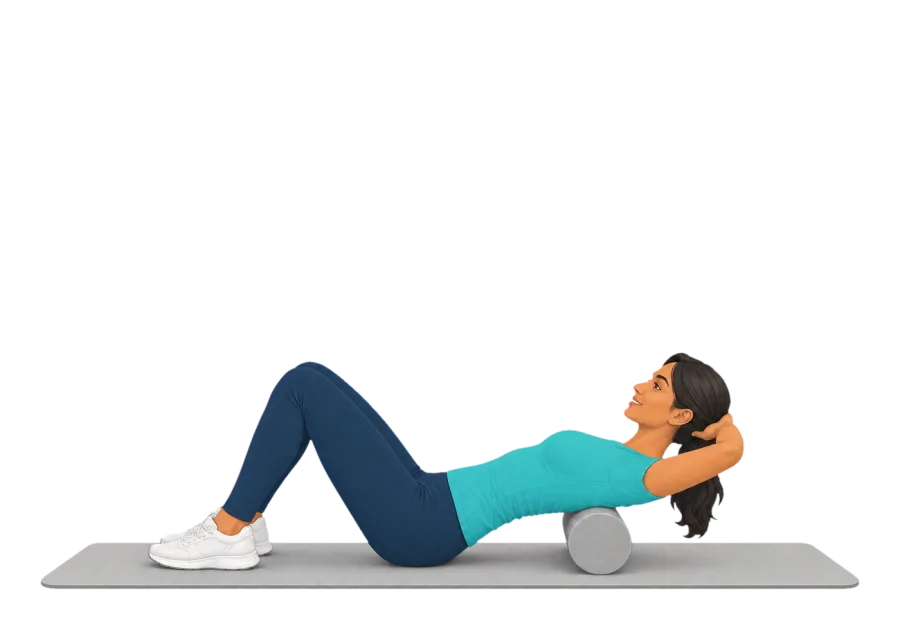
In Parsva Balasana as described in reference summaries, the free arm can reach forward, fold behind the back or point upwards.[5] A seated version, with one hand on the opposite knee, keeps the rotation without any weight on the knees or wrists. Related moves include the open book and foam roller extensions, which also target the upper back, and Puppy Pose, which shares the kneeling base.
Routines With This Move
- After the Shift
- Fifteen Minute Reset
- Long Wind Down
- Open Shoulders
- Slow Morning
- Ten Minute Reset
- Upper Body Unwind
See Also
Sources
- Thoracic Mobility Exercises to Address Shoulder Pain (opens in a new tab). American Council on Exercise, 2021.
- Threading the Needle Pose (Parsva Balasana) (opens in a new tab). Dimensions.com.
- Rhomboid muscles (opens in a new tab). Wikipedia.
- Abdominal external oblique muscle (opens in a new tab). Wikipedia.
- Balasana (opens in a new tab). Wikipedia.
- Yoga as exercise (opens in a new tab). Wikipedia.
Further Reading
- Supraspinatus muscle (opens in a new tab). Wikipedia.
- Yin Yoga (opens in a new tab). Wikipedia.
General information about this move, not medical advice. Stop if something hurts, and read our Safety page before you start. If you have a health condition, ask your doctor or physiotherapist first.