What It Is For
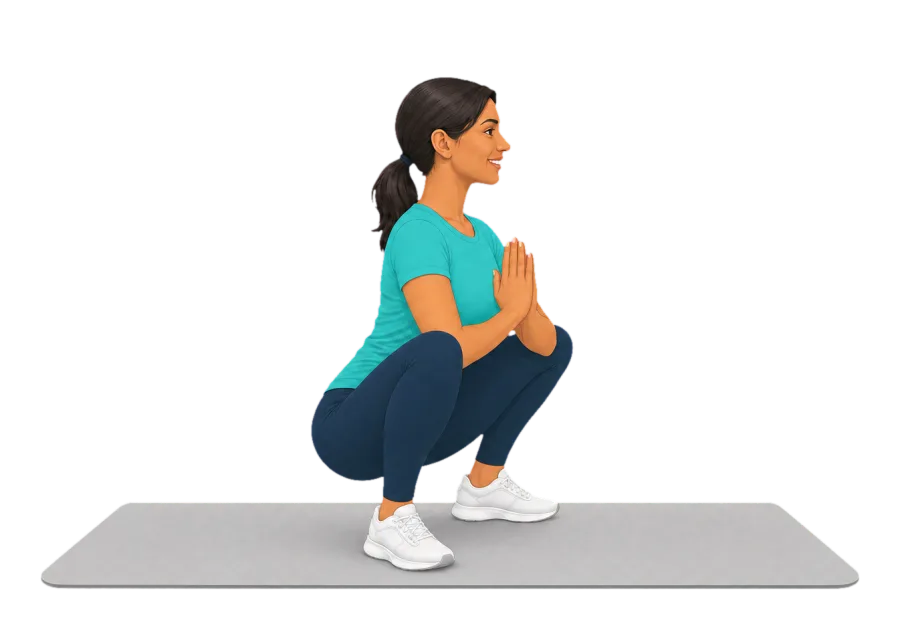
The Deep Squat Hold is a way of practising low-level rest. The person sits between the heels, chest up, weight even across both feet, often holding something for support. In the world's many cultures that use the floor, this is simply a way to rest or work. In gyms and studios, it serves as a mobility hold that asks for strong flexion at the hips and knees and dorsiflexion at the ankles at once.[1]
For lifters and physiotherapists, it can show where a person's squat stops. Depth depends on several factors: a 2015 study of 101 adults linked it with ankle dorsiflexion, hip flexion range and dorsiflexor strength, in a pattern which differed between men and women.[2] Holding the bottom position lets a person spend time at those limits without a load.
The posture is also of interest to researchers on inactivity. A study of Hadza hunter-gatherers found that squatting used more lower-limb muscle activity than chair sitting, a form of rest its authors called active.[3]
How to Do It
A resting squat, the shape your hips and ankles were built for. Sit down between your heels with your chest up and your weight even across both feet, holding onto something if you need to. A folded towel under your heels helps. You should feel a stretch through your hips, ankles and lower back.
- Sit down between your heels
- Chest up, weight even
- Hold onto something if you need to
Pad your knees with a folded towel or cushion. Skip it if kneeling hurts.
How It Got Its Name
Deep Squat Hold is a plain training description. Squat itself comes from the Old French esquatir, to press down, and its weightlifting sense is recorded from 1954.[1] The posture has several informal names. The zoologist Desmond Morris, in his 1987 book Manwatching, separated seven forms and distinguished a flat-footed squat, called Asian or Slav, from a tiptoe, heels-raised squat that he called Western.[1] These labels are popular shorthand and are not accurate maps of who can do what, since the ability is shaped by habit as well as geography.
History
The squat has no inventor, and its evidence lies in bones. Habitual squatting leaves marks known as squatting facets on the tibia and talus, formed by repeated extreme dorsiflexion. Barnett described them on European tali in 1954, and Trinkaus applied the idea to Neandertals in 1975.[1] Dewar and Pfeiffer studied 98 adults from South Africa's Later Stone Age and reported the highest frequency of one talar facet yet recorded, concluding that most adults there regularly squatted.[5] Such traits are evidence of a habit in a population, not a date of origin.
Anthropologists began to document the posture systematically in the 20th century. Marcel Mauss's 1934 essay Les Techniques du corps discussed the body's learned techniques. Gordon Hewes's 1955 survey of world postural habits catalogued squatting among many resting postures, including its use where the ground is too dirty or wet to sit or kneel.[1]
The move into exercise is much harder to date. An overhead deep squat forms part of the Functional Movement Screen, and a 2021 study concluded that its score mainly reflects squat depth.[6] As a held mobility drill it has no recorded starting point, and it overlaps with the yoga Garland Pose.
Muscles and Tendons
Very large joint angles are involved. A study of 30 Indian adults found a mean maximum knee flexion of 157 degrees when squatting with the heels up, and hip flexion of up to 95 degrees with the heels flat, with wide variation between people.[4] Staying flat-footed asks for far more ankle dorsiflexion than sitting in a chair ever does.
With the knees bent, the soleus and Achilles tendon carry most of the tension at the back of the ankle, because the gastrocnemius is slackened. The gluteus maximus lengthens as the thigh draws up towards the trunk, and the adductors lengthen as the knees sit apart. The lower back rounds a little in most people at the bottom, which accounts for the feeling across the back and the thoracolumbar fascia, and the app accordingly lists the lower back as a region.
It is not only passive. Raichlen and colleagues recorded higher lower-limb muscle activity in squatting than in chair sitting.[3] Balance is a further demand: a flat-footed squatter must keep the body's mass over a small base, which is why a folded towel under the heels or a hand on a post makes the position far easier. The towel reduces the ankle angle required.
Stretched
- Soleus
- Lengthened by strong ankle dorsiflexion with the knee bent
- Gluteus maximus
- Lengthened as the hips flex strongly
- Hip adductors
- Lengthened as the knees sit apart
- Spinal extensors
- Lower back muscles lengthen gently if the back rounds at the bottom
Working
- Lower-limb muscles
- Stay more active than in chair sitting, as electromyography has shown
- Tibialis anterior
- Helps draw the body forward over the feet and holds balance
- Trunk extensors
- Keep the chest up
Tendons and Fascia
- Achilles tendon
- Under tension when the heels stay flat
- Thoracolumbar fascia
- Sits across the lower back, which may feel the stretch
What Research Has Looked At
The Raichlen study, published in PNAS in 2020, fitted thigh accelerometers on Hadza adults, who spent about 9.9 hours a day not walking, similar to industrialised populations, but with much of that time in squatting postures. The authors proposed an Inactivity Mismatch Hypothesis, suggesting that human physiology may suit muscles which stay regularly active. It is a hypothesis from one population, not a demonstration of benefit from a squat routine.[3]
Long exposure is not simple either. The Beijing Osteoarthritis Study, published in 2004, reported that the prevalence of tibiofemoral knee osteoarthritis was higher among older adults who had squatted for long periods daily at age 25, with odds ratios up to 2.0 in men and 2.4 in women. The authors called prolonged squatting a strong risk factor in this group, although the published trend tests fell just short of conventional significance.[7] The study looked at hours a day across years, a very different dose from a one-minute hold, and it cannot say anything about short daily holds.
Reports have linked very prolonged squatting with a peroneal nerve palsy, known as squatter's palsy.[1] These are descriptions of unusual cases and are not a measure of risk for ordinary practice.
Where It Is Used Today
Outside training gyms, the squat remains ordinary. Research in Beijing found that 40 per cent of men and 68 per cent of women reported squatting for at least an hour a day at the age of 25.[7] Inside gyms, it is used as a warm-up for weightlifting, as a cool-down after lower-body work, and as a test of range.
The ability is not evenly shared. Wikipedia's survey of the subject reports that most Western adults cannot keep their heels down, and links this with shortened Achilles tendons, chairs and high heels. Those explanations are proposed, not settled.[1]
Variations and Related Moves
Heels on a plate or folded towel is the main easier version, and holding a post or a doorframe helps balance. A slow shift from side to side is the app's harder option, and turns a hold into a gentle drill.
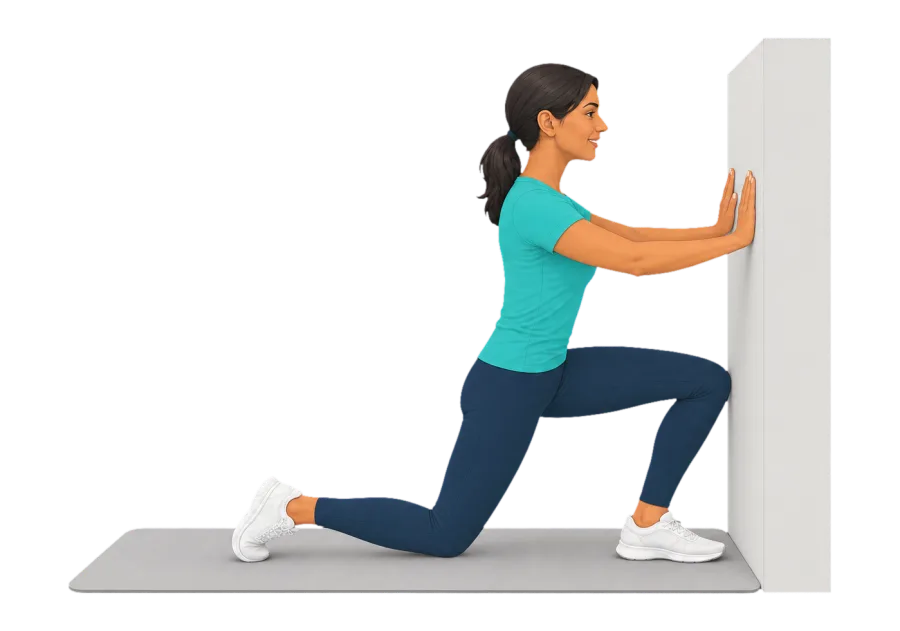
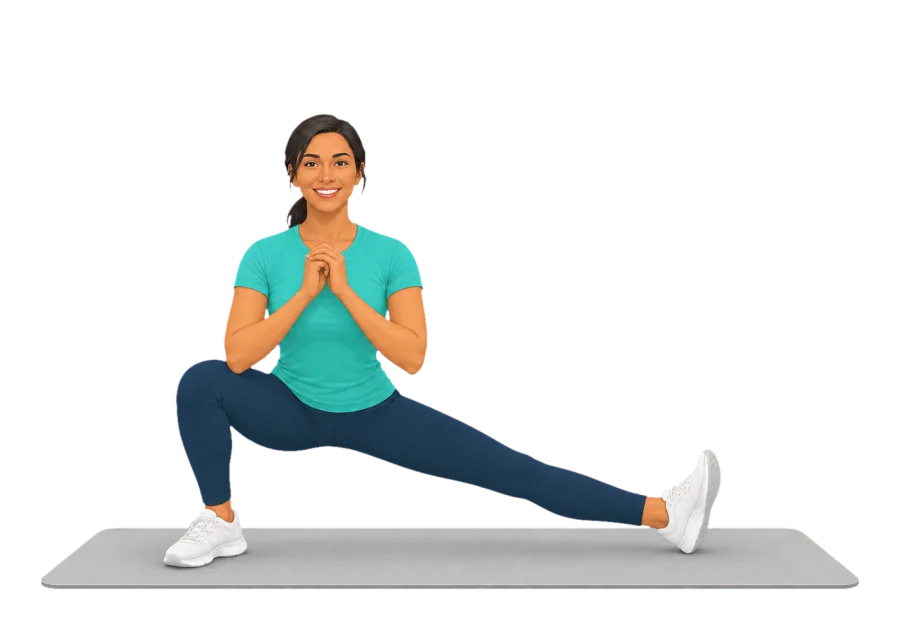
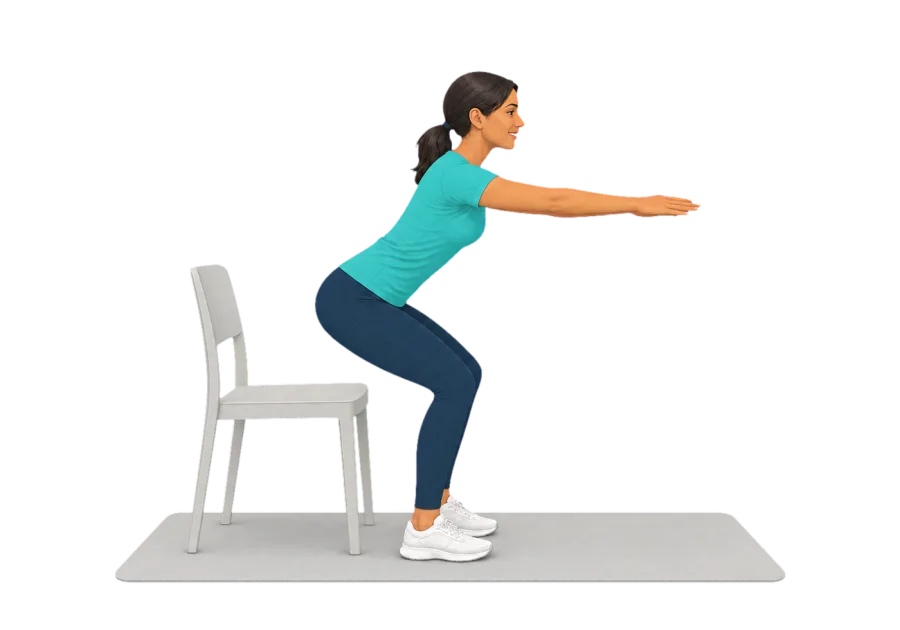
The Yoga Squat, also called Garland Pose, is the closest relative. Related moves include Knee-to-Wall Ankle Rocks, which train the ankle range the squat needs, the Cossack Squat, which takes one leg at a time into the same low position, and Sit-to-Stand, its everyday partner at a higher level.
Routines With This Move
- Lifter's Full Reset
- Squat Depth
See Also
Sources
- Squatting position (opens in a new tab). Wikipedia.
- Lower extremity strength and the range of motion in relation to squat depth (opens in a new tab). Journal of Human Kinetics, 2015.
- Sitting, squatting, and the evolutionary biology of human inactivity (opens in a new tab). Proceedings of the National Academy of Sciences, 2020.
- Hip, knee, and ankle kinematics of high range of motion activities of daily living (opens in a new tab). Journal of Orthopaedic Research, 2006.
- Postural behaviour of Later Stone Age people in South Africa (opens in a new tab). South African Archaeological Bulletin, 2004.
- Comparison of Lower Extremity Kinematics during the Overhead Deep Squat by Functional Movement Screen Score (opens in a new tab). Journal of Sports Science and Medicine, 2021.
- Association of squatting with increased prevalence of radiographic tibiofemoral knee osteoarthritis: the Beijing Osteoarthritis Study (opens in a new tab). Arthritis and Rheumatism, 2004.
Further Reading
- Hunter-Gatherers Sit as Much as Us, But How They Sit Makes All The Difference (opens in a new tab). ScienceAlert.
- How Are Squat Timing and Kinematics in The Sagittal Plane Related to Squat Depth? (opens in a new tab). Journal of Sports Science and Medicine.
General information about this move, not medical advice. Stop if something hurts, and read our Safety page before you start. If you have a health condition, ask your doctor or physiotherapist first.