What It Is For
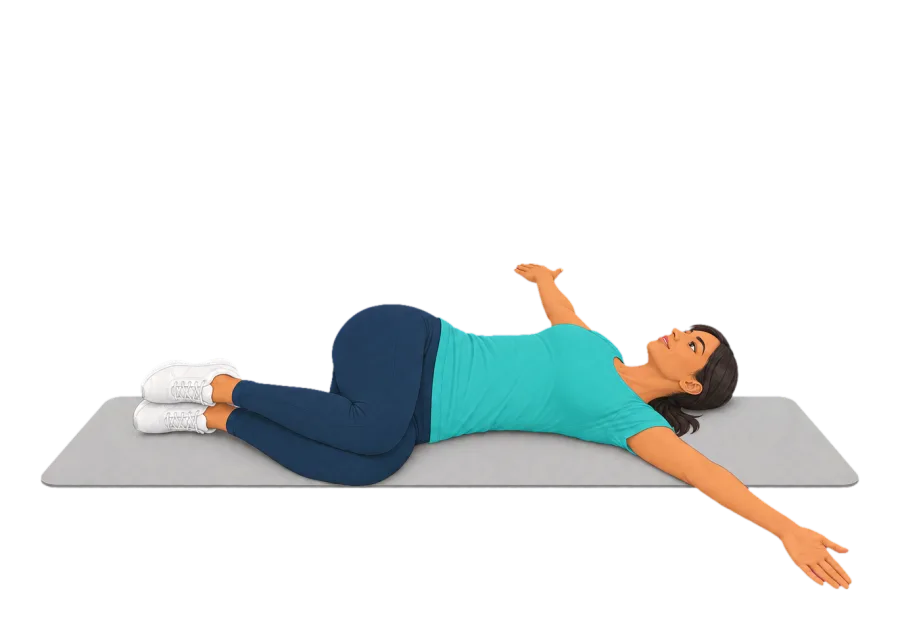
The Open Book is a rotation drill for the thoracic spine, the twelve vertebrae of the upper and middle back that carry the ribs.[1][2] A person lies on one side with the knees bent and stacked and the arms together in front, then moves the top arm up and over towards the floor behind, turning the trunk with it. A 2023 trial described the same sequence: legs flexed to 90 degrees, arms straight in front, and the top arm taken slowly away from the other towards the floor on the opposite side.[3]
Its purpose is to give rotation to the upper back while the lower back stays relatively quiet. Clinical guides list the aim as better upper back rotation and general spinal flexibility, and they stress the position of the legs, because holding the lower body still is what keeps the turn from being taken in the lumbar spine.[4][5] This matters because the lumbar spine has little rotation to give: one trial cites earlier measurements of only about 5 to 7 degrees there.[6] The eyes follow the moving hand, which brings the neck along with the turn.[4]
People also use it simply as a way of moving a stiff back after long periods of sitting, and as a chest opener. One clinical guide gives prolonged sitting as the usual reason for a stiff upper back, although that is a clinical rationale and not a tested finding.[4] It needs only a mat, and the intensity can be altered by changing how far the knees are bent.[5]
How to Do It
A floor twist that gets your upper back moving. Lie on your side with your knees stacked and arms together in front of you, then open the top arm across your body like a book, with your eyes following your hand. Keep your knees together. You should feel your upper back turning and your chest opening.
- Lie on your side, knees stacked
- Eyes follow the hand
- Only as far as is easy
Stay below the point of pinching. Smaller range is fine.
How It Got Its Name
The name is descriptive. The two arms begin together like closed pages and part as the top arm swings open, and exercise libraries list the move as the open book or book opening alongside the plainer clinical term, thoracic rotation in side lying.[5][8] Who first used the image is not documented. The earliest use could not be traced in the sources reviewed for this article, and physiotherapy papers tend to use the anatomical name.[3]
History
No single inventor is recorded for the Open Book, and no account of its origin was found in the physiotherapy or exercise literature reviewed here. Physitrack, a commercial library used by clinicians, publishes several versions and names no originator.[8] Rotation in side lying is simple enough that it may have arisen independently among therapists, but that is conjecture and no source documents it.
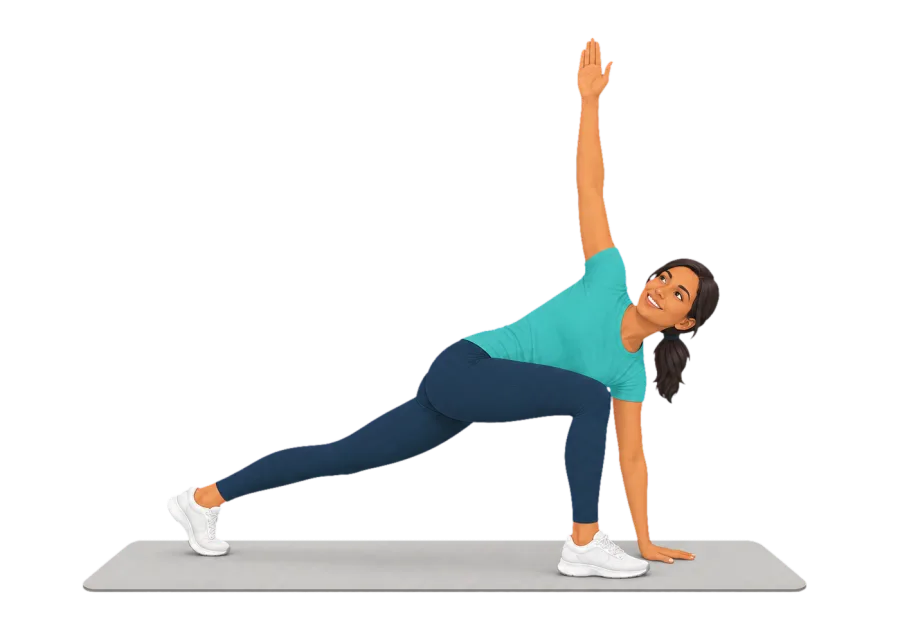
What can be traced is its place in the research record. In 2010 a group of researchers used a side-lying position as a way of measuring thoraco-lumbar rotation, and found the method reliable both within and between examiners.[9] This was a measurement and not an exercise, but it shows side-lying rotation in clinical use by that date. By the 2020s the exercise itself was appearing by name in trial protocols. A 2023 trial in the Turkish Journal of Medical Sciences included it in a four-part home programme with cat and camel, thoracic extension at a wall, and a half-kneeling chop.[3] A 2026 trial in professional footballers used the label open book for a related version performed from a side plank.[10]
Muscles and Tendons
Most of the sensation comes from the front of the chest and shoulder. As the arm opens, pectoralis major is lengthened: the muscle runs from the collarbone, breastbone and upper rib cartilages to the humerus, and its main actions of flexing, adducting and inwardly rotating the arm are the reverse of the open position.[7] Physiotherapy and massage sources also name the obliques, intercostals and latissimus dorsi as tissues involved.[8][4]
The turn itself is a joint movement as much as a muscular stretch. The thoracic vertebrae articulate with the ribs at their bodies and transverse processes, so rotating this part of the spine also moves the ribcage.[2] The obliques turn the trunk and control the return, and the muscles between the shoulder blades draw the top blade back. The lower body works only lightly, keeping the knees together. The arm is not being held against much resistance, so this is a low-load drill, and it should feel like easy movement and not a strong stretch.
Stretched
- Pectoralis major
- Lengthens across the front of the chest as the top arm opens
- Anterior deltoid
- Mild stretch at the front of the top shoulder
- Abdominal obliques
- Lengthen along the side and front of the trunk as the ribcage turns away from the pelvis
- Intercostals
- Mild stretch between the ribs on the upper side
Working
- Obliques
- The trunk rotators turn the ribcage and control the return
- Rhomboids and middle trapezius
- Draw the top shoulder blade back as the arm opens
- Posterior deltoid
- Carries the arm across and back
- Hip adductors
- Lightly hold the knees together so the pelvis stays still
Tendons and Fascia
- Pectoralis major tendon
- Tensioned lightly where it crosses the front of the shoulder to the humerus
What Research Has Looked At
No trial was found that tests the Open Book alone. It has been studied only inside bundles of exercises, so no single result can be credited to it. In the 2023 trial, 120 adults with tight hamstrings followed either the four-part thoracic programme or active-assisted hamstring stretching for four weeks. Both groups gained knee extension range, and the thoracic group gained more, with large between-group effect sizes.[3] The result is surprising, and it has not, as far as could be found, been repeated.
In the 2026 football trial, 42 players were randomised to routine training alone or routine training plus six thoracic exercises for six weeks. Thoracic rotation angles improved substantially more in the exercise group. The primary outcome, the sagittal kyphosis angle, showed no group difference.[10] A separate four-week trial in adolescent volleyball players found that thoracic mobility work added to training gave results similar to training alone for strength, endurance, flexibility and hitting speed.[11]
Where It Is Used Today
The move is a standard item in physiotherapy home exercise software, where it is issued to patients with a video and written instructions.[8][5] Massage providers use it too: one provider knowledge base lists it among patient exercises, within material for a medical massage study at McChord Air Force Base.[4] The cited pages show that it travels easily between clinic and home because it needs no equipment beyond a mat.[5]
In sport it appears as one piece of a wider thoracic programme. Professional footballers in the 2026 trial performed the side plank version among six exercises, three times a week, on top of normal training.[10] It is also common in gym warm-ups for rotational sports and for people whose work involves long hours at a desk, though the reach of that use has not been measured.
Variations and Related Moves
Easier versions place a pillow under the head so that the neck stays level. More intense versions pause at the end of the range for a few breaths. Clinical variations change the legs: some guides straighten the bottom leg and rest the top foot at the bottom knee to fix the pelvis,[4] and exercise libraries also list a version with a resistance band. Bending the knees more or less alters how the stretch feels.[5]
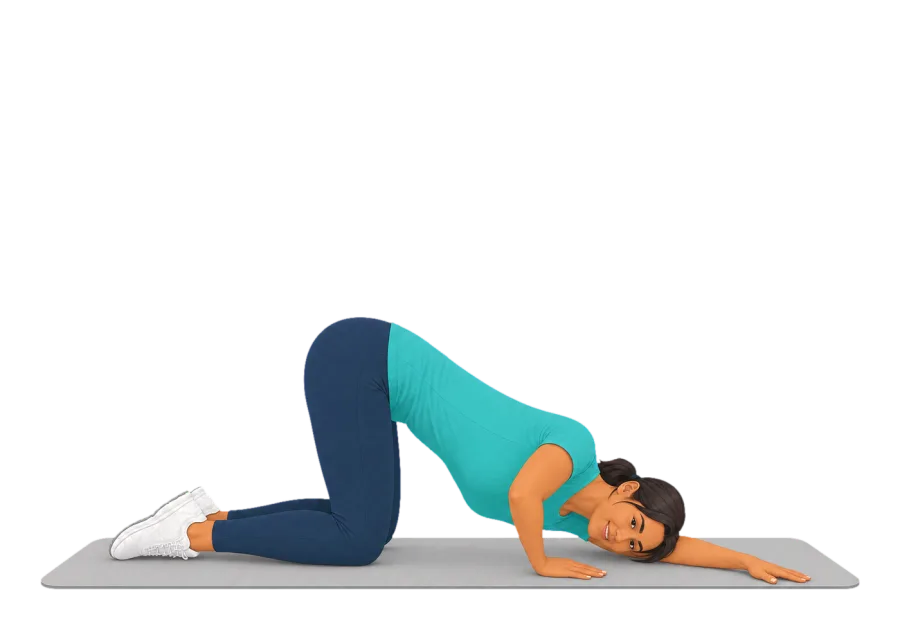
Physitrack's side lying rotation guide shows a form in which the top hand rests on the opposite shoulder, so that the trunk turns without the long arm reach.[8] Related rotation moves include Thread the Needle, performed on hands and knees, and the Supine Twist, which involves the lumbar spine more. The World's Greatest Stretch includes a thoracic rotation within a lunge.
Routines With This Move
- Overhead Ready
- Race Prep: Run, Sled and Lunge
- Upper Body Unwind
See Also
Sources
- Spinal column (opens in a new tab). Wikipedia.
- Thoracic vertebrae (opens in a new tab). Wikipedia.
- Effect of thoracic mobilization exercises on hamstring flexibility: a randomized controlled trial (opens in a new tab). Turkish Journal of Medical Sciences, 2023.
- Exercise 11: Side Lying Open Book (opens in a new tab). Zeel Provider Knowledge Base.
- Thoracic rotations in side lying (open book), Version 3 (opens in a new tab). Physitrack.
- Effects of Thoracic Spine Self-mobilization on Patients with Low Back Pain and Lumbar Hypermobility: A Randomized Controlled Trial (opens in a new tab). Progress in Rehabilitation Medicine, 2023.
- Pectoralis major (opens in a new tab). Wikipedia.
- How to perform the Side Lying Thoracic Rotation (opens in a new tab). Physitrack.
- Reliability and exploration of the side-lying thoraco-lumbar rotation measurement (STRM) (opens in a new tab). North American Journal of Sports Physical Therapy, 2010.
- Effects of adding thoracic spine exercises to routine soccer training on spinal alignment and mobility in professional male soccer players: a randomized controlled study (opens in a new tab). BMC Sports Science, Medicine and Rehabilitation, 2026.
- Thoracic mobility training and performance outcomes in adolescent female volleyball players: a randomized controlled trial (opens in a new tab). BMC Sports Science, Medicine and Rehabilitation, 2026.
Further Reading
General information about this move, not medical advice. Stop if something hurts, and read our Safety page before you start. If you have a health condition, ask your doctor or physiotherapist first.