What It Is For
The Bench Lat Stretch targets the muscles that pull the arm down and back. A person kneels in front of a bench or chair, places the elbows on it, joins the hands behind the head and lets the chest sink towards the floor. The stretch is felt from the armpits down the sides of the back.
Its use rests on simple anatomy. The latissimus dorsi extends, adducts and inwardly rotates the shoulder, so reaching overhead is the opposite of its action.[1] People therefore use the stretch when they want to take the arms overhead more easily, for example to hold a barbell overhead or to reach in swimming. Because the arm position is fixed and the knees take the body's weight, the person can relax into the position in a way that is harder when hanging or standing.
The bench also changes what the spine does. As the chest sinks, the upper back moves towards extension, so the stretch combines shoulder range and thoracic movement. The difficult part is keeping the lower back from arching, because that gives the feeling of more range without lengthening the target muscles.
How to Do It
A stretch for the big muscles down the sides of your back, which limit overhead reach. Kneel in front of a bench or chair with your elbows on it and your hands together behind your head, then sink your chest towards the floor. You should feel it from your armpits down your back.
- Elbows on a bench or chair
- Hands together behind your head
- Sink the chest down
Stay below the point of pinching. Smaller range is fine.
How It Got Its Name
Lat is gym shorthand for latissimus dorsi, a name built from the Latin for broadest and back, so the muscle is literally the broadest of the back.[1] Bodybuilders' use of lats has passed into everyday gym speech.[1] Bench refers only to the support used. Other names for the move are descriptive variations, and no source was found recording a first use of any of them.
History
No inventor or documented origin was found for this stretch. It does not seem to have a founding text, and the research reviewed here makes no reference to its beginnings. It is likely to have spread informally through gyms and coaching, but no reliable evidence for that spread, or for a date, could be found.
Similar shapes appear elsewhere. Yoga has a related kneeling pose, Uttana Shishosana or Extended Puppy Pose, which is listed as a relative of Balasana.[5] The article on Balasana notes that Child's Pose is not described until the 20th century, and that a similar shape appears in Niels Bukh's Primary Gymnastics of 1924.[5] This concerns Child's Pose and shows only that the shape has older parallels. It does not show that the bench stretch came from yoga or from gymnastics, and no source links them.
Muscles and Tendons
The latissimus dorsi is one of the largest muscles of the trunk. It fans out from the spinous processes of the lower thoracic vertebrae, the thoracolumbar fascia, the back of the iliac crest and the lower ribs, and it narrows to a broad tendon that inserts into the intertubercular groove of the humerus.[1] Its partner teres major reaches the same region of the humerus, runs parallel to it, and shares its action of pulling a raised arm down and back.[2] Both are lengthened here.
The hand position adds to this. With the elbows bent and the arms overhead, the long head of triceps is also stretched, because it arises from the scapula and crosses the shoulder as well as the elbow.[3] This is why some people feel the stretch at the back of the upper arm. Joining the hands behind the head also turns the upper arms outwards, the reverse of one of latissimus dorsi's actions.[1]
The muscle has a substantial link to the lower back. The superficial layer of the posterior thoracolumbar fascia is dominated by the aponeuroses of latissimus dorsi and serratus posterior inferior.[4] This fascia is one of the tissues placed under tension by the stretch. It should not be assumed to be the main site of any change: a tissue under load is not necessarily a tissue that lengthens.
Stretched
- Latissimus dorsi
- Lengthens from the upper arm down the side of the back as the shoulders flex
- Teres major
- Runs beside latissimus to the humerus and lengthens with it
- Triceps long head
- Crosses the shoulder and elbow, so it stretches with the arm overhead and the elbow bent
- Pectoralis major
- Lower fibres may be felt at the front of the armpit
Working
- Thoracic erector spinae
- Help the upper back extend as the chest sinks
- Abdominals
- Stop the lower back taking over by arching
- Serratus anterior and trapezius
- Keep the shoulder blades in upward rotation
Tendons and Fascia
- Thoracolumbar fascia
- The latissimus aponeurosis forms much of its superficial layer
- Latissimus dorsi tendon
- Broad tendon inserting into the intertubercular groove of the humerus
What Research Has Looked At
No study was found that tests this bench stretch as such. Research on the muscle offers some context. In the 2013 study of 19 collegiate swimmers, greater latissimus stiffness was associated with changes in how the shoulder blade moved as the arm rose, including more upward rotation and posterior tilt, and at some angles less internal rotation.[6] The design was cross-sectional, so it shows an association and not a cause.
An in vivo study by Carvalhais and colleagues placed 37 adults face down and measured the hip while the arm was held at 120 degrees of shoulder flexion with the shoulder blade elevated. Tension on latissimus dorsi moved the resting hip further into external rotation, which the authors read as force passing through the thoracolumbar fascia.[8] The result shows that this tissue connects the shoulder to the hip, but it says little about stretching as such.
The 2025 trial in the European Journal of Pain looked at stretching of the latissimus dorsi and thoracolumbar fascia complex in chronic low back pain.[7] The full paper was not available for this article, so its methods and results are not summarised here, and it is not known whether the stretch used resembled the bench version.
Where It Is Used Today
The stretch is a familiar gym exercise for overhead lifters. It also suits swimmers, who repeatedly reach overhead and pull. Latissimus stiffness has been measured in that group, in a 2013 study of collegiate swimmers.[6]
Stretching of the muscle and its fascia has also been studied in people with long-term low back pain, in a 2025 randomised trial.[7] The bench or chair also makes the move easy to do at home or at the end of a working day.
Variations and Related Moves
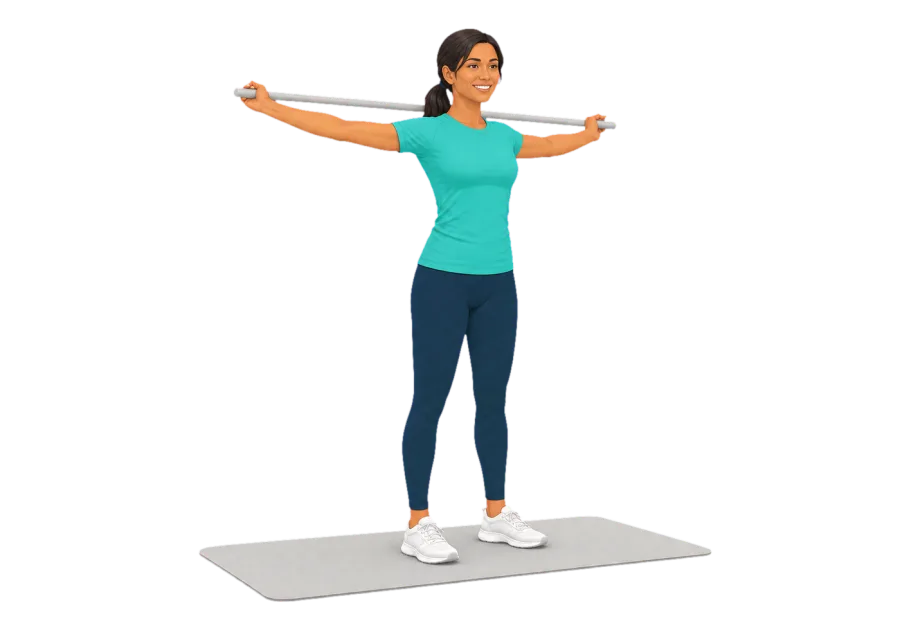
The easier option is to stand with the hands on a wall and lean the chest towards it, which reduces the depth of the shoulder position. Holding a light stick between the hands fixes their width and gives a little outward rotation. Moving the knees further from the bench increases the range.
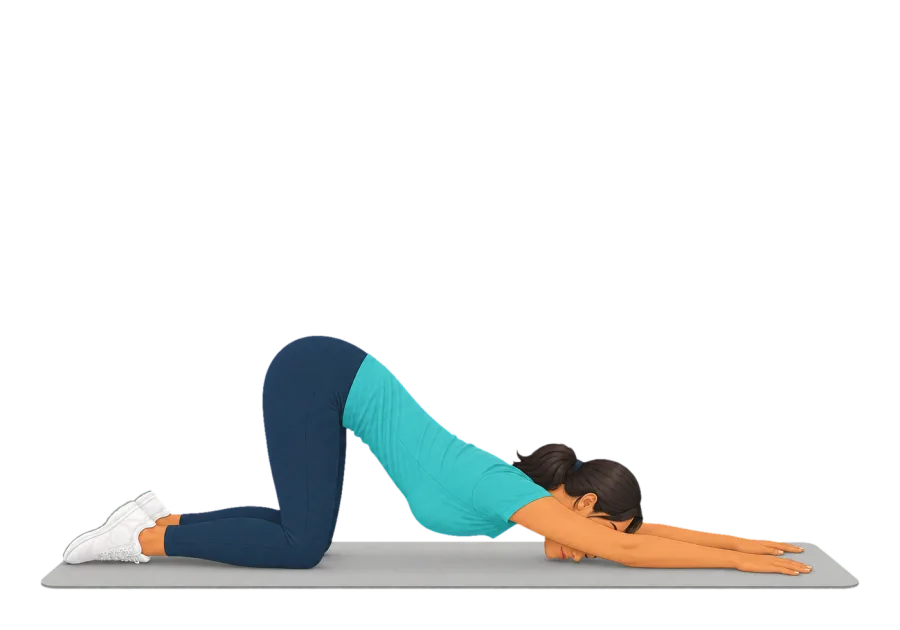
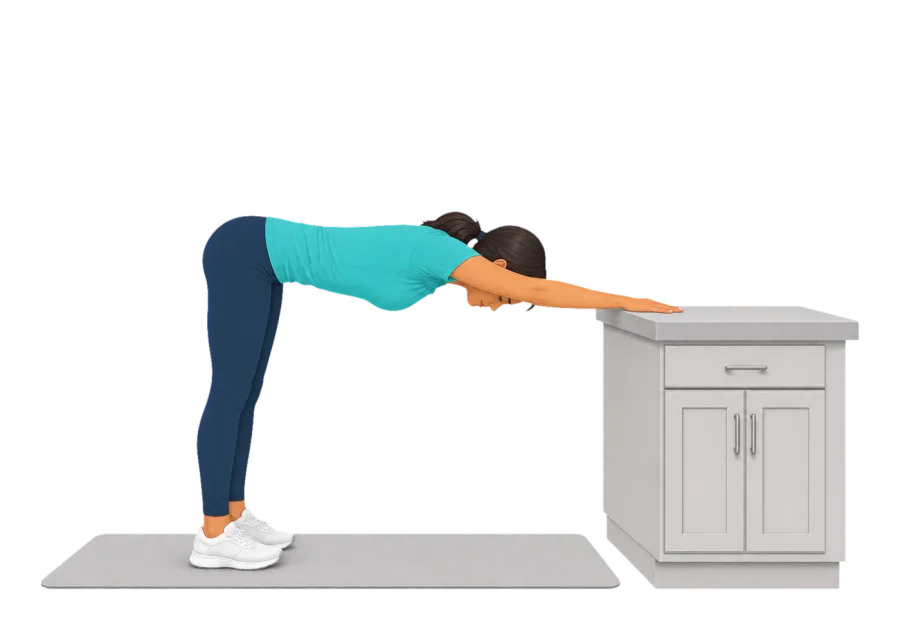
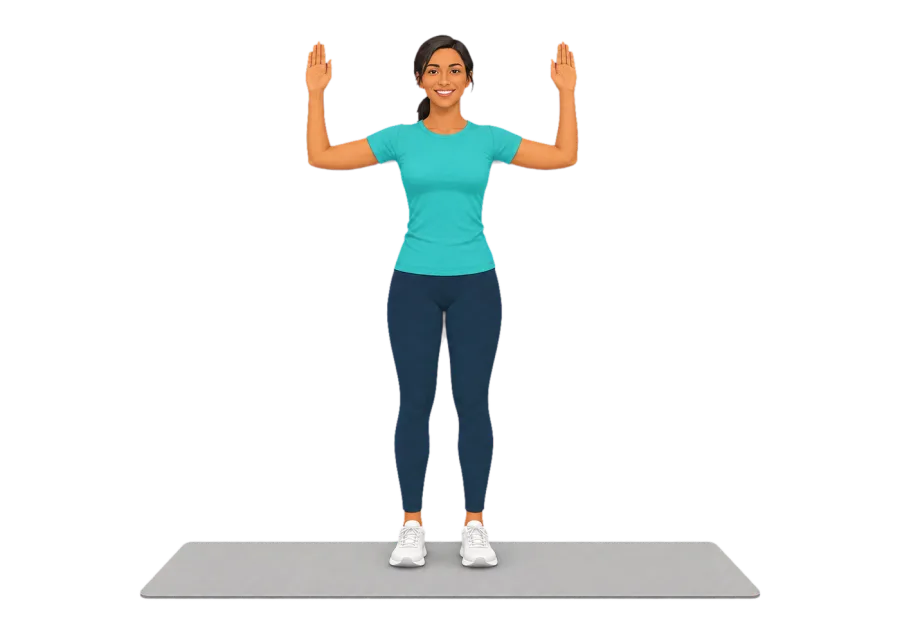
The Puppy Pose is a floor-based relative with the arms long. Counter Hang uses a kitchen counter to reach a similar line in standing. Shoulder Pass-Throughs and Wall Slides take the same overhead range into movement.
Routines With This Move
- Lifter's Full Reset
- Overhead Ready
- Upper Body Unwind
See Also
Sources
- Latissimus dorsi muscle (opens in a new tab). Wikipedia.
- Teres major muscle (opens in a new tab). Wikipedia.
- Triceps (opens in a new tab). Wikipedia.
- The thoracolumbar fascia: anatomy, function and clinical considerations (opens in a new tab). Journal of Anatomy, 2012.
- Balasana (opens in a new tab). Wikipedia.
- The relationship between latissimus dorsi stiffness and altered scapular kinematics among asymptomatic collegiate swimmers (opens in a new tab). Physical Therapy in Sport, 2013.
- Role of Latissimus Dorsi-Thoracolumbar Fascia Complex Stretching on Pain and Pain-Related Parameters in Patients With Chronic Low Back Pain: A Randomised Clinical Trial (opens in a new tab). European Journal of Pain, 2025.
- Force Transmission Through Thoracolumbar Fascia With Passive and Active Motion of Latissimus Dorsi (opens in a new tab). Brookbush Institute.
Further Reading
- Thoracolumbar fascia (opens in a new tab). Wikipedia.
- Scapula (opens in a new tab). Wikipedia.
General information about this move, not medical advice. Stop if something hurts, and read our Safety page before you start. If you have a health condition, ask your doctor or physiotherapist first.