What It Is For
The Quad Roll applies body weight through a foam roller to the muscles at the front of the thigh. It is a form of self-myofascial release, the term used for self-applied pressure on soft tissue.[1][2] The person lies face down on the forearms with the roller under one thigh, moves slowly, and pauses on tender spots.
Trainers place rolling in two parts of a session: before training as part of a warm-up, and afterwards or on rest days for soreness.[3] The quadriceps are an obvious target, because they are large, accessible and heavily used in squatting, running and cycling.
The move is not a stretch. It adds pressure and movement to the tissue, not length. Reviews suggest that its main measurable effects are short-term changes in range of motion and in how sore the muscle feels.[4][5]
How to Do It
Self-massage for the front of the thigh, using a foam roller. Lie on your front with the roller under one thigh and your forearms on the floor, then roll slowly and pause on any tight spots while you breathe. Stay off the knee and hip bones. You should feel firm pressure that eases as you stay on it, never sharp pain.
- Roller under one thigh
- Roll slowly, pause on tight spots
- Breathe, no gritting
How It Got Its Name
Quad is short for quadriceps, from the Latin for four-headed muscle of the femur.[6] Quad smash is a blunter coaching name for similar work.
The technical term self-myofascial release was popularised in the 1990s by physical therapist Mike Clark.[9][10] It has become contested. Current guidance from the National Academy of Sports Medicine advises trainers to stop speaking of breaking up tissue or releasing fascia, since present understanding points to nervous system effects more than mechanical ones.[3]
History
Foam rollers began as support props, not massage tools. They are traced to Moshe Feldenkrais (1904 to 1984), a physicist and martial artist who developed a method of movement awareness.[11][9] The dates differ. One history says Feldenkrais adopted foam packing rollers after moving to the United States in the mid-1970s, and another says practitioners of his method took them up in the 1980s, for body support and balance work.[10][9] Both accounts are short secondary histories, and an account of the primary record was not found.
The shift to self-massage is usually dated to 1987, when Sean Gallagher, a physical therapist and Feldenkrais student, began rolling on them. Gallagher is said to have passed the idea to the choreographer Jerome Robbins, whose dancers tried it, and the practice then spread among Broadway performers.[9][10] This story rests on secondary accounts, and no contemporary record of it was found.
In the 1990s Clark promoted rolling as self-myofascial release through training manuals, and his Integrated Training for the New Millennium followed in 2001.[9] Strength coaches then took it up: a 2004 T Nation article by Eric Cressey and Mike Robertson is cited as an early sign of enthusiasm, and the first US foam roller patent is dated to the same year.[9] Rolling then spread among gym users and into physiotherapy.[10] No individual is credited with first applying the roller to the quadriceps specifically.
Research followed practice. Systematic reviews date the relevant literature from the mid-2000s, and by 2020 several reviews had pooled the results.[12][4][5]
Muscles and Tendons
The quadriceps femoris has four heads. Rectus femoris is the most superficial and runs down the middle of the thigh, and it is the only one to cross the hip as well as the knee. Vastus lateralis and vastus medialis lie on either side, and vastus intermedius lies underneath. All four join into the quadriceps tendon, which continues past the kneecap as the patellar tendon to the shin.[6]
The roller compresses these muscles against the thigh bone. In the plain version they are not lengthened in any meaningful way, and most of the effort in the move comes from the abdominals, glutes and shoulders holding the body in a forearm plank. Bending and straightening the knee during a pause, the harder option, adds a stretch of the muscle while it is under pressure.
Safety advice from several sources keeps the roller off bones and joints. Harvard guidance names the knees and pelvis as places to avoid, and Cleveland Clinic warns about rolling over the knee.[7][8] Rolling is meant for the fleshy part of the muscle, between the kneecap and the front of the hip.
Stretched
- Quadriceps
- Pressed by the roller, not stretched. They lengthen only if the knee is bent during a pause, as in the harder option
Working
- Abdominals and glutes
- Hold the body in a long line, like a forearm plank
- Shoulder and chest muscles
- Support the upper body on the forearms
Tendons and Fascia
- Quadriceps tendon and patellar tendon
- Run over and below the kneecap. The roller stays above this area
- Fascia lata
- The sheet of connective tissue wrapping the thigh, which lies under the roller
- Iliotibial band
- The thickened outer strip of that fascia, away from the area this move targets
What Research Has Looked At
The quadriceps feature in two of the best known studies in the field. In 2013 Graham MacDonald and colleagues had 11 active men roll their quadriceps. Knee range of motion rose by about 10 degrees at two minutes and 8 degrees at ten minutes, with no loss in strength or muscle activation.[14] In 2014 a related study gave 20 strength-trained men a hard squat session, then assigned half of them to 20 minutes of rolling after the session and at 24 and 48 hours. The rolling group reported less muscle soreness and had better range of motion.[15] Both samples were small and all male.
Larger reviews give a cooler picture. A 2019 meta-analysis of 21 studies found small effects: flexibility rose by about 4 per cent when rolling was used as a warm-up, and the largest effect after exercise was on perceived muscle pain.[4] A 2020 meta-analysis reported a large pooled increase in range of motion and no evident harm to performance, but could not confirm direct performance benefits.[12] A 2022 analysis of training over several weeks found moderate range of motion gains in the hamstrings and quadriceps, and larger gains in programmes lasting more than four weeks.[16]
How rolling works is unresolved. One 2018 study found that rolling the gluteal muscles changed hip range of motion while rolling the mostly fascial iliotibial band did not, which led its authors to question the idea that rolling acts by breaking down fascial adhesions.[17] Reviewers have also called for better controlled studies with sham groups.[5]
Where It Is Used Today
Fitness certification bodies teach foam rolling. The National Academy of Sports Medicine places rolling first in its Corrective Exercise Continuum, before stretching and strengthening, and describes the quads as heavily used and commonly overactive.[3] The American Council on Exercise advises slow movement over short distances, avoiding bones and joints, and holding tender spots for 30 to 60 seconds.[1]
Clinical voices are more measured. Harvard guidance presents rolling as a helpful option, suggesting 30 to 60 seconds on each muscle group and a soft roller at first.[7] Cleveland Clinic describes it as useful for almost anyone, before and after workouts, and also for people who sit or stand all day.[8]
An international panel of 37 experts reached agreement in 2021 that open wounds and bone fractures rule rolling out, and that conditions such as deep vein thrombosis and local tissue inflammation call for caution.[13] The authors note that this is expert opinion and that clinical data are needed.
Variations and Related Moves
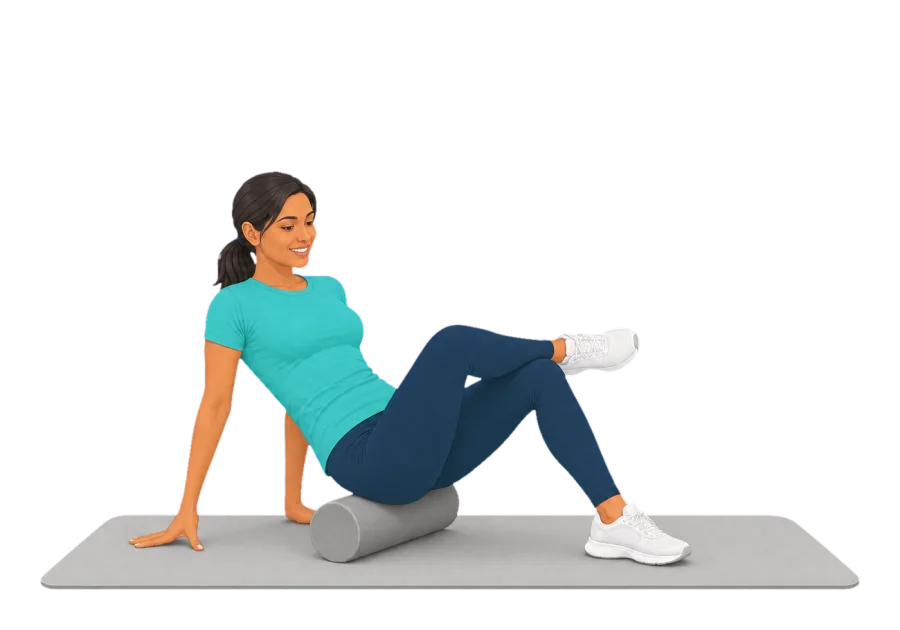
A softer roller reduces the pressure, and placing part of the weight on the other leg or the forearms makes a similar change. Bending and straightening the knee during a pause, as described above, is the usual harder option. Rolling both legs at once on a single roller is less intense, since the weight is shared.
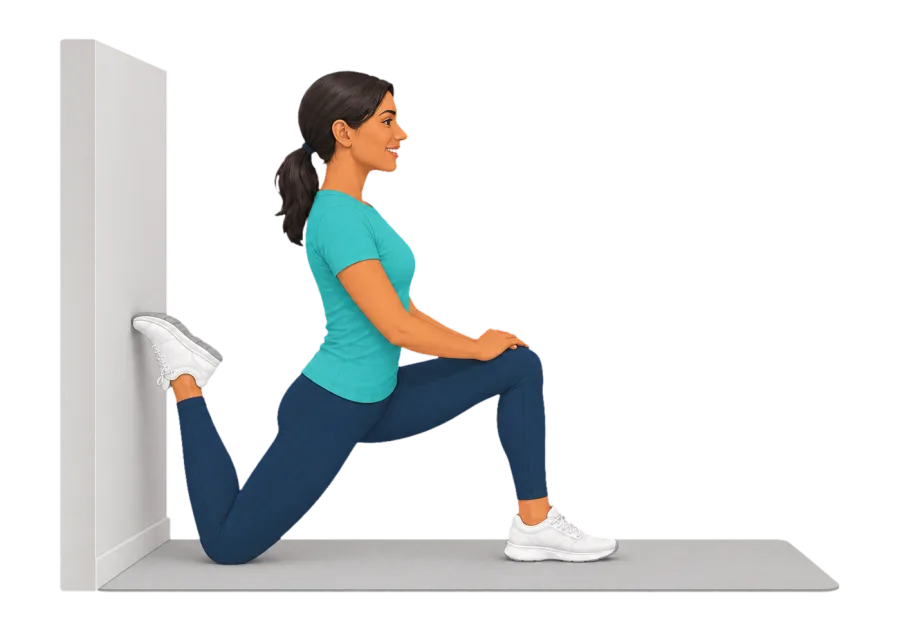
A hand-held roller or massage stick does the same work from a seated position. Trainers commonly follow rolling with a stretch for the same muscles, such as the Couch Stretch, or pair it with dynamic warm-up work.[3][5]
Routines With This Move
- Runner's Legs
See Also
Sources
- Foam Rolling 101 (opens in a new tab). American Council on Exercise, 2015.
- Foam roller (opens in a new tab). Wikipedia.
- Foam Rolling and Self-Myofascial Release: The Trainer's Application Guide (opens in a new tab). National Academy of Sports Medicine, 2026.
- A Meta-Analysis of the Effects of Foam Rolling on Performance and Recovery (opens in a new tab). Frontiers in Physiology, 2019.
- Effects of foam rolling on performance and recovery: A systematic review of the literature to guide practitioners on the use of foam rolling (opens in a new tab). Journal of Bodywork and Movement Therapies, 2020.
- Quadriceps (opens in a new tab). Wikipedia.
- Foam roller: Could you benefit from this massage tool? (opens in a new tab). Harvard Health Publishing, 2025.
- Should You Try Foam Rolling? (opens in a new tab). Cleveland Clinic, 2023.
- The History of the Foam Roller (opens in a new tab). Physical Culture Study, 2016.
- Foam Roller (opens in a new tab). History of Physiotherapy (history.physio), 2021.
- Moshé Feldenkrais (opens in a new tab). Wikipedia.
- A systematic review and meta-analysis of the effects of foam rolling on range of motion, recovery and markers of athletic performance (opens in a new tab). Journal of Bodywork and Movement Therapies, 2020.
- Expert Consensus on the Contraindications and Cautions of Foam Rolling-An International Delphi Study (opens in a new tab). Journal of Clinical Medicine, 2021.
- An acute bout of self-myofascial release increases range of motion without a subsequent decrease in muscle activation or force (opens in a new tab). Journal of Strength and Conditioning Research, 2013.
- Foam rolling as a recovery tool after an intense bout of physical activity (opens in a new tab). Medicine and Science in Sports and Exercise, 2014.
- Foam Rolling Training Effects on Range of Motion: A Systematic Review and Meta-Analysis (opens in a new tab). Sports Medicine, 2022.
- The Effects of an Acute Bout of Foam Rolling on Hip Range of Motion on Different Tissues (opens in a new tab). International Journal of Sports Physical Therapy, 2018.
Further Reading
- Myofascial release (opens in a new tab). Wikipedia.
- Feldenkrais method (opens in a new tab). Wikipedia.
General information about this move, not medical advice. Stop if something hurts, and read our Safety page before you start. If you have a health condition, ask your doctor or physiotherapist first.