What It Is For
Shoulder Rolls take the shoulder blades through a slow circle across the back of the rib cage. The arms hang loose. The shoulders lift, travel back, drop and come forward, and the circle then runs the other way. It is an active loosening movement and not a held stretch, used as a warm-up or as a short break from a fixed position.
The NHS, writing about neck pain, suggests sitting upright and gently rolling the shoulders back.[1] The National Axial Spondyloarthritis Society has people shrug and relax, then roll the shoulders forward in circles three times and repeat in the other direction.[2] These are descriptions of what people are advised to do. The feeling of warmth and ease is what users report, and it is not a measured outcome.
How to Do It
An easy loosener you can do anywhere. Lift your shoulders towards your ears, roll them back, let them drop, and keep going in slow circles, then reverse. Keep your arms relaxed and your neck long. You should feel the tops of your shoulders and upper back warm up and loosen.
- Lift, roll back, drop
- Now reverse the circles
- Keep them slow
How It Got Its Name
The name simply describes the action, and no first use has been traced. Roll is the word used in the NHS, Carnegie Mellon and CU Boulder material.[1][7][8] Shoulder circles is the common alternative, though it can also refer to larger arm circles, as on a yoga site that uses the phrase for sweeping circles of the arms.[9]
History
No inventor or date of origin is documented, and the search for one is probably misplaced. Circling the shoulders is an ordinary movement that people do without instruction, and it appears independently in many systems.
One documented relative comes from modern yoga. Skandha Chakra, or shoulder socket rotation, is listed in the book Asana Pranayama Mudra Bandha from the Satyananda tradition.[10] Modern accounts describe it as a circling of the elbows with the fingers resting on the shoulders. That is a larger movement than a simple shoulder roll, and yoga did not necessarily originate either one. Early Western physical culture may also have used shoulder circling, but no primary source could be checked for this article, so nothing further is claimed.
The move's modern place comes from workplace ergonomics. Occupational guidance in the computer era typically gives it as a short item in a desk routine.[7][8] The research on such breaks has focused less on individual exercises than on the breaks themselves.[11]
Muscles and Tendons
A shoulder roll is mainly movement of the shoulder blade, with each part of the circle handed from one muscle group to the next. The upper fibres of the trapezius and levator scapulae lift the blade.[3][4] The rhomboids then draw it back towards the spine.[5] The lower trapezius takes it down, and serratus anterior carries it forward around the ribs, opposing the rhomboids.[3][6]
Stretch is slight and brief. As the shoulders go back, the front of the chest opens a little, and as they come forward the muscles between the shoulder blades lengthen a little. Moving through the whole circle shifts load from one group to another, in contrast to the steady low-level work of holding the arms at a keyboard.
Effort should stay low. A hard shrug turns the upper part of the circle into strength work for the upper trapezius, which is the area people are usually trying to rest.
Stretched
- Pectoralis minor and front of the chest
- A brief, mild lengthening as the shoulders travel back
- Rhomboids and middle trapezius
- A brief, mild lengthening as the shoulders travel forward
Working
- Upper trapezius and levator scapulae
- Lift the shoulder blades towards the ears
- Rhomboids and middle trapezius
- Draw the shoulder blades back towards the spine
- Lower trapezius
- Draws the shoulder blades down
- Serratus anterior
- Carries the shoulder blades forward around the rib cage
What Research Has Looked At
No trial focused on shoulder rolls was found. The nearest evidence concerns breaks and stretching at work. A follow-up field study by NIOSH researchers gave data entry workers four extra five-minute breaks a day, with half told to do brief stretches. Discomfort and eyestrain were lower with the extra breaks, and work output held up. Workers stretched in only a minority of breaks, so the stretches themselves could not be properly assessed.[11]
Where the neck and shoulder muscles have been studied more closely, loading has received the most attention. A 2008 trial of 48 women with trapezius myalgia compared ten weeks of specific strength training for the painful muscle, which reported a large fall in pain scores, with leg cycling, which reported a small one.[12] That work used weights and is not evidence about gentle rolling.
Where It Is Used Today
Office stretching programmes are the most visible setting. Carnegie Mellon's guide sets five forward and five backward rolls, while the CU Boulder guide suggests backward circles for 20 seconds, two or three times, with a focus on drawing the shoulders down and bringing the blades together.[7][8] Note that this cue is a little different from a relaxed roll.
Charities use the movement in gentle programmes for people with stiff spines.[2] Yoga classes use shoulder circles in warm-ups and in joint-loosening sequences.[9] Fitness instructors commonly give it during warm-ups, since it needs no equipment or space.
Variations and Related Moves
Smaller circles are the easier form. Adding arm circles makes it a larger, more demanding movement for the shoulder joint. The CU Boulder guide suggests alternating and rolling one shoulder at a time.[8] A plain shrug and release, as taught by the National Axial Spondyloarthritis Society, keeps only the up and down part.[2]
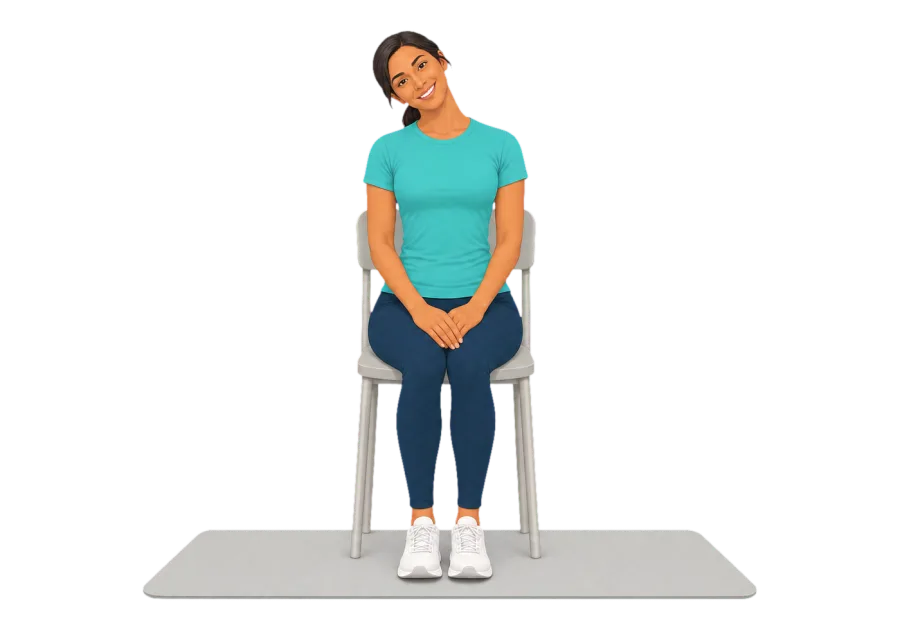
The direction matters to some teachers, with backward rolls often preferred for people who spend the day rounded forward, though both directions are normally used. The Neck Side Stretch and Chin Tuck commonly accompany it.
Routines With This Move
- Chair Break
- Desk Reset
- End of the Working Day
- Five Minute Reset
- Neck Release
- Open Shoulders
- Quick Wake Up
- Slow Morning
- Steady Five
- Steady and Strong
- Steady and Strong, Longer
- Upper Body Unwind
See Also
Sources
- Neck pain (opens in a new tab). NHS.
- Neck and Shoulder Stretches (opens in a new tab). National Axial Spondyloarthritis Society, 2020.
- Trapezius (opens in a new tab). Wikipedia.
- Levator scapulae muscle (opens in a new tab). Wikipedia.
- Rhomboid major muscle (opens in a new tab). Wikipedia.
- Serratus anterior muscle (opens in a new tab). Wikipedia.
- Desk Stretches (opens in a new tab). Carnegie Mellon University, Environmental Health and Safety.
- Stretching: For Seated, Office, and Desk Workers (opens in a new tab). CU Boulder Environmental Health and Safety.
- Upper Body Pawanmuktasana (opens in a new tab). Yin Yoga.
- Asan Pranayam Mudra Bandh (Skandha Chakra, shoulder socket rotation) (opens in a new tab). Jain QQ digital library.
- Supplementary breaks and stretching exercises for data entry operators: a follow-up field study (opens in a new tab). American Journal of Industrial Medicine, 2007.
- Effect of two contrasting types of physical exercise on chronic neck muscle pain (opens in a new tab). Arthritis and Rheumatism, 2008.
Further Reading
- Flexibility exercises (opens in a new tab). NHS.
- Exercises for the neck (opens in a new tab). Arthritis UK.
General information about this move, not medical advice. Stop if something hurts, and read our Safety page before you start. If you have a health condition, ask your doctor or physiotherapist first.